

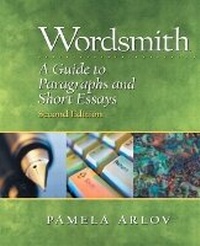
Wordsmith
A Guide to Paragraphs and Essays
2nd Edition
Published on 1. October 2003
Book
Paperback/Softback
592 pages
978-0-13-048895-4 (ISBN)
Description
In the REAL WORLD, do we write just ONE mode in isolation? With a strong focus on writing and the writing process, WORDSMITH: A GUIDE TO PARAGRAPHS AND SHORT ESSAYS, Second Edition also groups the methods of development in threes - to better show students the relationships between them, and to give students strategies for using more than one in their papers: The Showing and Telling chapter covers Description, Narration, and Example. The Limiting and Ordering chapter covers Definition, Classification, and Process. The Examining Logical Connections chapter covers Comparison-Contrast, Cause-Effect, and Argument. Throughout the text, WORDSMITH: A GUIDE TO PARAGRAPHS AND SHORT ESSAYS 2E also provides extensive exercises for students to practice their skills: Practice and Review Exercises are brief, short-answer style exercises. Editing, Group and Writing Assignments require working with or creating writing samples. Progressive Writing Assignments connect writing process concepts from other chapters. With a focus on writing and a variety of exercises, WORDSMITH: A GUIDE TO PARAGRAPHS AND SHORT ESSAYS 2E illustrates how the elements of good writing are rarely performed in isolation.
More details
Edition
2nd edition
Language
English
Place of publication
United States
Publishing group
Pearson Education (US)
Target group
Professional and scholarly
Dimensions
Height: 235 mm
Width: 191 mm
Weight
1000 gr
ISBN-13
978-0-13-048895-4 (9780130488954)
Copyright in bibliographic data and cover images is held by Nielsen Book Services Limited or by the publishers or by their respective licensors: all rights reserved.
Schweitzer Classification
Other editions
New editions
Book
05/2006
3rd Edition
Pearson
€38.37
Article exhausted; check for reprint
Content
I. COMPOSITION
1. The Writing Process.
2. Preparing to Write.
3. Writing Paragraphs: The Topic Sentence.
4. Writing Paragraph Support.
5. Writing Paragraphs: Unity and Coherence.
6. Revising, Proofreading, and Formatting.
7. Showing and Telling: Description, Narration, and Example.
8. Limiting and Ordering: Definition, Classification, and Process.
9. Examining Logical Connections: Comparison-Contrast, Cause-Effect, and Argument.
10. Writing an Essay.
11. Writing a Summary Report.
II. GRAMMAR
12. Verbs and Subjects.
13. Subject-Verb Agreement.
14. Verb Shifts.
15. Sentence Variety.
16. Run-On Sentences.
17. Sentence Fragments.
18. Pronoun Case.
19. Pronoun Agreement, Reference, and Point of View.
20. Adjectives, Adverbs, and Articles.
21. Capital Letters.
22. Words Commonly Confused.
23. Word Choice.
24. Commas.
25. Other Punctuation.
26. Apostrophes.
27. Quotation Marks, Underlining, and Italics.
III. READINGS
1. Action Hero, Rulon Openshaw.
2. Setting Boundaries, Cara DiMarco.
3.Against the Wall, Knight-Ridder/Tribune Information Services.
4. Older and Wiser-- or Just Older? William Raspberry.
5. Barbie Madness, Cynthia Tucker.
6. Living at Warp Speed, Michael Ashcraft.
7. Spanish Spoken Here, Janice Castro, with Dan Cook and Cristina Garcia.
8. Recipe for a Sick Society, Donna Britt.
9. Don't Blame Me! The New "Culture of Victimization," John J. Macionis.
10. How about Us? Leonard Pitts.
11. Mixed Blessings, Jim Auchmutey.
12. One for the Books, Rheta Grimsley Johnson.
13. American Space, Chinese Place, Yi-Fu Tuan.
14. Disorders R Us, Michael Skube.
15. Civil Rites, Caroline Miller.
16. All the Rage, Dave Barry.
17. Conversational Ballgames, Nancy Masterton Sakamoto.
18. I Wonder: Was It Me, or Was It My Sari? Shoba Narayan.
19. Music: A Universal Language, Candace Dyer.
20. What If My Friends Hadn?t Run? Bill Pippin .
Index.
1. The Writing Process.
2. Preparing to Write.
3. Writing Paragraphs: The Topic Sentence.
4. Writing Paragraph Support.
5. Writing Paragraphs: Unity and Coherence.
6. Revising, Proofreading, and Formatting.
7. Showing and Telling: Description, Narration, and Example.
8. Limiting and Ordering: Definition, Classification, and Process.
9. Examining Logical Connections: Comparison-Contrast, Cause-Effect, and Argument.
10. Writing an Essay.
11. Writing a Summary Report.
II. GRAMMAR
12. Verbs and Subjects.
13. Subject-Verb Agreement.
14. Verb Shifts.
15. Sentence Variety.
16. Run-On Sentences.
17. Sentence Fragments.
18. Pronoun Case.
19. Pronoun Agreement, Reference, and Point of View.
20. Adjectives, Adverbs, and Articles.
21. Capital Letters.
22. Words Commonly Confused.
23. Word Choice.
24. Commas.
25. Other Punctuation.
26. Apostrophes.
27. Quotation Marks, Underlining, and Italics.
III. READINGS
1. Action Hero, Rulon Openshaw.
2. Setting Boundaries, Cara DiMarco.
3.Against the Wall, Knight-Ridder/Tribune Information Services.
4. Older and Wiser-- or Just Older? William Raspberry.
5. Barbie Madness, Cynthia Tucker.
6. Living at Warp Speed, Michael Ashcraft.
7. Spanish Spoken Here, Janice Castro, with Dan Cook and Cristina Garcia.
8. Recipe for a Sick Society, Donna Britt.
9. Don't Blame Me! The New "Culture of Victimization," John J. Macionis.
10. How about Us? Leonard Pitts.
11. Mixed Blessings, Jim Auchmutey.
12. One for the Books, Rheta Grimsley Johnson.
13. American Space, Chinese Place, Yi-Fu Tuan.
14. Disorders R Us, Michael Skube.
15. Civil Rites, Caroline Miller.
16. All the Rage, Dave Barry.
17. Conversational Ballgames, Nancy Masterton Sakamoto.
18. I Wonder: Was It Me, or Was It My Sari? Shoba Narayan.
19. Music: A Universal Language, Candace Dyer.
20. What If My Friends Hadn?t Run? Bill Pippin .
Index.