

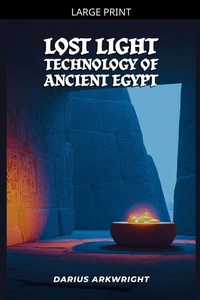
Lost Light Technology of Ancient Egypt
Published on 5. May 2026
Book
Paperback/Softback
296 pages
979-8-233-13360-2 (ISBN)
Description
Beneath the blazing sun of Egypt lies a world that was never meant to be seen.
Hidden below the Giza Plateau, deep within sealed chambers and forgotten passageways, a question lingers that challenges everything we think we know about the ancient world: how did they see in the dark? The absence of soot, the mystery of enclosed spaces, and the strange accounts of light that behaved unlike fire all point toward something far more advanced than simple torches and oil lamps.
Ancient texts speak of "Light-Makers." Philosophers described underground chambers that illuminated themselves. Witnesses told of glowing tubes that dimmed when touched, and of silver liquid that escaped like living metal when broken. Across civilizations, echoes of this mystery appear again-shining pearls in Solomon's temple, metallic spheres in ancient cities, and lamps said to burn without fuel or flame.
Were these myths... or fragments of a lost technology?
Lost Light Technology of Ancient Egypt takes you into the heart of one of history's most enduring enigmas. Drawing on archaeology, ancient testimony, material science, and forgotten traditions, this book explores the possibility that the ancient Egyptians possessed a method of illumination now lost to time-clean, controlled, and perhaps far more sophisticated than we ever imagined.
This is not just a story about light.
It is a story about knowledge that vanished, secrets buried beneath stone, and a civilization that may have mastered darkness in ways we are only beginning to rediscover.
More details
Series
Edition
Large type / large print edition
Language
English
Edition type
Large type / large print edition
Product notice
Paperback (trade)
Unsewn / adhesive bound
Dimensions
Height: 229 mm
Width: 152 mm
Thickness: 17 mm
Weight
432 gr
ISBN-13
979-8-233-13360-2 (9798233133602)
Copyright in bibliographic data and cover images is held by Nielsen Book Services Limited or by the publishers or by their respective licensors: all rights reserved.
Schweitzer Classification
Person
Darius Arkwright is a scholar-editor whose work moves at the intersection of narrative, archaeology, and the enduring human fascination with origins. As Chief Editor and Senior Writer for Matrix Wisdom Podcast and Media Publishing, he has shaped a body of work that explores ancient civilizations not as distant relics, but as living systems of thought-encoded in stone, myth, and memory. His writing bridges the academic and the atmospheric, bringing together rigorous historical inquiry with a carefully measured sense of wonder.
Arkwright's academic grounding lies in Comparative Ancient Civilizations, with a specialization in Ancient Near Eastern Studies and Archaeoastronomy. His research interests extend across Egypt, Mesopotamia, and the civilizations of Mesoamerica, where he examines the interplay between cosmology, architecture, and cultural identity. He is particularly known for his work on symbolic systems-how ancient peoples expressed complex theological and astronomical ideas through monuments, ritual spaces, and mythological narratives. His approach avoids easy conclusions, favoring instead layered interpretation and cross-cultural synthesis.
Within Matrix Wisdom, Arkwright serves as both curator and architect of ideas. He oversees editorial direction, develops long-form research series, and guides the tone of the platform toward a balance of intellectual discipline and evocative storytelling. His voice-measured, precise, and quietly intense-has become a defining element of the brand, often leading audiences through subjects such as forgotten knowledge traditions, the philosophical underpinnings of myth, and the possibility that ancient cultures encoded far more sophisticated understandings of the cosmos than is typically assumed.
Colleagues describe him as meticulous and exacting, yet deeply imaginative. He is known to spend long stretches immersed in primary texts, inscriptions, and site reports, often reconstructing broader cultural frameworks from fragments others might overlook. At the same time, he maintains a storyteller's instinct, ensuring that even the most complex material retains clarity and narrative momentum. This dual nature-scholar and narrator-has positioned him as a distinctive voice in contemporary discussions of ancient history and esoteric traditions.