

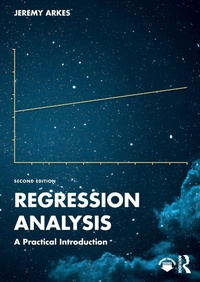
Regression Analysis
A Practical Introduction
2nd Edition
Published on 19. January 2023
Book
Paperback/Softback
392 pages
978-1-032-25783-9 (ISBN)
Description
This thoroughly practical and engaging textbook is designed to equip students with the skills needed to undertake sound regression analysis without requiring high-level math.
Regression Analysis covers the concepts needed to design optimal regression models and to properly interpret regressions. It details the most common pitfalls, including three sources of bias not covered in other textbooks. Rather than focusing on equations and proofs, the book develops an understanding of these biases visually and with examples of situations in which such biases could arise. In addition, it describes how 'holding other factors constant' actually works and when it does not work. This second edition features a new chapter on integrity and ethics, and has been updated throughout to include more international examples. Each chapter offers examples, exercises, and clear summaries, all of which are designed to support student learning to help towards producing responsible research.
This is the textbook the author wishes he had learned from, as it would have helped him avoid many research mistakes he made in his career. It is ideal for anyone learning quantitative methods in the social sciences, business, medicine, and data analytics. It will also appeal to researchers and academics looking to better understand regressions. Additional digital supplements are available at: www.youtube.com/channel/UCenm3BWqQyXA2JRKB_QXGyw.
Regression Analysis covers the concepts needed to design optimal regression models and to properly interpret regressions. It details the most common pitfalls, including three sources of bias not covered in other textbooks. Rather than focusing on equations and proofs, the book develops an understanding of these biases visually and with examples of situations in which such biases could arise. In addition, it describes how 'holding other factors constant' actually works and when it does not work. This second edition features a new chapter on integrity and ethics, and has been updated throughout to include more international examples. Each chapter offers examples, exercises, and clear summaries, all of which are designed to support student learning to help towards producing responsible research.
This is the textbook the author wishes he had learned from, as it would have helped him avoid many research mistakes he made in his career. It is ideal for anyone learning quantitative methods in the social sciences, business, medicine, and data analytics. It will also appeal to researchers and academics looking to better understand regressions. Additional digital supplements are available at: www.youtube.com/channel/UCenm3BWqQyXA2JRKB_QXGyw.
More details
Edition
2nd edition
Language
English
Place of publication
London
United Kingdom
Publishing group
Taylor & Francis Ltd
Target group
College/higher education
Postgraduate and Undergraduate
Illustrations
70 s/w Abbildungen, 70 s/w Zeichnungen, 63 s/w Tabellen
63 Tables, black and white; 70 Line drawings, black and white; 70 Illustrations, black and white
Dimensions
Height: 246 mm
Width: 174 mm
Thickness: 22 mm
Weight
734 gr
ISBN-13
978-1-032-25783-9 (9781032257839)
Copyright in bibliographic data and cover images is held by Nielsen Book Services Limited or by the publishers or by their respective licensors: all rights reserved.
Schweitzer Classification
Other editions
New editions
Book
09/2025
3rd Edition
Routledge
€104.30
Shipment within 15-20 days
Additional editions
Book
01/2023
2nd Edition
Routledge
€193.13
Shipment within 10-20 days
Previous edition
Book
02/2019
1st Edition
Routledge
€102.93
Article exhausted; check for reprint
Person
Jeremy Arkes is a retired economics professor from the Graduate School of Business and Public Policy, Naval Postgraduate School, U.S.A. He is currently writing books on economics, nature, and basketball.
Content
1. Introduction
2. Regression analysis basics
3. Essential tools for regression analysis
4. What does "holding other factors constant" mean?
5. Standard errors, hypothesis tests, p-values, and aliens
6. What could go wrong when estimating causal effects?
7. Strategies for other regression objectives
8. Methods to address biases
9. Other methods besides Ordinary Least Squares
10. Time-series models
11. Some really interesting research
12. How to conduct a research project
13. The ethics of regression analysis
14. Summarizing thoughts
Appendix of background statistical tools
2. Regression analysis basics
3. Essential tools for regression analysis
4. What does "holding other factors constant" mean?
5. Standard errors, hypothesis tests, p-values, and aliens
6. What could go wrong when estimating causal effects?
7. Strategies for other regression objectives
8. Methods to address biases
9. Other methods besides Ordinary Least Squares
10. Time-series models
11. Some really interesting research
12. How to conduct a research project
13. The ethics of regression analysis
14. Summarizing thoughts
Appendix of background statistical tools