

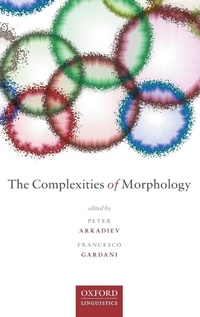
The Complexities of Morphology
Published on 24. September 2020
Book
Hardback
412 pages
978-0-19-886128-7 (ISBN)
Description
This volume explores the multiple aspects of morphological complexity, investigating primarily whether certain aspects of morphology can be considered more complex than others, and how that complexity can be measured. The book opens with a detailed introduction from the editors that critically assesses the foundational assumptions that inform contemporary approaches to morphological complexity. In the chapters that follow, the volume's expert contributors approach the topic from typological, acquisitional, sociolinguistic, and diachronic perspectives; the concluding chapter offers an overview of these various approaches, with a focus on the minimum description length principle. The analyses are based on rich empirical data from both well-known languages such as Russian and lesser-studied languages from Africa, Australia, and the Americas, as well as experimental data from artificial language learning.
More details
Edition
1
Language
English
Place of publication
Oxford
United Kingdom
Target group
Professional and scholarly
Dimensions
Height: 240 mm
Width: 161 mm
Thickness: 27 mm
Weight
781 gr
ISBN-13
978-0-19-886128-7 (9780198861287)
Copyright in bibliographic data and cover images is held by Nielsen Book Services Limited or by the publishers or by their respective licensors: all rights reserved.
Schweitzer Classification
Other editions
Additional editions
Peter Arkadiev | Francesco Gardani
The Complexities of Morphology
E-Book
09/2020
1st Edition
OUP eBook
€79.49
Available for download
Persons
Peter Arkadiev is Senior Researcher at the Institute of Slavic Studies of the Russian Academy of Sciences and Assistant Professor at the Russian State University for the Humanities. His research interests include language typology and areal linguistics, morphology, case and alignment systems, tense and aspect, and Baltic and Northwest Caucasian languages. He is the co-editor of Contemporary Approaches to Baltic Linguistics (with Axel Holvoet and Bjoern Wiemer) and Borrowed Morphology (with Francesco Gardani and Nino Amiridze), both published by De Gruyter in 2015
Francesco Gardani is Professor of Romance Linguistics at the University of Zuerich. He is co-Editor-in-Chief of The Oxford Encyclopedia of Romance Linguistics.
Francesco Gardani is Professor of Romance Linguistics at the University of Zuerich. He is co-Editor-in-Chief of The Oxford Encyclopedia of Romance Linguistics.
Content
1: Peter Arkadiev and Francesco Gardani: Introduction: Complexities in morphology
Part I: The language-specific perspective
2: Jeff Parker and Andrea D. Sims: Irregularity, paradigmatic layers, and the complexity of inflection class systems: A study of Russian nouns
3: John Mansfield and Rachel Nordlinger: Demorphologization and deepening complexity in Murrinhpatha
4: Felicity Meakins and Sasha Wilmoth: Overabundance resulting from language contact: Complex cell-mates in Gurindji Kriol
5: Fabiola Henri, Gregory Stump, and Delphine Tribout: Derivation and the morphological complexity of three French-based creoles
6: Michele Loporcaro: Simplification and complexification in Wolof noun morphology and morphosyntax
Part II: The crosslinguistic perspective
7: Johanna Nichols: Canonical complexity
8: Francesca Di Garbo: The complexity of grammatical gender and language ecology
9: Adam J. R. Tallman and Patience Epps: Morphological complexity, autonomy, and areality in western Amazonia
Part III: The acquisitional perspective
10: John H. McWhorter: Radical analyticity as a diagnostic of adult acquisition
11: Aleksandrs Berdicevskis and Arturs Semenuks: Different trajectories of morphological overspecification and irregularity under imperfect language learning
12: Marianne Mithun: Where is morphological complexity?
13: OEsten Dahl: Morphological complexity and the minimum description length approach
Part I: The language-specific perspective
2: Jeff Parker and Andrea D. Sims: Irregularity, paradigmatic layers, and the complexity of inflection class systems: A study of Russian nouns
3: John Mansfield and Rachel Nordlinger: Demorphologization and deepening complexity in Murrinhpatha
4: Felicity Meakins and Sasha Wilmoth: Overabundance resulting from language contact: Complex cell-mates in Gurindji Kriol
5: Fabiola Henri, Gregory Stump, and Delphine Tribout: Derivation and the morphological complexity of three French-based creoles
6: Michele Loporcaro: Simplification and complexification in Wolof noun morphology and morphosyntax
Part II: The crosslinguistic perspective
7: Johanna Nichols: Canonical complexity
8: Francesca Di Garbo: The complexity of grammatical gender and language ecology
9: Adam J. R. Tallman and Patience Epps: Morphological complexity, autonomy, and areality in western Amazonia
Part III: The acquisitional perspective
10: John H. McWhorter: Radical analyticity as a diagnostic of adult acquisition
11: Aleksandrs Berdicevskis and Arturs Semenuks: Different trajectories of morphological overspecification and irregularity under imperfect language learning
12: Marianne Mithun: Where is morphological complexity?
13: OEsten Dahl: Morphological complexity and the minimum description length approach