

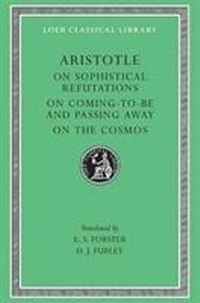
On Sophistical Refutations. On Coming-To-Be and Passing Away. On the Cosmos
Will be published approx. on 1. January 1955
Book
Hardback
448 pages
978-0-674-99441-6 (ISBN)
Description
Fallacies, contraries, consistencies.
Aristotle, great Greek philosopher, researcher, reasoner, and writer, born at Stagirus in 384 BC, was the son of a physician. He studied under Plato at Athens and taught there (367-347); subsequently he spent three years at the court of a former pupil in Asia Minor. After some time at Mitylene, in 343-342 he was appointed by King Philip of Macedon to be tutor of his teen-aged son Alexander. After Philip's death in 336, Aristotle became head of his own school (of "Peripatetics"), the Lyceum at Athens. Because of anti-Macedonian feeling there after Alexander's death in 323, he withdrew to Chalcis in Euboea, where he died in 322.
Nearly all the works Aristotle prepared for publication are lost; the priceless ones extant are lecture-materials, notes, and memoranda (some are spurious). They can be categorized as follows:
I Practical: Nicomachean Ethics; Great Ethics (Magna Moralia); Eudemian Ethics; Politics; Economics (on the good of the family); On Virtues and Vices.
II Logical: Categories; Analytics (Prior and Posterior); Interpretation; Refutations used by Sophists; Topica.
III Physical: Twenty-six works (some suspect) including astronomy, generation and destruction, the senses, memory, sleep, dreams, life, facts about animals, etc.
IV Metaphysics: on being as being.
V Art: Rhetoric and Poetics.
VI Other works including the Constitution of Athens; more works also of doubtful authorship.
VII Fragments of various works such as dialogues on philosophy and literature; and of treatises on rhetoric, politics, and metaphysics.
The Loeb Classical Library edition of Aristotle is in twenty-three volumes.
Aristotle, great Greek philosopher, researcher, reasoner, and writer, born at Stagirus in 384 BC, was the son of a physician. He studied under Plato at Athens and taught there (367-347); subsequently he spent three years at the court of a former pupil in Asia Minor. After some time at Mitylene, in 343-342 he was appointed by King Philip of Macedon to be tutor of his teen-aged son Alexander. After Philip's death in 336, Aristotle became head of his own school (of "Peripatetics"), the Lyceum at Athens. Because of anti-Macedonian feeling there after Alexander's death in 323, he withdrew to Chalcis in Euboea, where he died in 322.
Nearly all the works Aristotle prepared for publication are lost; the priceless ones extant are lecture-materials, notes, and memoranda (some are spurious). They can be categorized as follows:
I Practical: Nicomachean Ethics; Great Ethics (Magna Moralia); Eudemian Ethics; Politics; Economics (on the good of the family); On Virtues and Vices.
II Logical: Categories; Analytics (Prior and Posterior); Interpretation; Refutations used by Sophists; Topica.
III Physical: Twenty-six works (some suspect) including astronomy, generation and destruction, the senses, memory, sleep, dreams, life, facts about animals, etc.
IV Metaphysics: on being as being.
V Art: Rhetoric and Poetics.
VI Other works including the Constitution of Athens; more works also of doubtful authorship.
VII Fragments of various works such as dialogues on philosophy and literature; and of treatises on rhetoric, politics, and metaphysics.
The Loeb Classical Library edition of Aristotle is in twenty-three volumes.
More details
Series
Language
English
Place of publication
Cambridge, Mass
United States
Target group
College/higher education
Professional and scholarly
Illustrations
Indexes
Dimensions
Height: 167 mm
Width: 115 mm
Thickness: 30 mm
Weight
332 gr
ISBN-13
978-0-674-99441-6 (9780674994416)
Copyright in bibliographic data and cover images is held by Nielsen Book Services Limited or by the publishers or by their respective licensors: all rights reserved.
Schweitzer Classification