

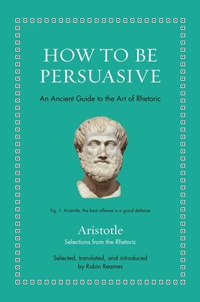
How to Be Persuasive
An Ancient Guide to the Art of Rhetoric
Will be published approx. on 23. February 2027
Book
Hardback
272 pages
978-0-691-27589-5 (ISBN)
Description
A new translation of essential selections from Aristotle's Rhetoric, which teaches how to recognize-and resist-persuasive techniques that can be used to mislead and manipulate
Today, the word "rhetoric" is typically used to criticize language that is empty or misleading. But the study of rhetoric was originally designed to drain false speech of its power. Rhetoric grew up in ancient Athens alongside the first democracy because the arguments of citizens were needed to replace the diktats of kings and the demagoguery of tyrants. In How to Be Persuasive, Robin Reames presents a vivid new translation of essential passages from Aristotle's Rhetoric-a work filled with insights about how words move our hearts and minds. Featuring illuminating commentary and the original Greek on facing pages, How to Be Persuasive offers a concise and accessible introduction to Aristotle's timeless classic.
How to Be Persuasive includes at least one selection from nearly every chapter of Aristotle's Rhetoric, covering the importance of a speaker's character and an audience's emotions; common topics that can be used in every kind of argument; style and delivery; and more. Aristotle instills a keen awareness of what makes words compelling-precisely what Athenians needed to defend themselves against the linguistic distortions that led to their devastating war with Sparta two generations before. Indeed, he may have been the first to argue that the less we know about rhetoric-including how to spot the difference between good and bad arguments-the more vulnerable we are to tyranny.
The result is an enlightening introduction to how persuasion works-and how we can resist its abuse.
Today, the word "rhetoric" is typically used to criticize language that is empty or misleading. But the study of rhetoric was originally designed to drain false speech of its power. Rhetoric grew up in ancient Athens alongside the first democracy because the arguments of citizens were needed to replace the diktats of kings and the demagoguery of tyrants. In How to Be Persuasive, Robin Reames presents a vivid new translation of essential passages from Aristotle's Rhetoric-a work filled with insights about how words move our hearts and minds. Featuring illuminating commentary and the original Greek on facing pages, How to Be Persuasive offers a concise and accessible introduction to Aristotle's timeless classic.
How to Be Persuasive includes at least one selection from nearly every chapter of Aristotle's Rhetoric, covering the importance of a speaker's character and an audience's emotions; common topics that can be used in every kind of argument; style and delivery; and more. Aristotle instills a keen awareness of what makes words compelling-precisely what Athenians needed to defend themselves against the linguistic distortions that led to their devastating war with Sparta two generations before. Indeed, he may have been the first to argue that the less we know about rhetoric-including how to spot the difference between good and bad arguments-the more vulnerable we are to tyranny.
The result is an enlightening introduction to how persuasion works-and how we can resist its abuse.
More details
Series
Language
English
Place of publication
New Jersey
United States
Target group
College/higher education
Professional and scholarly
Product notice
Trade binding
Dimensions
Height: 171 mm
Width: 114 mm
ISBN-13
978-0-691-27589-5 (9780691275895)
Copyright in bibliographic data and cover images is held by Nielsen Book Services Limited or by the publishers or by their respective licensors: all rights reserved.
Schweitzer Classification
Persons
Aristotle (384-322 BCE) is one of the most important and influential figures in Western philosophy. Nearly every academic discipline-from physics to poetics-owes its first method, if not its very existence, to him. Robin Reames is professor of English and the Culbertson Chair of Writing at Indiana University. She is the author of The Ancient Art of Thinking for Yourself: The Power of Rhetoric in Polarized Times and the coeditor of The Rhetorical Tradition, among other books.