

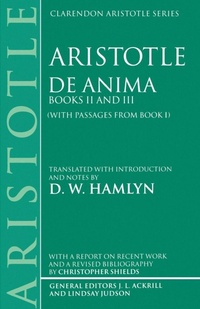
De Anima
Books II and III (with passages from Book I)
2nd Edition
Published on 9. September 1993
Book
Paperback/Softback
212 pages
978-0-19-824085-3 (ISBN)
Description
Aristotle's "De Anima" has a claim to be the first systematic treatment of issues in the philosophy of mind, and also to be one of the greatest works on the subject. This volume provides an accurate translation of Books 2 and 3, together with some sections of Book 1. Particular attention has been given to the translation of difficult terms, to help the student of philosophy who does not know Greek. A brief introduction discusses Aristotle's approach to his subject, while notes provide a continuous philosophical commentary on the text. Since the original publication of this volume, Aristotle's philosophy of mind has been the focus of lively scholarly debate; for this revised edition, Christopher Shields has added a substantial review of this recent work, together with a new bibliography.
More details
Series
Edition
2. Auflage
Language
English
Place of publication
Oxford
United Kingdom
Publishing group
Oxford University Press
Target group
Professional and scholarly
Dimensions
Height: 216 mm
Width: 140 mm
Thickness: 13 mm
Weight
311 gr
ISBN-13
978-0-19-824085-3 (9780198240853)
Copyright in bibliographic data and cover images is held by Nielsen Book Services Limited or by the publishers or by their respective licensors: all rights reserved.
Schweitzer Classification
Other editions
Additional editions
Book
09/1993
2nd Edition
Clarendon Press
€184.70
Shipment within 15-20 days
Persons
Aristotle (Greek: ¿¿¿¿¿¿¿¿¿¿¿ Aristotél¿s, pronounced [aristotél¿¿s]; 384-322 BC)[A] was a Greek philosopher and polymath during the Classical period in Ancient Greece. Taught by Plato, he was the founder of the Lyceum, the Peripatetic school of philosophy, and the Aristotelian tradition. His writings cover many subjects. including physics, biology, zoology, metaphysics, logic, ethics, estheticspoetry, theatre, music, rhetoric, psychology, linguistics, economics, politics, and government. Aristotle provided a complex synthesis of the various philosophies existing prior to him. It was above all from his teachings that the West inherited its intellectual lexicon, as well as problems and methods of inquiry. As a result, his philosophy has exerted a unique influence on almost every form of knowledge in the West and it continues to be a subject of contemporary philosophical discussion.
Little is known about his life. Aristotle was born in the city of Stagira in Northern Greece. His father, Nicomachus, died when Aristotle was a child, and he was brought up by a guardian. At seventeen or eighteen years of age he joined Plato's Academy in Athens and remained there until the age of thirty-seven (c. 347 BC).[4] Shortly after Plato died, Aristotle left Athens and, at the request of Philip II of Macedon, tutored Alexander the Great beginning in 343 BC.[5] He established a library in the Lyceum which helped him to produce many of his hundreds of books on papyrus scrolls. Though Aristotle wrote many elegant treatises and dialogues for publication, only around a third of his original output has survived, none of it intended for publication.[6]
Aristotle's views on physical science profoundly shaped medieval scholarship. Their influence extended from Late Antiquity and the Early Middle Ages into the Renaissance, and were not replaced systematically until the Enlightenment and theories such as classical mechanics. Some of Aristotle's zoological observations found in his biology, such as on the hectocotyl (reproductive) arm of the octopus, were disbelieved until the 19th century. His works contain the earliest known formal study of logic, studied by medieval scholars such as Peter Abelard and John Buridan. Aristotle's influence on logic also continued well into the 19th century.