

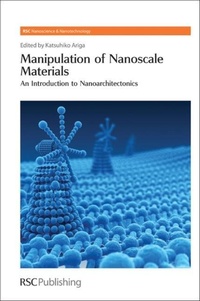
Manipulation of Nanoscale Materials
An Introduction to Nanoarchitectonics
Published on 5. September 2012
Book
Hardback
473 pages
978-1-84973-415-8 (ISBN)
Description
Techniques and strategies for the production of nanomaterials and nanostructures have developed to an advanced level. However, the concepts and methods needed to correctly architect these materials into viable applications remains seriously lacking. This book introduces the concept of "Nanoarchitechtonics", a term introduced by Dr Masakazu Aono to describe the correct manipulation of nanoscale materials in the creation of nano-devices and applications. With contributions from across the globe, Manipulation of Nanoscale Materials presents a broad spectrum of nanomaterials and their applications. Following an introductory chapter prepared by the editors, the book is divided into three further sections of chapters, detailing Nanoarchitectonics for Materials Development, Materials Nanoarchitechtonics for Bio-Conjugates and Bio-Applications, Materials Nanoarchitechtonics for Advanced Devices. The first book in its field, this is essential reading for anyone creating or deploying nanomaterials. Fully referenced to the primary literature, this title presents an excellent source of information, and inspiration, to the reader and should appeal to experienced materials scientists, nanotechnologists and postgraduate students. Dr. Katsuhiko Ariga is the Director of Supermolecules Group and Principal Investigator of World Premier International (WPI) Research Center for Materials Nanoarchitectonics (MANA), the National Institute for Materials Science (NIMS). Dr Masakazu Aono is Director General of MANA and group leader of the nano-system organiszation group MANA, NIMS.
More details
Series
Language
English
Place of publication
Cambridge
United Kingdom
Target group
Professional and scholarly
Product notice
Unsewn / adhesive bound
Dimensions
Height: 243 mm
Width: 163 mm
Thickness: 42 mm
Weight
943 gr
ISBN-13
978-1-84973-415-8 (9781849734158)
Copyright in bibliographic data and cover images is held by Nielsen Book Services Limited or by the publishers or by their respective licensors: all rights reserved.
Schweitzer Classification
Other editions
Additional editions
E-Book
09/2012
1st Edition
Royal Society of Chemistry
€212.99
Available for download
Complete work / Part of the work
Other
02/2014
Royal Society of Chemistry
€851.50
Article not available at the moment
Person
Dr. Katsuhiko Ariga is the Director of Supermolecules Group and Principal Investigator of World Premier International (WPI) Research Center for Materials Nanoarchitectonics (MANA), the National Institute for Materials Science (NIMS). He was born in 1962, and received his B.Eng., M.Eng., and Ph.D. degrees from the Tokyo Institute of Technology (TIT). His major interests are the fabrication of novel functional nanostructures based on molecular recognition and self-assembly, including Langmuir-Blodgett films, layer-by-layer films, and mesoporous materials.
Content
1. Introduction: Origin and Future of Materials Nanoarchitechtonics;
2. Nanoarchitechtonics for Materials Development;
2.1. Supramolecular materials nanoarchitechtonics;
2.2. Controlled multiscale dewetting of self-organized block copolymers;
2.3. New materials nanoarchitechtonics based on clays;
2.4. Nanoarchtechtonics of Mesoporous Materials;
2.5. Nanoscale oxides in catalysis;
2.6. Nanoarchitechtonics of photocatalytic materials;
3. Materials Nanoarchitechtonics for Bio-Conjugates and Bio-Applications;
3.1. Design, synthesis, and application of bio-conjugate nanostructures;
3.2. Architechtonics of active sites: Life processes at nanodimension;3.3. Nanotechnology in drug delivery systems;3.4. Health impact of nanomaterials;
3.5.Separation of medically useful radionuclides: Role of nano-sorbents;
3.6. Self-assembled molecular gate field effect transistors for biomolecular sensing;
3.7. Nanostructured materials for biosensor applications: comparative review of preparation methods;
4. Materials Nanoarchitechtonics for Advanced Devices;
4.1 Nanostructures in organic photovoltaics devices;
4.2. Substrate alignment by surface probe lithography;
4.3. Multiple-scanning-probe microscopy and related techniques;
4.4. Cantilever array sensors;
4.5. Design of quantum Hamiltonian single molecule logic gate
2. Nanoarchitechtonics for Materials Development;
2.1. Supramolecular materials nanoarchitechtonics;
2.2. Controlled multiscale dewetting of self-organized block copolymers;
2.3. New materials nanoarchitechtonics based on clays;
2.4. Nanoarchtechtonics of Mesoporous Materials;
2.5. Nanoscale oxides in catalysis;
2.6. Nanoarchitechtonics of photocatalytic materials;
3. Materials Nanoarchitechtonics for Bio-Conjugates and Bio-Applications;
3.1. Design, synthesis, and application of bio-conjugate nanostructures;
3.2. Architechtonics of active sites: Life processes at nanodimension;3.3. Nanotechnology in drug delivery systems;3.4. Health impact of nanomaterials;
3.5.Separation of medically useful radionuclides: Role of nano-sorbents;
3.6. Self-assembled molecular gate field effect transistors for biomolecular sensing;
3.7. Nanostructured materials for biosensor applications: comparative review of preparation methods;
4. Materials Nanoarchitechtonics for Advanced Devices;
4.1 Nanostructures in organic photovoltaics devices;
4.2. Substrate alignment by surface probe lithography;
4.3. Multiple-scanning-probe microscopy and related techniques;
4.4. Cantilever array sensors;
4.5. Design of quantum Hamiltonian single molecule logic gate