

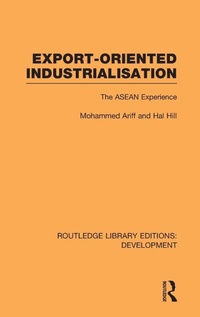
Export-Oriented Industrialisation
The ASEAN Experience
1st Edition
Published on 26. November 2010
Book
Hardback
288 pages
978-0-415-59370-0 (ISBN)
Description
First published in 1985, this study is a comparative examination of industrialisation and industrial policy from the early 1960s to the early 1980s in the five original member countries of the Association of South-East Asian Nations (ASEAN): namely Indonesia, Malaysia, the Philippines, Singapore and Thailand.
The work provides an integrated overview of industrial policies and performance in the five countries and forms essential reading for both those with a specialist interest in the ASEAN countries and their economic performance, and for students of industrialisation in developing countries the world over.
The work provides an integrated overview of industrial policies and performance in the five countries and forms essential reading for both those with a specialist interest in the ASEAN countries and their economic performance, and for students of industrialisation in developing countries the world over.
More details
Series
Language
English
Place of publication
London
United Kingdom
Publishing group
Taylor & Francis Ltd
Target group
College/higher education
Dimensions
Height: 240 mm
Width: 161 mm
Thickness: 20 mm
Weight
602 gr
ISBN-13
978-0-415-59370-0 (9780415593700)
Copyright in bibliographic data and cover images is held by Nielsen Book Services Limited or by the publishers or by their respective licensors: all rights reserved.
Schweitzer Classification
Other editions
Additional editions
Book
03/2013
1st Edition
Routledge
€71.70
Shipment within 15-20 days
E-Book
08/2012
1st Edition
Routledge
€64.49
Available for download
E-Book
08/2012
1st Edition
Routledge
€64.49
Available for download
Persons
Content
1. Introduction 2. The Export Drive: An Overview 3. Protection and Market Penetration 4. Government Regulation and Industrialisation 5. Industrialisation and Structural Change 6. Manufactured Exports: Performance and Shifts in Comparative Advantage 7. Conclusion and Future Prospects