

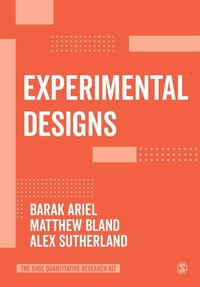
Experimental Designs
1st Edition
Published on 21. March 2022
Book
Paperback/Softback
240 pages
978-1-5264-2662-8 (ISBN)
Description
The fourth book in The SAGE Quantitative Research Kit, this resource covers the basics of designing and conducting basic experiments, outlining the various types of experimental designs available to researchers, while providing step-by-step guidance on how to conduct your own experiment.
As well as an in-depth discussion of Random Controlled Trials (RCTs), this text highlights effective alternatives to this method and includes practical steps on how to successfully adopt them. Topics include:
? The advantages of randomisation
? How to avoid common design pitfalls that reduce the validity of experiments
? How to maintain controlled settings and pilot tests
? How to conduct quasi-experiments when RCTs are not an option
Practical and succintly written, this book will give you the know-how and confidence needed to succeed on your quantitative research journey.
As well as an in-depth discussion of Random Controlled Trials (RCTs), this text highlights effective alternatives to this method and includes practical steps on how to successfully adopt them. Topics include:
? The advantages of randomisation
? How to avoid common design pitfalls that reduce the validity of experiments
? How to maintain controlled settings and pilot tests
? How to conduct quasi-experiments when RCTs are not an option
Practical and succintly written, this book will give you the know-how and confidence needed to succeed on your quantitative research journey.
Reviews / Votes
This is an important and recommended contribution to demystifying RCTs and to cross-conceptual design choices for evaluators. -- David Parsons * Social Research Association 'Research Matters' Magazine *More details
Series
Edition
First Edition
Language
English
Place of publication
London
United Kingdom
Target group
College/higher education
Dimensions
Height: 244 mm
Width: 170 mm
Thickness: 14 mm
Weight
422 gr
ISBN-13
978-1-5264-2662-8 (9781526426628)
Copyright in bibliographic data and cover images is held by Nielsen Book Services Limited or by the publishers or by their respective licensors: all rights reserved.
Schweitzer Classification
Other editions
Additional editions
Barak Ariel | Matthew P. Bland | Alex Sutherland
Experimental Designs
E-Book
03/2022
1st Edition
SAGE Publications Ltd
€61.49
Available for download
Barak Ariel | Matthew P. Bland | Alex Sutherland
Experimental Designs
E-Book
03/2022
1st Edition
SAGE Publications Ltd
€61.49
Available for download
Persons
Barak Ariel is a Professor of Experimental Criminology at the University of Cambridge and an Associate Professor at the Hebrew University of Jerusalem. His areas of research include experimental designs, spatial analyses of crime, and policing. Matthew Bland is an Associate Professor in Evidence-based policing at the University of Cambridge. Dr Bland is the former head of analysis in two police forces in England and Wales. His research interest is domestic abuse, and specifically analysing police data.
Alex is Chief Scientist and Director of Research and Evaluation at the Behavioural Insights Team (AKA 'the nudge unit'). Before joining BIT, Alex was at RAND Europe for 5.5 years, and spent three years teaching research design/quantitative methods at the University of Cambridge. Prior to Cambridge, he worked at the Centre for Criminology, University of Oxford and has a D.Phil. in sociology, also from Oxford. His interests cover evaluation of public policy, randomised trials, and research design.
Alex is Chief Scientist and Director of Research and Evaluation at the Behavioural Insights Team (AKA 'the nudge unit'). Before joining BIT, Alex was at RAND Europe for 5.5 years, and spent three years teaching research design/quantitative methods at the University of Cambridge. Prior to Cambridge, he worked at the Centre for Criminology, University of Oxford and has a D.Phil. in sociology, also from Oxford. His interests cover evaluation of public policy, randomised trials, and research design.
Content
Introduction
R is for Random
C is for Control
T is for Tests
Running Experimental Designs
Conclusions and Final Remarks
R is for Random
C is for Control
T is for Tests
Running Experimental Designs
Conclusions and Final Remarks