

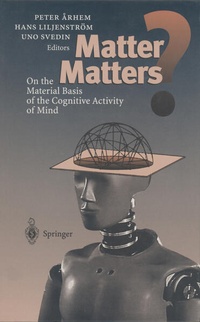
Matter Matters?
On the Material Basis of the Cognitive Activity of Mind
Published on 20. November 2013
Book
Paperback/Softback
IX, 269 pages
978-3-642-64459-7 (ISBN)
Description
This book, written for a wide readership with some background in the natural sciences, addresses the very old problem of the mind-brain-relationship. The authors, all well-known scientists, approach the subject in different stages. The first part addresses some general principles based on physics, computer science, and theoretical biology. The two following parts deal with the problem at different organizational levels, from the microscopic to the macroscopic. The fourth part addresses the subjective level founded on the findings of psychologists and neurophysiologists.
More details
Edition
Softcover reprint of the original 1st ed. 1997
Language
English
Place of publication
Berlin
Germany
Publishing group
Springer Berlin
Target group
Professional and scholarly
Research
Illustrations
104 s/w Abbildungen, 6 farbige Abbildungen
IX, 269 p. 110 illus., 6 illus. in color.
Dimensions
Height: 203 mm
Width: 133 mm
Thickness: 16 mm
Weight
322 gr
ISBN-13
978-3-642-64459-7 (9783642644597)
DOI
10.1007/978-3-642-60570-3
Schweitzer Classification
Other editions
Additional editions
Peter Arhem | Hans Liljenström | Uno Svedin
Matter Matters?
On the Material Basis of the Cognitive Activity of Mind
Book
06/1997
Springer
€85.55
Article exhausted; check different version
Content
1. Introduction.- I Some New Perspectives.- 2. The Need for a Non-computational Extension of Quantum Action in the Brain.- 3. The Berry Paradox.- 4. Mind as Phenotype.- II Subcellular Levels.- 5. Quantum Automata in Cytoskeletal Microtubules: A Nanoscale Substrate for Cognition.- 6. Of Maps and Territories: A Three Point Landing on the Mind-Body Problem.- III Network and Systems Level.- 7. Synergetics of the Brain.- 8. Cognition and the Efficiency of Neural Processes.- IV The Subjective Level.- 9. Consciousness and the Matter of Perception.- 10. On Consciousness and Spontaneous Brain Activity.- 11. Concluding Remarks.