

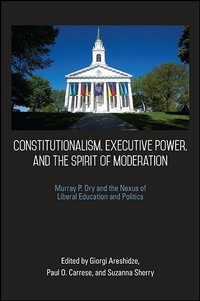
Constitutionalism, Executive Power, and the Spirit of Moderation
Murray P. Dry and the Nexus of Liberal Education and Politics
Published on 2. January 2017
Book
Paperback/Softback
416 pages
978-1-4384-6042-0 (ISBN)
Description
Leading scholars and legal practitioners explore constitutional, legal, and philosophical topics.
In Constitutionalism, Executive Power, and the Spirit of Moderation, contributors ranging from scholars to practitioners in the federal executive and judicial branches blend philosophical and political modes of analysis to examine a variety of constitutional, legal, and philosophical topics. Part 1, "The Role of Courts in Constitutional Democracy," analyzes the proper functions and limits of the judiciary and judicial decision making in constitutional government. Part 2, "Law and Executive Authority," reflects on the tensions between constitutionalism and presidential leadership in both domestic and international arenas. Part 3, "Liberal Education, Constitutionalism, and Philosophic Moderation," shifts the focus to the relationship between constitutionalism and political philosophy, and especially to the modern modes of philosophy that most directly influenced the American Founders. A valuable resource for specialists, the book also will be of use in political science and law school classes.
In Constitutionalism, Executive Power, and the Spirit of Moderation, contributors ranging from scholars to practitioners in the federal executive and judicial branches blend philosophical and political modes of analysis to examine a variety of constitutional, legal, and philosophical topics. Part 1, "The Role of Courts in Constitutional Democracy," analyzes the proper functions and limits of the judiciary and judicial decision making in constitutional government. Part 2, "Law and Executive Authority," reflects on the tensions between constitutionalism and presidential leadership in both domestic and international arenas. Part 3, "Liberal Education, Constitutionalism, and Philosophic Moderation," shifts the focus to the relationship between constitutionalism and political philosophy, and especially to the modern modes of philosophy that most directly influenced the American Founders. A valuable resource for specialists, the book also will be of use in political science and law school classes.
Reviews / Votes
"Each essay is thoughtful and well-argued." - CHOICE"...highly recommended for college library Judicial Studies collections." - Midwest Book Review
More details
Series
Language
English
Place of publication
Albany, NY
United States
Target group
College/higher education
Professional and scholarly
US School Grade: College Graduate Student and over
Product notice
Paperback (trade)
Dimensions
Height: 224 mm
Width: 150 mm
Thickness: 30 mm
Weight
567 gr
ISBN-13
978-1-4384-6042-0 (9781438460420)
Copyright in bibliographic data and cover images is held by Nielsen Book Services Limited or by the publishers or by their respective licensors: all rights reserved.
Schweitzer Classification
Other editions
Additional editions
Giorgi Areshidze | Paul O. Carrese | Suzanna Sherry
Constitutionalism, Executive Power, and the Spirit of Moderation
Murray P. Dry and the Nexus of Liberal Education and Politics
E-Book
05/2016
1st Edition
De Gruyter
from
€91.99
Available for download
Persons
Giorgi Areshidze is Assistant Professor of Government at Claremont McKenna College. Paul O. Carrese is Professor and Director of the US Air Force Academy Scholars Program and the author of The Cloaking of Power: Montesquieu, Blackstone, and the Rise of Judicial Activism. Suzanna Sherry is Herman O. Loewenstein Professor of Law at Vanderbilt University. Her books include Judgment Calls: Principle and Politics in Constitutional Law (coauthored with Daniel A. Farber).
Content
Foreword
Harvey C. Mansfield
Acknowledgments
Introduction: Liberal Education and Politics
Giorgi Areshidze and Paul O. Carrese
Part I. The Role of Courts in Constitutional Democracy 1. Why We Need More Judicial Activism
Suzanna Sherry
2. Legal Realism, Innate Morality, and the Structural Role of the Supreme Court in the U.S. Constitutional Democracy
Karl Coplan
3. Is Judicialization Good for Democracy? A Comparative Discussion
Ayse Zarakol
4. If There's a Right, Is There a Remedy? The Federal Courts' Role in Remedying Constitutional Violations
Barbara Kritchevsky Part II. Law and Executive Authority
5. The Necessary and the Good in Lincoln's Wartime Reconstruction Policy
Sean Mattie
6. Progress, Return, and the Constitution
C. Kevin Marshall
7. Ideas Meet Institutions and the People Rise Up: Four Classic Ideas and the Strange Century of Health Reform
James A. Morone Part III. Liberal Education, Constitutionalism, and Philosophic Moderation
8. The Polis, the State, and the Constitution
James R. Stoner Jr.
9. Adam Smith's Invisible Hands
Peter Minowitz
10. The Founders and the Conditions of Popular Political Deliberation
David R. Upham
11. Tocqueville on Liberal Democracy and the Philosophy of Moderation
Paul O. Carrese
12. John Rawls and EU Multiculturalism: Is Post-Enlightenment Rawlsian Liberalism Sustainable?
Giorgi Areshidze
Publications by Murray P. Dry
Constitutionalism, Executive Power, and the Spirit of Moderation
Contributors
Index
Harvey C. Mansfield
Acknowledgments
Introduction: Liberal Education and Politics
Giorgi Areshidze and Paul O. Carrese
Part I. The Role of Courts in Constitutional Democracy 1. Why We Need More Judicial Activism
Suzanna Sherry
2. Legal Realism, Innate Morality, and the Structural Role of the Supreme Court in the U.S. Constitutional Democracy
Karl Coplan
3. Is Judicialization Good for Democracy? A Comparative Discussion
Ayse Zarakol
4. If There's a Right, Is There a Remedy? The Federal Courts' Role in Remedying Constitutional Violations
Barbara Kritchevsky Part II. Law and Executive Authority
5. The Necessary and the Good in Lincoln's Wartime Reconstruction Policy
Sean Mattie
6. Progress, Return, and the Constitution
C. Kevin Marshall
7. Ideas Meet Institutions and the People Rise Up: Four Classic Ideas and the Strange Century of Health Reform
James A. Morone Part III. Liberal Education, Constitutionalism, and Philosophic Moderation
8. The Polis, the State, and the Constitution
James R. Stoner Jr.
9. Adam Smith's Invisible Hands
Peter Minowitz
10. The Founders and the Conditions of Popular Political Deliberation
David R. Upham
11. Tocqueville on Liberal Democracy and the Philosophy of Moderation
Paul O. Carrese
12. John Rawls and EU Multiculturalism: Is Post-Enlightenment Rawlsian Liberalism Sustainable?
Giorgi Areshidze
Publications by Murray P. Dry
Constitutionalism, Executive Power, and the Spirit of Moderation
Contributors
Index