

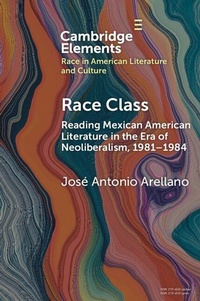
Race Class
Reading Mexican American Literature in the Era of Neoliberalism, 1981-1984
Will be published approx. on 31. December 2025
Book
Paperback/Softback
75 pages
978-1-009-42954-2 (ISBN)
Description
Race Class identifies two competing aesthetics, the 'recognitional' and the 'redistributive,' that developed in Mexican American literature during the 1980s. Recognitional literature seeks to express an ethnic identity via a circular narratological discourse of self-creation. This expressive view of literature fosters readerly sympathy via testimony and textual personification, the author argues, but ultimately forecloses interpretive judgement. Redistributive literature instead averts the readers' sympathy to produce the evaluative distance through which interpretative judgement and structural critique are enabled. By tracking these competing aesthetics, Race Class shows why the Chicano Movement should not be understood as a working-class enterprise, why higher education cannot be a mechanism of social justice, and why the left continues to misunderstand the nature of economic inequality today.
More details
Series
Language
English
Place of publication
Cambridge
United Kingdom
Product notice
Paperback (trade)
Illustrations
Worked examples or Exercises
Dimensions
Height: 229 mm
Width: 152 mm
Thickness: 5 mm
Weight
131 gr
ISBN-13
978-1-009-42954-2 (9781009429542)
Copyright in bibliographic data and cover images is held by Nielsen Book Services Limited or by the publishers or by their respective licensors: all rights reserved.
Schweitzer Classification
Other editions
Additional editions
Jose Antonio Arellano
Race Class
Reading Mexican American Literature in the Era of Neoliberalism, 1981-1984
Book
approx. 12/2025
Cambridge University Press
€75.20
Not yet published
Person
Content
1. Introduction; 2. The Development of Chicano Literature and Culture; 3. The Limits of the Chicano Solution; 4. A Critique of Chicano Activism and Literature: Richard Rodriguez Hunger of Memory (1982); 5. Recognitional Witnessing versus Redistributive Representation: I, Rigoberta Menchu (1984); 6. Identifying the Enemy: Daniel James Famous All Over Town (1983); 7. Recognitional Novels: Arturo Islas The Rain God (1984); 8. The Culture of Poverty and the Program Era: Sandra Cisneros The House on Mango Street (1984); 9. Against Literature? The Redistributive within The House on Mango Street; 10. Conclusion.