

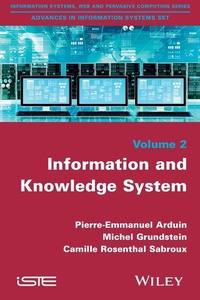
Information and Knowledge System
1st Edition
Published on 3. July 2015
Book
Paperback/Softback
104 pages
978-1-84821-752-2 (ISBN)
Description
The purpose of this book is to question the relationships involved in decision making and the systems designed to support it: decision support systems (DSS). The focus is on how these systems are engineered; to stop and think about the questions to be asked throughout the engineering process and, in particular, about the impact designers' choices have on these systems.
This therefore involves identifying the elements of the problem of decision support systems engineering: the main objects and dimensions to be considered and the relationships they involve, issues at the levels of the decision-maker, of the organization (and even of society), the general approach to which to subscribe and so on.
This therefore involves identifying the elements of the problem of decision support systems engineering: the main objects and dimensions to be considered and the relationships they involve, issues at the levels of the decision-maker, of the organization (and even of society), the general approach to which to subscribe and so on.
More details
Language
English
Place of publication
London
United Kingdom
Target group
Professional and scholarly
Product notice
Paperback (trade)
Unsewn / adhesive bound
Dimensions
Height: 234 mm
Width: 156 mm
Thickness: 6 mm
Weight
172 gr
ISBN-13
978-1-84821-752-2 (9781848217522)
Copyright in bibliographic data and cover images is held by Nielsen Book Services Limited or by the publishers or by their respective licensors: all rights reserved.
Schweitzer Classification
Other editions
Additional editions
Pierre-Emmanuel Arduin | Michel Grundstein | Camille Rosenthal-Sabroux
Information and Knowledge Systems
E-Book
06/2015
Wiley-ISTE
€139.99
Available for download
Pierre-Emmanuel Arduin | Michel Grundstein | Camille Rosenthal-Sabroux
Information and Knowledge Systems
E-Book
06/2015
Wiley-ISTE
€139.99
Available for download
Persons
Pierre-Emmanuel Arduin is a specialist in knowledge management, and a lecturer at Paris-Dauphine University, France.
Michel Grundstein is an associate researcher for LAMSADE at Paris-Dauphine University, France. His main field of study is knowledge management.
Camille Rosenthal Sabroux teaches information systems at Paris-Dauphine University, France, where she is also in charge of the Master's studies in the field of extended enterprise information systems.
Michel Grundstein is an associate researcher for LAMSADE at Paris-Dauphine University, France. His main field of study is knowledge management.
Camille Rosenthal Sabroux teaches information systems at Paris-Dauphine University, France, where she is also in charge of the Master's studies in the field of extended enterprise information systems.
Content
PREFACE vii
INTRODUCTION xi
CHAPTER 1. INFORMATION SYSTEMS AND DIGITAL TECHNOLOGY 1
1.1. The concept of information systems 1
1.2. History of the concept of information systems 5
1.2.1. The centralized processing stage (1950s-1960s) 5
1.2.2. The data decentralization stage (1970s-1990s) 6
1.2.3. The interoperability and standardization stage (1990s) 6
1.2.4. The universality and globalization stage (2000 onward) 7
1.3. What is "digital" technology? 9
1.4. Information systems and digital technology for business 11
1.5. Key points 15
CHAPTER 2. KNOWLEDGE MANAGEMENT 17
2.1. Historical overview 18
2.2. Knowledge Management: two dominant approaches 20
2.2.1. The technological approach 21
2.2.2. The managerial and sociotechnical approach to KM 22
2.3. Specific management principles for KM 23
2.3.1. Definition of Knowledge Management 24
2.3.2. The organizational context 24
2.3.3. The vision 26
2.3.4. Guiding principles 27
2.3.5. Ad hoc infrastructures 28
2.3.6. Generic KM processes 31
2.3.7. Methods and tools for KM 34
2.4. A model for general knowledge management within the enterprise (MGKME) 36
2.4.1. Description of the MGKME 36
2.4.2. State indicators for knowledge management systems 40
2.5. Conclusions 42
2.6. Key points 43
CHAPTER 3. THE ENTERPRISE'S INFORMATION AND KNOWLEDGE SYSTEM (EIKS) 45
3.1. Basic theories 45
3.1.1. Three fundamental postulates 45
3.1.2. Creation of individual and tacit knowledge 47
3.1.3. Commensurability of interpretative frameworks 50
3.1.4. Conditions in which knowledge can be assimilated to an object 50
3.2. The enterprise's information and knowledge system 52
3.3. A knowledge system is not a knowledge-based system 54
3.4. Evolution of an EIKS 59
3.5. Representative example of an EIKS 59
3.5.1. Presentation of the context 60
3.5.2. EIKS in this context 61
3.6. Key points 63
CONCLUSIONS AND PERSPECTIVES 65
APPENDIX. SEVEN GOLDEN RULES FOR SUCCESSFUL KNOWLEDGE MANAGEMENT 69
BIBLIOGRAPHY 75
INDEX 83
INTRODUCTION xi
CHAPTER 1. INFORMATION SYSTEMS AND DIGITAL TECHNOLOGY 1
1.1. The concept of information systems 1
1.2. History of the concept of information systems 5
1.2.1. The centralized processing stage (1950s-1960s) 5
1.2.2. The data decentralization stage (1970s-1990s) 6
1.2.3. The interoperability and standardization stage (1990s) 6
1.2.4. The universality and globalization stage (2000 onward) 7
1.3. What is "digital" technology? 9
1.4. Information systems and digital technology for business 11
1.5. Key points 15
CHAPTER 2. KNOWLEDGE MANAGEMENT 17
2.1. Historical overview 18
2.2. Knowledge Management: two dominant approaches 20
2.2.1. The technological approach 21
2.2.2. The managerial and sociotechnical approach to KM 22
2.3. Specific management principles for KM 23
2.3.1. Definition of Knowledge Management 24
2.3.2. The organizational context 24
2.3.3. The vision 26
2.3.4. Guiding principles 27
2.3.5. Ad hoc infrastructures 28
2.3.6. Generic KM processes 31
2.3.7. Methods and tools for KM 34
2.4. A model for general knowledge management within the enterprise (MGKME) 36
2.4.1. Description of the MGKME 36
2.4.2. State indicators for knowledge management systems 40
2.5. Conclusions 42
2.6. Key points 43
CHAPTER 3. THE ENTERPRISE'S INFORMATION AND KNOWLEDGE SYSTEM (EIKS) 45
3.1. Basic theories 45
3.1.1. Three fundamental postulates 45
3.1.2. Creation of individual and tacit knowledge 47
3.1.3. Commensurability of interpretative frameworks 50
3.1.4. Conditions in which knowledge can be assimilated to an object 50
3.2. The enterprise's information and knowledge system 52
3.3. A knowledge system is not a knowledge-based system 54
3.4. Evolution of an EIKS 59
3.5. Representative example of an EIKS 59
3.5.1. Presentation of the context 60
3.5.2. EIKS in this context 61
3.6. Key points 63
CONCLUSIONS AND PERSPECTIVES 65
APPENDIX. SEVEN GOLDEN RULES FOR SUCCESSFUL KNOWLEDGE MANAGEMENT 69
BIBLIOGRAPHY 75
INDEX 83