

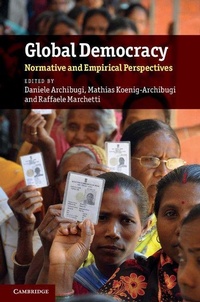
Global Democracy
Normative and Empirical Perspectives
Published on 27. October 2011
Book
Hardback
310 pages
978-0-521-19784-7 (ISBN)
Description
Democracy is increasingly seen as the only legitimate form of government, but few people would regard international relations as governed according to democratic principles. Can this lack of global democracy be justified? Which models of global politics should contemporary democrats endorse and which should they reject? What are the most promising pathways to global democratic change? To what extent does the extension of democracy from the national to the international level require a radical rethinking of what democratic institutions should be? This book answers these questions by providing a sustained dialogue between scholars of political theory, international law and empirical social science. By presenting a broad range of views by prominent scholars, it offers an in-depth analysis of one of the key challenges of our century: globalizing democracy and democratizing globalization.
Reviews / Votes
'Is global democracy a chimera, an oxymoron, or a utopia? The wide-ranging views in this book are essential reading for those seeking answers - opponents resisting the move beyond individual states as well as for proponents looking for future pathways toward supranational governance with fewer political inequalities.' Thomas G. Weiss, Presidential Professor of Political Science, The Graduate Center, The City University of New York 'This is an ambitious, well conceived, and important book that brings together normative and empirical perspectives on the notion of global democracy. The best scholars in the field illuminate the need to democratize international authority and analyze both the opportunities and limits of such an endeavor.' Michael Zuern, Director, The Social Science Research Center Berlin (WZB), and Professor for International Relations, Free University of BerlinMore details
Language
English
Place of publication
Cambridge
United Kingdom
Target group
Professional and scholarly
Dimensions
Height: 235 mm
Width: 157 mm
Thickness: 21 mm
Weight
605 gr
ISBN-13
978-0-521-19784-7 (9780521197847)
Copyright in bibliographic data and cover images is held by Nielsen Book Services Limited or by the publishers or by their respective licensors: all rights reserved.
Schweitzer Classification
Other editions
Additional editions
Daniele Archibugi | Mathias Koenig-Archibugi | Raffaele Marchetti
Global Democracy
Normative and Empirical Perspectives
E-Book
03/2012
1st Edition
Cambridge University Press
€20.49
Available for download
Daniele Archibugi | Mathias Koenig-Archibugi | Raffaele Marchetti
Global Democracy
Normative and Empirical Perspectives
Book
10/2011
Cambridge University Press
€32.50
Shipment within 15-20 days
E-Book
10/2011
Cambridge University Press
€21.99
Available for download
Persons
Daniele Archibugi is Research Director at the Italian National Research Council and Professor of Innovation, Governance and Public Policy at Birkbeck, University of London. Mathias Koenig-Archibugi is Lecturer in Global Politics in the Department of Government and the Department of International Relations at the London School of Economics and Political Science. Raffaele Marchetti (Laurea, Rome; PhD, London) is Assistant Professor of International Relations at LUISS University. His research interests concern global politics and international political theory, especially global democracy and civil society.
Content
1. Introduction: mapping global democracy Daniele Archibugi, Mathias Koenig-Archibugi and Raffaele Marchetti; 2. Models of global democracy: in defence of cosmo-federalism Raffaele Marchetti; 3. Citizens or stakeholders? Exclusion, equality and legitimacy in global stakeholder democracy Terry Macdonald; 4. Is democratic legitimacy possible for international institutions? Thomas Christiano; 5. Cosmopolitan democracy: neither a category mistake nor a categorical imperative Andreas Follesdal; 6. Regional versus global democracy: advantages and limitations Carol C. Gould; 7. Towards the metamorphosis of the United Nations: a proposal for establishing global democracy Tim Murithi; 8. Flexible government for a globalized world Bruno S. Frey; 9. Global democracy and domestic analogies Mathias Koenig-Archibugi; 10. Global democracy for a partially joined-up world: toward a multi-level system of public power and democratic governance? Kate Macdonald; 11. Civil society and global democracy: an assessment Jonas Tallberg and Anders Uhlin; 12. Global capitalism and global democracy: subverting the other? B. S. Chimni; 13. From peace between democracies to global democracy Daniele Archibugi; 14. The promise and perils of global democracy Richard A. Falk.