

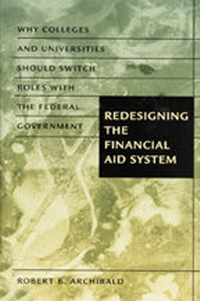
Redesigning the Financial Aid System
Why Colleges and Universities Should Switch Roles with the Federal Government
Published on 7. February 2003
Book
Hardback
256 pages
978-0-8018-7123-8 (ISBN)
Description
As the cost of higher education continues to rise, students and their families find it increasingly difficult to navigate the financial aid maze. In Redesigning the Financial Aid System, economist Robert Archibald examines the history of the system and its current flaws, and he makes a radical proposal for changing the structure of the system. Archibald argues that one of the problems with the current model-in which universities are responsible for the majority of grants while the federal government provides student loans-is that a student cannot know the final price of attending a given institution until after he or she has applied, been accepted, and received a financial aid offer. As a result, students remain largely uninformed about the cost of their college educations until very late in the decision-making process and so have difficulty making a timely choice. In addition, financial aid information is kept private, creating confusion over the price of a college education and the role of financial aid.
Under Archibald's proposed reforms, the federal government would assess a student's financial need and provide need-based grants, while institutions would be responsible for guaranteeing student loans. Not only would this new system demystify financial aid and allow students to be better informed about the cost of college earlier in the process, but it would greatly simplify the application procedure and prevent financial aid allocation from contributing to the problem of rising tuition costs. Archibald's clear explanation of the current system-its impact, strengths, and weaknesses-as well as his plans for reform, will be of interest to educators, administrators, students, and parents.
Under Archibald's proposed reforms, the federal government would assess a student's financial need and provide need-based grants, while institutions would be responsible for guaranteeing student loans. Not only would this new system demystify financial aid and allow students to be better informed about the cost of college earlier in the process, but it would greatly simplify the application procedure and prevent financial aid allocation from contributing to the problem of rising tuition costs. Archibald's clear explanation of the current system-its impact, strengths, and weaknesses-as well as his plans for reform, will be of interest to educators, administrators, students, and parents.
Reviews / Votes
[An] exhaustively researched and meticulously reasoned argument. -- Jennifer Patterson Lorenzetti University Business Offers an interesting series of ideas around a general premise that the roles and responsibilities of government and schools in higher education subsidies should be changed. -- David R. Smedley Pennsylvania Association of Student Financial Administrators Newsletter 2004More details
Language
English
Place of publication
Baltimore, MD
United States
Target group
Professional and scholarly
Product notice
sewn/stitched
Cloth over boards
Illustrations
17 s/w Zeichnungen
17 Line drawings, black and white
Dimensions
Height: 221 mm
Width: 176 mm
Thickness: 25 mm
Weight
494 gr
ISBN-13
978-0-8018-7123-8 (9780801871238)
DOI
10.56021/9780801871238
Copyright in bibliographic data and cover images is held by Nielsen Book Services Limited or by the publishers or by their respective licensors: all rights reserved.
Schweitzer Classification
Other editions
Additional editions

Robert B. Archibald
Redesigning the Financial Aid System
Why Colleges and Universities Should Switch Roles with the Federal Government
E-Book
07/2003
Johns Hopkins University Press
€39.49
Available for download
Person
Robert B. Archibald is professor of economics and director of the Thomas Jefferson Program in Public Policy at the College of William and Mary.
Content
Contents: Lists of Tables and Figures Preface and Acknowledgements1. Introduction 2. The History of Financial Aid in the United States 3. The Financial System: How It Works and How Well It Works 4. Theoretical Considerations: Access, Choice, Affordability, and Merit 5. Institutionally Funded Grants 6. Federal Loan Gaurantees 7. Eligibility for Financial Aid and Other Redesign Issues 8. Evaluating the Redesign Proposals 9. On Political Feasibility 10. Final Thoughts: Facing Trade-offs Notes References Index