

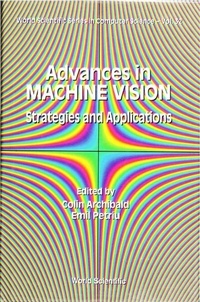
Advances In Machine Vision: Strategies And Applications
Will be published approx. on 1. April 1992
Book
Hardback
380 pages
978-981-02-0976-6 (ISBN)
Description
This book describes recent strategies and applications for extracting useful information from sensor data. For example, the methods presented by Roth and Levine are becoming widely accepted as the 'best' way to segment range images, and the neural network methods for Alpha-numeric character recognition, presented by K Yamada, are believed to be the best yet presented. An applied system to analyze the images of dental imprints presented by J Cote, et al. is one of several examples of image processing systems that have already been proven to be practical, and can serve as a model for the image processing system designer. Important aspects of the automation of processes are presented in a practical way which can provide immediate new capabilities in fields as diverse as biomedical image processing, document processing, industrial automation, understanding human perception, and the defence industries. The book is organized into sections describing Model Driven Feature Extraction, Data Driven Feature Extraction, Neural Networks, Model Building, and Applications.
Reviews / Votes
"This book shows the breadth of computer vision research, from low-level processing to high-level analysis and applications." Keith Price Computing Reviews, 1994More details
Series
Language
English
Place of publication
Singapore
Singapore
Target group
Professional and scholarly
Product notice
sewn/stitched
Cloth over boards
ISBN-13
978-981-02-0976-6 (9789810209766)
Copyright in bibliographic data and cover images is held by Nielsen Book Services Limited or by the publishers or by their respective licensors: all rights reserved.
Schweitzer Classification
Persons
Content
Random sampling for pose determination and refinement, G. Roth and M. Levine; robust high breakdown estimation and consensus, P. Meer; model-based synthesis of vision routines, T. Messer; electromagnetic models for perceptual grouping, T. Pun; multiple-font alpha-numeric recognition using multi-layer neural networks with a rejection function, K. Yamada; 3-D object model synthesis in a monocular imaging system, A.M. Earnshaw and A.K.C. Wong; a microcomputer based supervised system for automatic scoring of mitotic index in cytotoxicity studies, M. Garza-Jinich et al; a multi-operator approach for the segmentation of 3-D images of dental imprints, J. Cote et al; modeling sonar range sensors, D. Wilkes et al.