

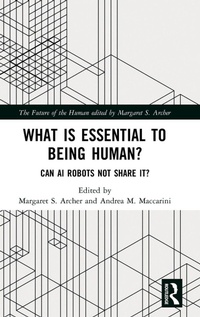
What is Essential to Being Human?
Can AI Robots Not Share It?
1st Edition
Published on 15. July 2021
Book
Hardback
220 pages
978-0-367-36828-9 (ISBN)
Description
This book asks whether there exists an essence exclusive to human beings despite their continuous enhancement - a nature that can serve to distinguish humans from artificially intelligent robots, now and in the foreseeable future. Considering what might qualify as such an essence, this volume demonstrates that the abstract question of 'essentialism' underpins a range of social issues that are too often considered in isolation and usually justify 'robophobia', rather than 'robophilia', in terms of morality, social relations and legal rights. Any defence of human exceptionalism requires clarity about what property(ies) ground it and an explanation of why these cannot be envisaged as being acquired (eventually) by AI robots. As such, an examination of the conceptual clarity of human essentialism and the role it plays in our thinking about dignity, citizenship, civil rights and moral worth is undertaken in this volume. What is Essential to Being Human? will appeal to scholars of social theory and philosophy with interests in human nature, ethics and artificial intelligence.
More details
Series
Language
English
Place of publication
London
United Kingdom
Publishing group
Taylor & Francis Ltd
Target group
College/higher education
Illustrations
4 s/w Abbildungen, 4 s/w Zeichnungen, 3 s/w Tabellen
3 Tables, black and white; 4 Line drawings, black and white; 4 Illustrations, black and white
Dimensions
Height: 240 mm
Width: 161 mm
Thickness: 17 mm
Weight
517 gr
ISBN-13
978-0-367-36828-9 (9780367368289)
Copyright in bibliographic data and cover images is held by Nielsen Book Services Limited or by the publishers or by their respective licensors: all rights reserved.
Schweitzer Classification
Other editions
Additional editions
Margaret S. Archer | Andrea M. Maccarini
What is Essential to Being Human?
Can AI Robots Not Share It?
Book
05/2023
1st Edition
Routledge
€65.20
Shipment within 10-20 days
Margaret S. Archer | Andrea M. Maccarini
What is Essential to Being Human?
Can AI Robots Not Share It?
E-Book
07/2021
1st Edition
Routledge
€59.49
Available for download
Margaret S. Archer | Andrea M. Maccarini
What is Essential to Being Human?
Can AI Robots Not Share It?
E-Book
07/2021
1st Edition
Routledge
€59.49
Available for download
Persons
Margaret S. Archer founded the Centre for Social Ontology in 2013 (now based at the Ecole de Management, Universite de Grenoble) when she was Professor of Social Theory at the Ecole Polytechnique Federale de Lausanne, Switzerland. Her books include Social Origins of Educational Systems; Culture and Agency: The Place of Culture in Social Theory; Realist Social Theory: The Morphogenetic Approach; Being Human: The Problem of Agency; Structure, Agency and the Internal Conversation; Making our Way Through the World; The Reflexive Imperative; Late Modernity: Trajectories Towards Morphogenic Society; Generative Mechanisms Transforming the Social Order; Morphogenesis and the Crisis of Normativity; and Morphogenesis and Human Flourishing.
Andrea M. Maccarini is Professor of Sociology and Associate Chair in the Department of Political Science, Law and International Studies at the University of Padua, Italy. He is also a member of the teaching board of the Ph.D. programme in Sociology and Social Research at the University of Bologna, Italy, and has been a visiting scholar at the University of California Los Angeles (UCLA), Boston University and the Humboldt-Universitaet Berlin, among others. He is a board member of IACR (International Association for Critical Realism) and collaborator of the Centre for Social Ontology, founded by Margaret S. Archer. His current research interests lie in the fields of social theory, education and socialiaation, and cultural change. He is the author of Deep Change and Emergent Structures in Global Society: Explorations in Social Morphogenesis and the co-editor of Engaging with the World: Agency, Institutions, Historical Formations.
Andrea M. Maccarini is Professor of Sociology and Associate Chair in the Department of Political Science, Law and International Studies at the University of Padua, Italy. He is also a member of the teaching board of the Ph.D. programme in Sociology and Social Research at the University of Bologna, Italy, and has been a visiting scholar at the University of California Los Angeles (UCLA), Boston University and the Humboldt-Universitaet Berlin, among others. He is a board member of IACR (International Association for Critical Realism) and collaborator of the Centre for Social Ontology, founded by Margaret S. Archer. His current research interests lie in the fields of social theory, education and socialiaation, and cultural change. He is the author of Deep Change and Emergent Structures in Global Society: Explorations in Social Morphogenesis and the co-editor of Engaging with the World: Agency, Institutions, Historical Formations.
Content
1. Introduction 2. On Robophilia and Robophobia 3. Sapience and Sentience: A Reply to Porpora 4. Relational Essentialism 5. Artificial Intelligence: Sounds like a friend, looks like a friend, is it a friend? 6. Growing Up in a World of Platforms: What Changes and What Doesn't? 7. On Macropolitics of Knowledge for Collective Learning in the Age of AI-Boosted Big Relational Tech 8. Can AIs do Politics? 9. Inhuman Enhancements? When Human Enhancements Alienate from Self, Others, Society and Nature 10. The Social Meanings of Perfection: Human Self-Understanding in a Post-Human Society