

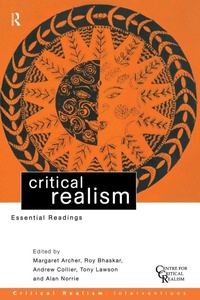
Critical Realism
Essential Readings
Published on 17. September 1998
Book
Paperback/Softback
780 pages
978-0-415-19632-1 (ISBN)
Description
Critical realism is a movement in philosophy and the human sciences most closely associated with the work of Roy Bhaskar. Since the publication of Bhaskars A Realist Theory of Science, critical realism has had a profound influence on a wide range of subjects. This reader makes accessible, in one volume, key readings to stimulate debate about and within critical realism.
It explores the following themes:
* transcendental realist
* the theory of explanatory critique
* dialectics
* Bhaskar's critical naturalist philosophy of science.
It explores the following themes:
* transcendental realist
* the theory of explanatory critique
* dialectics
* Bhaskar's critical naturalist philosophy of science.
More details
Series
Language
English
Place of publication
London
United Kingdom
Publishing group
Taylor & Francis Ltd
Target group
College/higher education
Professional and scholarly
Illustrations
8 s/w Tabellen
8 Tables, black and white
Dimensions
Height: 234 mm
Width: 156 mm
Thickness: 42 mm
Weight
1167 gr
ISBN-13
978-0-415-19632-1 (9780415196321)
Copyright in bibliographic data and cover images is held by Nielsen Book Services Limited or by the publishers or by their respective licensors: all rights reserved.
Schweitzer Classification
Other editions
Additional editions
Book
09/2015
1st Edition
Routledge
€210.20
Shipment within 10-20 days
E-Book
06/2013
Routledge
€86.99
Available for download
E-Book
06/2013
Routledge
€86.99
Available for download
Persons
Margaret Archer, Roy Bhaskar, Andrew Collier, Tony Lawson, Alan Norrie
Content
Part 1 Transcendental Realism and Science; Chapter 1 Introduction, Roy Bhaskar, Tony Lawson; Chapter 2 Philosophy and Scientific Realism Source: A Realist Theory of Science, London: Verso, 1997, chap. 1, pp. 21-62., Roy Bhaskar; Chapter 3 The Logic of Scientific Discovery Source: A Realist Theory of Science, London: Verso, 1997, chap. 3, sections 3.1-3.3, pp. 143-84, and sections 3.5 and 3.6, pp. 199-228., Roy Bhaskar; Chapter 4 Conceptual and Natural Necessity Source: Causal Powers: A Theory of Natural Necessity, Oxford: Basil Blackwell, 1975, chap. 1, Sections II-VI, pp. 8-26., R. Harre, E.H. Madden; Chapter 5 Abstraction Source: Radical Philosophy, 1981, Summer, pp. 6-15., Andrew Sayer; Chapter 6 Economic Science Without Experimentation Source: Economics and Reality, London: Routledge, 1997, chaps 15 and 16, pp. 199-226 and 227-237., Tony Lawson; Chapter 6a Abstraction; Part 2 Critical Naturalism and Social Science; Chapter 7 Introduction, Margaret Archer; Chapter 8 Societies Source: The Possibility of Naturalism, chap. 2, Harvester Wheatsheaf, Hemel Hempstead, 1989 (referred to as PON in this chapter)., Roy Bhaskar; Chapter 9 Stratified Explanation and Marx's Conception of History Source: Scientific Realism and Socialist Thought, chap. 2, pp. 43-72., Andrew Collier; Chapter 10 Realism and Social Science Source: New Philosophies of Social Science, chap. 3, pp. 44-60 (referred to in the text as NPSS)., William Outhwaite; Chapter 11 Realism and Social Science Source: Radical Philosophy, 27, 1981, pp. 13-21., Ted Benton; Chapter 12 A Realist Social Science Source: A History and Philosophy of the Social Sciences, chap. 13, pp. 266-293 (referred to in the text as AHPSS)., Peter Manicas; Chapter 13 Four Concepts Of Social Structure Source: Journal for the Theory of Social Behaviour, 19, 2, 1989, pp. 195-211., Douglas V Porpora; Chapter 14 Realism and Morphogenesis Source: Realist Social Theory: The Morphogenetic Approach, chap. 5, pp. 135-161 (referred to in the text as RST)., Margaret Archer; Part 3 The Theory of Explanator Critiques; Chapter 15 Introduction, Roy Bhaskar, Andrew Collier; Chapter 16 Reason as Dialectic Source: Radical Philosophy, 15, 1976, pp. 2-7., Roy Edgley; Chapter 17 Facts and Values Source: Scientific Realism and Human Emancipation, London: Verso, 1986, chap. 2, sections 5, 6 and 7, pp. 169-211, Roy Bhaskar; Chapter 17a Reason and the Dialectic of Human Emancipation; Chapter 17b Depth, Rationality and Change; Chapter 18 Explanation and Emancipation Source: Critical Realism, London: Verso, 1994, chap. 6, pp. 169-204., Andrew Collier; Chapter 19 Neutrality in the Social Sciences Source: Journal for the Theory of Social Behaviour, 27, 2/3, 1997, pp. 213-41., Hugh Lacey; Chapter 20 Addressing the Cultural System Source: Culture and Agency, Cambridge: Cambridge University Press, 1988, chap. 5, pp. 103-42., Margaret Archer; Chapter 21 The Praxiology of Legal JudgementSource'. Crime, Reason and History, London: Butterworths, 1993, pp. 221-60, Alan Nome; Part 4 Dialectic and Dialectical Critical Realism; Chapter 22 Introduction, Roy Bhaskar, Alan Norrie; Chapter 23 Critical Realism and DialecticSource: Dialectic: The Pulse of Freedom, London: Verso, 1993, chapters 1.5-1.7, 2.1, 2.2 and 2.7., Roy Bhaskar; Chapter 23a Dialectic; Chapter 24 Dialectical Critical Realism and EthicsSource: Dialectic: The Pulse of Freedom, London: Verso, 1993, chapters 3.1, 3.2, 3.7 and 3.10., Roy Bhaskar; Chapter 25 The Power of Negative ThinkingSource: Radical Philosophy, 69, January-February 1995, pp. 36-9., Andrew Collier; Chapter 26 Realism and Formalism in Ethics, Andrew Collier; Chapter 27 The Limits of JusticeSource: Modern Law Review, 59, 1996, pp. 540-56., Alan Norrie; Chapter 28 Between Structure and Difference Source: The Emergence of Law Through Economy, Politics and Culture, 1997, vol. 1, chap. 2, Ofiati: International Institute for the Sociology of Law., Alan Norrie;