

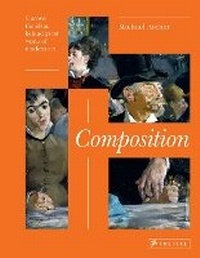
Composition
Uncover the Ideas Behind the Great Works of Modern Art
Published on 5. September 2023
Book
Hardback
240 pages
978-3-7913-7991-3 (ISBN)
Description
This refreshing and clear-eyed overview of modern and contemporary art is the first to focus on how, from Impressionism forward, the principles of composition have consistently been redefined by artists in startling and exciting ways.
While the concept of composition dates back to ancient Egypt and Greece, its use is continually evolving. Ideas around balance, hierarchy, and negative space developed over time to embrace the rule of thirds, linear perspective, and other means of making a piece of art visually appealing.
This refreshing overview takes as its starting point a revolution in art that sent ideas around composition in completely different directions. In five beautifully illustrated chapters, one of the world's foremost art historians shows how artists have been using new sets of tools and ideas to navigate the world-from Manet's revolutionary brushwork and Ukiyo-e artists' use of asymmetry and movement; to Muybridge's experiments in motion photography and Nam June Paik's embrace of video and electronic media.
Filled with enlightening discussions of major and lesser-known artists from the optical revolution of the nineteenth century to contemporary twenty-first century concerns, this book thrillingly and precisely maps how scientific, technological and social advances have changed the way artists see reality; the way they view their subjects; and how they tell their stories.
While the concept of composition dates back to ancient Egypt and Greece, its use is continually evolving. Ideas around balance, hierarchy, and negative space developed over time to embrace the rule of thirds, linear perspective, and other means of making a piece of art visually appealing.
This refreshing overview takes as its starting point a revolution in art that sent ideas around composition in completely different directions. In five beautifully illustrated chapters, one of the world's foremost art historians shows how artists have been using new sets of tools and ideas to navigate the world-from Manet's revolutionary brushwork and Ukiyo-e artists' use of asymmetry and movement; to Muybridge's experiments in motion photography and Nam June Paik's embrace of video and electronic media.
Filled with enlightening discussions of major and lesser-known artists from the optical revolution of the nineteenth century to contemporary twenty-first century concerns, this book thrillingly and precisely maps how scientific, technological and social advances have changed the way artists see reality; the way they view their subjects; and how they tell their stories.
More details
Language
English
Place of publication
Munich
Germany
Dimensions
Height: 284 mm
Width: 224 mm
Thickness: 25 mm
Weight
1463 gr
ISBN-13
978-3-7913-7991-3 (9783791379913)
Copyright in bibliographic data and cover images is held by Nielsen Book Services Limited or by the publishers or by their respective licensors: all rights reserved.
Schweitzer Classification
Person
MICHAEL ARCHER is a Professor of Art at Goldsmiths University of London. His work has appeared widely in print, including Artforum, Art Monthly, Frieze, Parkett and the Guardian and in numerous catalogues. He is the author of Art Since 1960 and contributed chapters on modern and contemporary art to the book A World History of Art.