

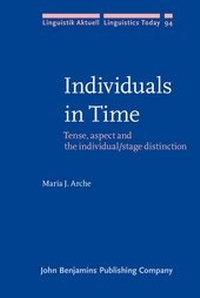
Individuals in Time
Tense, aspect and the individual/stage distinction
Published on 17. August 2006
Book
Hardback
281 pages
978-90-272-3358-5 (ISBN)
Description
This monograph investigates the temporal properties of those predicates referring to individuals - the so-called individual-level (IL) predicates - in contrast to those known as stage-level (SL) predicates. Many of the traditional tenets attributed to the IL/SL dichotomy are not solidly founded, this book claims, as it examines current theoretical issues concerning the syntax/semantics inter-face such as the relation between semantic prop-erties of predicates and their syntactic structure. By using the contrast found in Spanish copular clauses (ser vs. estar), Individuals in Time shows that the conception of IL predicates as permanent and stative cannot be maintained. The existence of nonstative IL predicates is demonstrated through analyzing the correlation between the syntactic presence of certain projections (specifi-cally, preposi-tional complements) and process-like aspect properties. This detailed examin-ation of IL predicates in the domains of inner aspect, outer aspect, and tense will be welcomed by scholars and students with an interest in event structure, tense, and aspect.
More details
Series
Language
English
Place of publication
Amsterdam
Netherlands
Target group
Professional and scholarly
Dimensions
Height: 245 mm
Width: 164 mm
Weight
690 gr
ISBN-13
978-90-272-3358-5 (9789027233585)
Copyright in bibliographic data and cover images is held by Nielsen Book Services Limited or by the publishers or by their respective licensors: all rights reserved.
Schweitzer Classification
Other editions
Additional editions
E-Book
08/2006
1st Edition
John Benjamins Publishing Company
€144.99
Available for download
Content
1. Acknowledgments; 2. Foreword, by Tim Stowell; 3. Presentation of the Study; 4. Individual-Level Predicates; 5. Event Classes and Individual-Level Predicates; 6. Aspectual Alternations in Individual-Level Predicates; 7. Outer Aspect and Individual-Level Predicates; 8. Tense and Individual-Level Predicates; 9. Conclusions and Final Remarks; 10. References; 11. Name Index; 12. Subject Index