

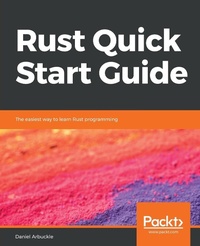
Rust Quick Start Guide
The easiest way to learn Rust programming
Published on 30. October 2018
Book
Paperback/Softback
180 pages
978-1-78961-670-5 (ISBN)
Description
Get familiar with writing programs in the trending new systems programming language that brings together the powerful performance of low-level languages with the advanced features like thread safety in multi-threaded code
Key Features
Learn the semantics of Rust, which can be significantly different from other programming languages
Understand clearly how to work with the Rust compiler which strictly enforces rules that may not be obvious
Examples and insights beyond the Rust documentation
Book DescriptionRust is an emerging programming language applicable to areas such as embedded programming, network programming, system programming, and web development. This book will take you from the basics of Rust to a point where your code compiles and does what you intend it to do!
This book starts with an introduction to Rust and how to get set for programming, including the rustup and cargo tools for managing a Rust installation and development work?ow.
Then you'll learn about the fundamentals of structuring a Rust program, such as functions, mutability, data structures, implementing behavior for types, and many more. You will also learn about concepts that Rust handles differently from most other languages.
After understanding the Basics of Rust programming, you will learn about the core ideas, such as variable ownership, scope, lifetime, and borrowing. After these key ideas, you will explore making decisions in Rust based on data types by learning about match and if let expressions. After that, you'll work with different data types in Rust, and learn about memory management and smart pointers.What you will learn
Install Rust and write your first program with it
Understand ownership in Rust
Handle different data types
Make decisions by pattern matching
Use smart pointers
Use generic types and type specialization
Write code that works with many data types
Tap into the standard library
Who this book is forThis book is for people who are new to Rust, either as their first programming language or coming to it from somewhere else. Familiarity with computer programming in any other language will be helpful in getting the best out of this book.
Key Features
Learn the semantics of Rust, which can be significantly different from other programming languages
Understand clearly how to work with the Rust compiler which strictly enforces rules that may not be obvious
Examples and insights beyond the Rust documentation
Book DescriptionRust is an emerging programming language applicable to areas such as embedded programming, network programming, system programming, and web development. This book will take you from the basics of Rust to a point where your code compiles and does what you intend it to do!
This book starts with an introduction to Rust and how to get set for programming, including the rustup and cargo tools for managing a Rust installation and development work?ow.
Then you'll learn about the fundamentals of structuring a Rust program, such as functions, mutability, data structures, implementing behavior for types, and many more. You will also learn about concepts that Rust handles differently from most other languages.
After understanding the Basics of Rust programming, you will learn about the core ideas, such as variable ownership, scope, lifetime, and borrowing. After these key ideas, you will explore making decisions in Rust based on data types by learning about match and if let expressions. After that, you'll work with different data types in Rust, and learn about memory management and smart pointers.What you will learn
Install Rust and write your first program with it
Understand ownership in Rust
Handle different data types
Make decisions by pattern matching
Use smart pointers
Use generic types and type specialization
Write code that works with many data types
Tap into the standard library
Who this book is forThis book is for people who are new to Rust, either as their first programming language or coming to it from somewhere else. Familiarity with computer programming in any other language will be helpful in getting the best out of this book.
More details
Language
English
Place of publication
Birmingham
United Kingdom
Target group
Professional and scholarly
US School Grade: College Graduate Student
Dimensions
Height: 235 mm
Width: 191 mm
Thickness: 11 mm
Weight
348 gr
ISBN-13
978-1-78961-670-5 (9781789616705)
Copyright in bibliographic data and cover images is held by Nielsen Book Services Limited or by the publishers or by their respective licensors: all rights reserved.
Schweitzer Classification
Other editions
Additional editions
E-Book
09/2024
Packt Publishing
€23.49
Available for download
Person
Daniel Arbuckle gained his PhD in Computer Science from the University of Southern California. He has published numerous papers along with several books and video courses, and he is both a teacher of computer science and a professional programmer.
Content
Table of Contents
Getting Ready
Basics of the Rust Language
The Big Ideas
Making Decisions by Pattern Matching
One Data Type Representing Multiple Kinds of Data
Heap Memory and Smart Pointers
Generic Types
Important Standard Traits
Getting Ready
Basics of the Rust Language
The Big Ideas
Making Decisions by Pattern Matching
One Data Type Representing Multiple Kinds of Data
Heap Memory and Smart Pointers
Generic Types
Important Standard Traits