

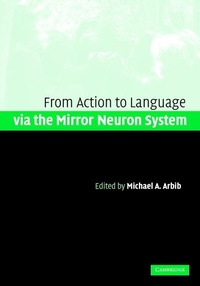
Action to Language via the Mirror Neuron System
Published on 7. September 2006
Book
Hardback
568 pages
978-0-521-84755-1 (ISBN)
Description
Mirror neurons may hold the brain's key to social interaction - each coding not only a particular action or emotion but also the recognition of that action or emotion in others. The Mirror System Hypothesis adds an evolutionary arrow to the story - from the mirror system for hand actions, shared with monkeys and chimpanzees, to the uniquely human mirror system for language. In this accessible volume, experts from child development, computer science, linguistics, neuroscience, primatology and robotics present and analyse the mirror system and show how studies of action and language can illuminate each other. Topics discussed in the fifteen chapters include: what do chimpanzees and humans have in common? Does the human capability for language rest on brain mechanisms shared with other animals? How do human infants acquire language? What can be learned from imaging the human brain? How are sign- and spoken-language related? Will robots learn to act and speak like humans?
More details
Language
English
Place of publication
Cambridge
United Kingdom
Target group
Professional and scholarly
Dimensions
Height: 260 mm
Width: 183 mm
Thickness: 35 mm
Weight
1250 gr
ISBN-13
978-0-521-84755-1 (9780521847551)
Copyright in bibliographic data and cover images is held by Nielsen Book Services Limited or by the publishers or by their respective licensors: all rights reserved.
Schweitzer Classification
Other editions
Additional editions
Michael A. Arbib
Action to Language via the Mirror Neuron System
Book
02/2011
Cambridge University Press
€87.80
Shipment within 15-20 days
Michael A. Arbib
Action to Language via the Mirror Neuron System
E-Book
11/2006
1st Edition
Cambridge University Press
€64.99
Available for download
Person
Michael A. Arbib is the Fletcher Jones Professor of Computer Science, as well as a Professor of Biological Sciences, Biomedical Engineering, Electrical Engineering, Neuroscience and Psychology at the University of Southern California (USC), which he joined in 1986. He has been named as one of a small group of university professors at USC in recognition of his contributions across many disciplines.
Content
Preface; Part I. Two Perspectives: 1. The mirror system hypothesis on the linkage of action and languages Michael Arbib; 2. The origin and evolution of language: a plausible, strong-AI account Jerry Hobbs; Part II. Brain, Evolution and Comparative Analysis: 3. Cognition, imitation and culture in the great apes Craig Stanford; 4. The signer as an embodied mirror neuron: neural systems underlying sign language and action Karen Emmorey; 5. Neural homologies and the grounding of neurolinguistics Michael Arbib and Mihail Bota; Part III. Dynamical Systems in Action and Language: 6. Dynamical systems: brain, body and imitation Stefan Schaal; 7. The role of vocal tract gestural action units in understanding the evolution of phonology Louis Goldstein, Dani Byrd and Elliot Saltzman; 8. Lending a helping hand to hearing: a motor theory of speech perception Jeremy I. Skipper, Howard C. Nusbaum and Steven L. Small; Part IV. From Mirror System to Syntax and Theory of Mind: 9. Attention and the minimal subscene Laurent Itti and Michael Arbib; 10. Action verbs, argument structure constructions, and the mirror neuron system David Kemmerer; 11. Linguistic corpora and theory of mind Andrew Gordon; Part V. Development of Action and Language: 12. The development of grasping and the mirror system Erhan Oztop, Nina Bradley and Michael Arbib; 13. Development of goal-directed imitation, object manipulation and language in humans and robots Iona D. Goga and Aude Billard; 14. Affordances, effectivities and the mirror system in child development Patricia Zukow-Goldring; 15. Implications of mirror neurons for the ontogeny and phylogeny of cultural processes: the examples of tools and language Patricia Greenfield.