

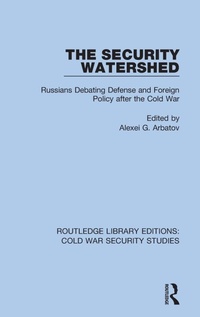
The Security Watershed
Russians Debating Defense and Foreign Policy after the Cold War
1st Edition
Published on 27. January 2021
Book
Hardback
658 pages
978-0-367-62903-8 (ISBN)
Description
This book, first published in 1993, is an analytical review that discusses the changes in the international security policies of the USA and USSR at the end of the Cold War, as well as the main events that occurred in the area of arms control. A distinctive feature of this work is the detailed analysis of competing Russian views concerning arms control agreements and Russian military reforms.
More details
Series
Language
English
Place of publication
London
United Kingdom
Publishing group
Taylor & Francis Ltd
Target group
College/higher education
Dimensions
Height: 240 mm
Width: 161 mm
Thickness: 40 mm
Weight
1142 gr
ISBN-13
978-0-367-62903-8 (9780367629038)
Copyright in bibliographic data and cover images is held by Nielsen Book Services Limited or by the publishers or by their respective licensors: all rights reserved.
Schweitzer Classification
Other editions
Additional editions
Alexei G. Arbatov
The Security Watershed
Russians Debating Defense and Foreign Policy after the Cold War
Book
06/2022
1st Edition
Routledge
€76.30
Shipment within 15-20 days
Alexei G. Arbatov
The Security Watershed
Russians Debating Defense and Foreign Policy after the Cold War
E-Book
01/2021
1st Edition
Routledge
€67.49
Available for download
Alexei G. Arbatov
The Security Watershed
Russians Debating Defense and Foreign Policy after the Cold War
E-Book
01/2021
1st Edition
Routledge
€67.49
Available for download
Person
Alexei G. Arbatov
Content
Part 1. Nuclear and Space Weapons 1. Strategic Offensive Arms: Reducing or Adjusting? Alexei Arbatov 2. Talks on Defence in Space Alexei Arbatov and Nikolai kishilov 3. The START Treaty: Preliminary Assessment Alexei Arbatov 4. SDI: An Evaluation of its Status and Programs Mikhail Gerasev 5. Brilliant Pebbles: One More Ultimate Weapon? Oleg Prilutsky 6. Offensive Space Weapons: Perceptions and Realities Alexander Pikayev Part 2. Shifts in Superpowers' Military Policies 7. Military Reform in the Former USSR Alla Kozlova, Vadim Makarevsky and Yuri Streltsov 8. The End of the Cold War: Trends in US and Soviet/Russian Defence Policies and Budgets Sergei Rogov Part 3. Security in Europe 9. Political Changes in Europe Vladimir Baranovsky 10. From the Atlantic to the Urals: Conventional Forces Reductions 1989-1991 Oleg Amirov and Sergei Oznobicshev 11. Coping with Tactical Nuclear Weapons Alexei Arbatov, Oleg Amirov and Victor Mizin Part 4. Prospects for Naval Stability 12. Confidence-Building, Transparency and Predictability Anatoly Vishnevsky 13. Limiting Naval Operations Anatoly Vishnevsky 14. Limiting Naval Armaments Alexei Arbatov and Anatoly Vishnevsky 15. Naval Tactical Nuclear Weapons Anatoly Vishnevsky and Boris Makeev Part 5. Conversion of Defence Industries in the Commonwealth of Independent States 16. The State Conversion Program: Its Goals and Performance Alexander Kalyadin 17. Arms Production and Economic Reform Alexei Isumov 18. An Alternate Conception of Conversion Alexander Ojogov, Eugene Rogovsky and Yuri Yaremenko 19. Controversies Surrounding Conversion Alexander Kalyadin and Kirill Fesenko Part 6. Multilateral Security Cooperation 20. Limitations on Sales and Deliveries of Arms Yuri Pinchukov and Tamara Farnasova 21. A New Trinity: Nuclear, Chemical and Missile Non-Proliferation Yuri Pinchukov 22. Open Skies: A Source of Confidence or Suspicion? Yuri Pinchukov 23. Space Controversies in the Former Soviet Union Vadim Vladimirov 24. Disarmament and the United Nations Alexander Kalyadin Part 7. Regional Conflicts 25. The Gulf War George Bechter 26. The Middle East George Bechter 27. Afghanistan Vladimir Avakov 28. Southern Africa Vladimir Avakov 29. Central America Vladimir Avakov 30. Prospects for the Cambodian Settlement Yuri Belokon 31. The Indo-Pakistan Conflict Nadezhda Doropheeva Appendix 1. Chronology Tamara Farnasova Appendix 2. New Publications on Disarmament and Security Vadim Vladimirov