

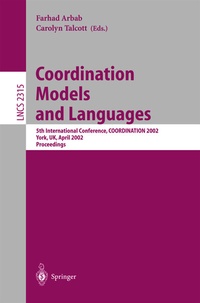
Coordination Models and Languages
5th International Conference, COORDINATION 2002, YORK, UK, April 8-11, 2002 Proceedings
Published on 27. March 2002
Book
Paperback/Softback
XII, 412 pages
978-3-540-43410-8 (ISBN)
Description
This volume contains the proceedings of the Fifth International Conference on Coordination Models and Languages (Coordination 2002), held in York, UK, 8-11 April 2002. Coordination models and languages close the conceptual gap - tween the cooperation model used by the constituent parts of an application and the lower-level communication model used in its implementation. Coordinati- based methods provide a clean separation between individual software com- nents and their interactions within their overall software organization. This se- ration, together with the higher-level abstractions o?ered by coordination models and languages, improve software productivity, enhance maintainability, advocate modularity, promote reusability, and lead to software organizations and arc- tectures that are more tractable and more amenable to veri?cation and global analysis. Coordination is relevant in design, development, debugging, maintenance, and reuse of all complex concurrent and distributed systems. Speci?cally, - ordination becomes paramount in the context of open systems, systems with mobile entities, and dynamically re-con?gurable evolving systems. Moreover, - ordination models and languages focus on such key issues in Component Based Software Engineering as speci?cation, interaction, and dynamic composition of components.
More details
Series
Edition
2002 ed.
Language
English
Place of publication
Berlin
Germany
Publishing group
Springer Berlin
Target group
Professional and scholarly
Research
Illustrations
XII, 412 p.
Dimensions
Height: 235 mm
Width: 155 mm
Thickness: 23 mm
Weight
639 gr
ISBN-13
978-3-540-43410-8 (9783540434108)
DOI
10.1007/3-540-46000-4
Schweitzer Classification
Other editions
Additional editions
Farhad Arbab | Carolyn Talcott
Coordination Models and Languages
5th International Conference, COORDINATION 2002, YORK, UK, April 8-11, 2002 Proceedings
E-Book
08/2003
Springer
€53.49
Available for download
Persons
Content
Invited Presentations.- Playing Games with Software Design.- Coordination and System Design in a Network-Centric Age.- Time, Knowledge, and Cooperation: Alternating-Time Temporal Epistemic Logic and Its Applications.- Accepted Papers.- Coordination for Orchestration.- Concurrent Semantics for the Web Services Specification Language DAML-S.- Coordination through Channel Composition.- Exogenous and Endogenous Extensions of Architectural Types.- Coordinating Mobile Object-Oriented Code.- Formalizing Properties of Mobile Agent Systems.- Dynamically Adapting the Behaviour of Software Components.- An Associative Broadcast Based Coordination Model for Distributed Processes.- State-and Event-Based Reactive Programming in Shared Dataspaces.- Integrating Two Organizational Systems through Communication Genres.- OpenCoLaS a Coordination Framework for CoLaS Dialects.- Coordination in a Reflective Architecture Description Language.- Coordinating Software Evolution via Two-Tier Programming.- Criteria for the Analysis of Coordination in Multi-agent Applications.- Towards a Colimit-Based Semantics for Visual Programming.- The Cost of Communication Protocols and Coordination Languages in Embedded Systems.- Operational Semantics for Coordination in Paradigm.- Service Provision in Ad Hoc Networks.- PN2: An Elementary Model for Design and Analysis of Multi-agent Systems.- A Recovery Technique Using Multi-agent in Distributed Computing Systems.- An Order-Based, Distributed Algorithm for Implementing Multiparty Interactions.- Exploiting Transiently Shared Tuple Spaces for Location Transparent Code Mobility.- Formal Specification of JavaSpacesT Architecture Using ?CRL.- Objective vs. Subjective Coordination in Agent-Based Systems: A Case Study.- Scheduling under Uncertainty: Planning forthe Ubiquitous Grid.- Using Logical Operators as an Extended Coordination Mechanism in Linda.- A Framework for Coordinating Parallel Branch and Bound Algorithms.- Policies for Cooperative Virtual Teams.- The Spacetub Models and Framework.- Tuple-Based Models in the Observation Framework.- Extending the Matching Facilities of Linda.- Semantics of Protocol Modules Composition and Interaction.