

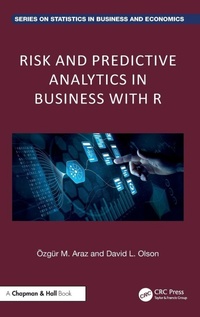
Risk and Predictive Analytics in Business with R
1st Edition
Published on 25. August 2025
Book
Hardback
176 pages
978-1-032-91269-1 (ISBN)
Description
Supply chain operations face many risks, including political, environmental, and economic. The past five years have seen major challenges, from pandemic, impacts of global warming, wars, and tariff impositions. In this rapidly changing world, risks appear in every aspect of operations. This book presents data mining and analytics tools with R programming as well as a brief presentation of Monte Carlo simulation that can be used to anticipate and manage these risks. RStudio software and R programming language are widely used in data mining. For Monte Carlo simulation applications we cover Crystal Ball software, one of a number of commercially available Monte Carlo simulation tools.
Chapter 1 of this book deals with classification of risks. It includes a typical supply chain example published in academic literature. Chapter 2 gives a brief introduction to R programming. It is not intended to be comprehensive, but sufficient for a user to get started using this free open source and highly popular analytics tool. Chapter 3 discusses risks commonly found in finance, to include basic data mining tools applied to analysis of credit card fraud data. Like the other datasets used in the book, this data comes from the Kaggle.com site, a free site loaded with realistic datasets.
The remainder of the book covers risk analytics tools. Chapter 4 presents R association rule modeling using a supply chain related dataset. Chapter 5 presents Monte Carlo simulation of some supply chain risk situations. Chapter 6 gives both time series and multiple regression prediction models as well as autoregressive integrated moving average (ARIMA; Box-Jenkins) models in SAS and R. Chapter 7 covers classification models demonstrated with credit risk data. Chapter 8 deals with fraud detection and the common problem of modeling imbalanced datasets. Chapter 9 introduces Naive Bayes modeling with categorical data using an employee attrition dataset.
Features:
Overview of predictive analytics presented in an understandable manner
Presentation of useful business applications of predictive data mining
Coverage of risk management in finance, insurance, and supply chain contexts
Presentation of predictive models
Demonstration of using these predictive models in R
Screenshots enabling readers to develop their own models
The purpose of the book is to present tools useful to analyze risks, especially those faced in supply chain management and finance.
Chapter 1 of this book deals with classification of risks. It includes a typical supply chain example published in academic literature. Chapter 2 gives a brief introduction to R programming. It is not intended to be comprehensive, but sufficient for a user to get started using this free open source and highly popular analytics tool. Chapter 3 discusses risks commonly found in finance, to include basic data mining tools applied to analysis of credit card fraud data. Like the other datasets used in the book, this data comes from the Kaggle.com site, a free site loaded with realistic datasets.
The remainder of the book covers risk analytics tools. Chapter 4 presents R association rule modeling using a supply chain related dataset. Chapter 5 presents Monte Carlo simulation of some supply chain risk situations. Chapter 6 gives both time series and multiple regression prediction models as well as autoregressive integrated moving average (ARIMA; Box-Jenkins) models in SAS and R. Chapter 7 covers classification models demonstrated with credit risk data. Chapter 8 deals with fraud detection and the common problem of modeling imbalanced datasets. Chapter 9 introduces Naive Bayes modeling with categorical data using an employee attrition dataset.
Features:
Overview of predictive analytics presented in an understandable manner
Presentation of useful business applications of predictive data mining
Coverage of risk management in finance, insurance, and supply chain contexts
Presentation of predictive models
Demonstration of using these predictive models in R
Screenshots enabling readers to develop their own models
The purpose of the book is to present tools useful to analyze risks, especially those faced in supply chain management and finance.
More details
Series
Language
English
Place of publication
United Kingdom
Publishing group
Taylor & Francis Ltd
Target group
Professional and scholarly
Professional Practice & Development
Illustrations
63 s/w Abbildungen, 63 s/w Zeichnungen, 38 s/w Tabellen
38 Tables, black and white; 63 Line drawings, black and white; 63 Illustrations, black and white
Dimensions
Height: 240 mm
Width: 161 mm
Thickness: 15 mm
Weight
452 gr
ISBN-13
978-1-032-91269-1 (9781032912691)
Copyright in bibliographic data and cover images is held by Nielsen Book Services Limited or by the publishers or by their respective licensors: all rights reserved.
Schweitzer Classification
Other editions
Additional editions
Ozgur M. Araz | David L. Olson
Risk and Predictive Analytics in Business with R
E-Book
08/2025
Chapman and Hall
€73.99
Available for download
Ozgur M. Araz | David L. Olson
Risk and Predictive Analytics in Business with R
E-Book
08/2025
Chapman and Hall
€73.99
Available for download
Persons
OEzguer M. Araz is the Ronald and Carol Cope Professor and Professor of Supply Chain Management and Analytics at the University of Nebraska-Lincoln. His research interests are systems simulation, business analytics, healthcare operations, and public health informatics.
David L. Olson is the James and H.K. Stuart Chancellor's Distinguished Chair in the Department of Supply Chain Management and Analytics at the University of Nebraska-Lincoln. His research interests are data mining, knowledge management, multiple criteria decision-making, and simulation modeling.
David L. Olson is the James and H.K. Stuart Chancellor's Distinguished Chair in the Department of Supply Chain Management and Analytics at the University of Nebraska-Lincoln. His research interests are data mining, knowledge management, multiple criteria decision-making, and simulation modeling.
Content
1. Measuring and Managing Risk. 2. R Programming Language and RStudio. 3. Risk Measures in Finance and Insurance. 4. Association Rule Modeling in Supply Chains. 5. Simulating Supply Chain Risks. 6. Regression. 7. Classification Tools. 8. Fraud Detection. 9. Mixed Data.