

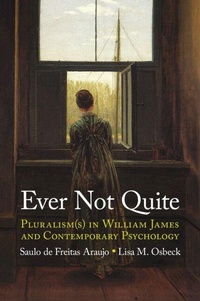
Ever Not Quite
Pluralism(s) in William James and Contemporary Psychology
Published on 4. September 2025
Book
Paperback/Softback
195 pages
978-1-009-70473-1 (ISBN)
Description
William James made many references to pluralism throughout his career. Interestingly, many contemporary psychologists also discuss pluralism and indeed call for pluralism as a corrective to the discipline's philosophical and methodological foundations. Yet, pluralism and the purposes to which it is applied are understood in a variety of ways, and the relation of contemporary pluralism to the pluralism(s) of William James is uncertain. This book offers conceptual clarification in both contexts, first distinguishing diverse senses of pluralism in psychology and then systematically examining different forms of pluralism across the writings of James. A comparison of meanings and analysis of implications follows, aimed at illuminating what is at stake in ongoing calls for pluralism in psychology.
Reviews / Votes
'This book presents abundant evidence for the pluralism in William James's understanding of the human thought and action. It documents James's close reading of psychological and philosophical research and theorizing and shows that he intuited the directions of later psychological science. Holding this book's insights alongside the work of contemporary psychology offers potential to 'stretch the boundaries of psychological science.' For James's deliberate explorations, Araujo and Osbeck are sure-footed and intelligent guides.' Paul Croce, Stetson University 'This book gives a lucid overview of the pluralistic position(s) articulated by William James and teases out insights we might glean from James for contemporary discussions about pluralism in psychology. The authors reconstruct how James's views about pluralism evolved over time and take a broad view of how they fit within (but are not reducible to) other well-known aspects of James intellectual project. An important contribution to the James scholarship, opening up exciting new avenues for future research in theoretical psychology.' Uljana Feest, Leibniz Universitaet Hannover, Germany 'Araujo and Osbeck's volume marks the most thorough examination to date of the nature and implications of the many uses of 'pluralism' in contemporary psychology. The authors stimulate reflection on these uses in relation to a broad range of William James's scholarly productions and correspondence, a formidable task to which the authors bring nuance, humility, and insightfulness.' Kevin P. Weinfurt, Duke University 'Saulo Araujo and Lisa Osbeck have written a scholarly masterpiece that takes the pluralistic bull by its historical, disciplinary, and conceptual-analytic horns, shedding much-needed light on a much-used concept. In demonstrating how various contemporary positions on pluralism reflect and depart from James's views, the authors open 'new paths for encouraging psychologists to reflect on James's pluralistic philosophy.' Ever Not Quite is sure to inspire new ways to tackle psychology's age-old problems - be they metatheoretical, theoretical, methodological, or practical. I predict it will become a classic in our time and beyond.' Barbara S. Held, Bowdoin College, USAMore details
Language
English
Place of publication
Cambridge
United Kingdom
Product notice
Paperback (trade)
Illustrations
Worked examples or Exercises
Dimensions
Height: 229 mm
Width: 152 mm
Thickness: 11 mm
Weight
268 gr
ISBN-13
978-1-009-70473-1 (9781009704731)
Copyright in bibliographic data and cover images is held by Nielsen Book Services Limited or by the publishers or by their respective licensors: all rights reserved.
Schweitzer Classification
Other editions
Additional editions
Saulo de Freitas Araujo | Lisa M. Osbeck
Ever Not Quite
Pluralism(s) in William James and Contemporary Psychology
Book
06/2023
Cambridge University Press
€120.50
Shipment within 15-20 days
Persons
Saulo de Freitas Araujo is Professor of Psychology at Federal University of Juiz de Fora, Brazil and Director of the Wilhelm Wundt Center for the History and Philosophy of Psychology (NUHFIP). His research is primarily concerned with the history and philosophy of scientific psychology. He is a past recipient of APA's Early Career Award (Division 26) and author of Wundt and the Philosophical Foundations of Psychology: A Reappraisal (2016); his edited works include John B. Watson: Classical Behaviorism (2020), The force of an idea: New essays on Christian Wolff's psychology (2021), and Edward B. Titchener: Psychology, science, and technology (2022). Lisa M. Osbeck is Professor of Psychology at the University of West Georgia, USA. She is a past recipient of the Joseph B. Gittler award and the Arthur W. Staats lecture award from the American Psychological Foundation, and the William James Book award from the American Psychological Association (APA). Her authored works include Science as Psychology: Sense-Making and Identity in Science Practice (2010) and Values in Psychological Science (2019); her edited works include Rational Intuition (2014), Psychological Studies of Science and Technology (2019), and Person-Centered Studies in Psychology of Science (forthcoming, 2022).
Content
1. The problem of pluralism(s); 2. Pluralism(s) in contemporary psychology; 3. 'Pluralism' and related terms in the broader context of James's life and writing; 4. A systematic analysis of James's pluralism(s); 5. Implications of pluralism for contemporary psychology; 6. Concluding remarks.