

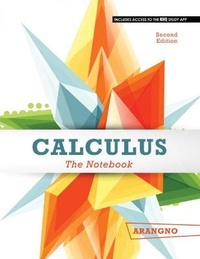
Calculus: The Notebook
2nd Edition
Published on 30. May 2021
Book
Paperback/Softback
277 pages
978-1-7924-6325-9 (ISBN)
Description
The study of Calculus enables us to solve problems and articulate abstract concepts far beyond the theoretical reach of Algebra. The power of Calculus derives from the ingenuity and simplicity of its notation. This mathematical language allows the mathematician the freedom and immense versatility to accurately describe physical problems and the tools to solve them. This book consists of lectures on all the topics of a 3-course series on Calculus: Calculus I, II, and III. It can be used as a textbook, or as a supplement to other texts. Both students and instructors will find it helpful in elucidating the ideas and methods of Calculus.
More details
Edition
2nd Revised edition
Language
English
Place of publication
Iowa
United States
Target group
College/higher education
Edition type
Revised edition
ISBN-13
978-1-7924-6325-9 (9781792463259)
Copyright in bibliographic data and cover images is held by Nielsen Book Services Limited or by the publishers or by their respective licensors: all rights reserved.
Schweitzer Classification
Content
- Preface
About the Author
Formulas
Introduction
- Part 1 Calculus I
Chapter 1 Functions and Limits
1.1 Functions, Transformations
1.2 Tangent and Velocity Functions
1.3 Limit of a Function, Limit Laws
1.4 Formal Definition of a Limit
1.5 Limit Laws
1.6 Continuity
- Chapter 2 Derivatives
2.1 Derivatives and Rates of Change
2.2 Derivative as a Function, Differentiation Formulas
2.3 Derivatives of Trigonometric Functions
2.4 Linear Approximations and Differentials
2.5 Chain Rule
2.6 Implicit Differentiation
2.7 Related Rates
- Chapter 3 Applications of Differentiation
3.1 Mean Value Theorem
3.2 Maximum and Minimum Values
3.3 Optimization Problems
3.4 Derivatives and Curve Sketching
3.5 Limits at Infinity
3.6 Newton's Method
- Chapter 4 Integrals
4.1 Antiderivatives
4.2 Areas and Distances
4.3 Definite Integral
4.4 Fundamental Theorem of Calculus
- Chapter 5 Applications of Integration
5.1 Areas Between Curves
5.2 Volumes of Solids of Revolution: Slices
5.3 Volumes of Solids of Revolution: Cylindrical Shells
5.4 Average Value of a Function
5.5 Improper Integrals
- Part 2 Calculus II
Chapter 6 Special Functions, Indeterminate Forms
6.1 Logs and Exponents
6.2 Exponential Growth and Decay
6.3 Inverse Trig Functions
6.4 L'Hospital's Rule
- Chapter 7 Techniques of Integration
7.1 U-Substitution
7.2 Integration by Parts
7.3 Trig Integrals
7.4 Trigonometric Substitution
7.5 Partial Fractions
7.6 Numerical Integration
- Chapter 8 Applications of the Integral
8.1 Arclength
8.2 Surface Areas of Revolution
8.3 Mass, Work
- Chapter 9 Introduction to Differential Equations
9.1 Direction Fields and Euler's Method
9.2 Separable Differential Equations
9.3 Linear Differential Equations
- Chapter 10 Conics, Polar Coordinates, and Parametric Equations
10.1 Conics
10.2 Polar Coordinates
10.3 Parametric Equations
- Chapter 11 Sequences and Series
11.1 Sequences
11.2 Series
11.3 Convergence Tests
11.4 Power Series
- Part 3 Calculus III
Chapter 12 Geometry in 3 Dimensions
12.1 3D coordinates
12.2 Vectors
12.3 The Dot Product
12.4 The Cross Product
12.5 Vector Equations of Lines, Planes
12.6 Vector Valued Functions
12.7 Calculus of Vector Valued Functions
12.8 Arclength
12.9 Tangent, Normal, and Binormal Vectors
12.10 Curvature
12.11 Motion in Space: Velocity and Acceleration
- Chapter 13 Functions of Several Variables
13.1 Introduction
13.2 Quadratic & Cylindrical Surfaces
13.3 Limits, Continuity
13.4 Partial Derivatives
13.5 Chain Rule
13.6 Directional Derivatives, Gradients
13.7 Tangent Planes, Normal Lines
13.8 Local Maxima, Local Minima, Saddle Points
13.9 Global Maxima and Minima
13.10 Lagrange Multipliers
- Chapter 14 Multiple Integrals
14.1 Double Integrals
14.2 Double Integrals in Polar Coordinates
14.3 Triple Integrals
14.4 Triple Integrals in Cylindrical Coordinates
14.5 Triple Integrals in Spherical Coordinates
- Chapter 15 Vector Calculus
15.1 Vector Fields
15.2 Line Integrals
15.3 Fundamental Theorem of Line Integrals
15.4 Green's Theorem
15.5 Line Integrals Made Easy
15.6 Surface Integrals
15.7 Flux Integrals
15.8 Stokes Theorem
15.9 Divergence Theorem
- Appendix Derivatives and Integrals
About the Author
Formulas
Introduction
- Part 1 Calculus I
Chapter 1 Functions and Limits
1.1 Functions, Transformations
1.2 Tangent and Velocity Functions
1.3 Limit of a Function, Limit Laws
1.4 Formal Definition of a Limit
1.5 Limit Laws
1.6 Continuity
- Chapter 2 Derivatives
2.1 Derivatives and Rates of Change
2.2 Derivative as a Function, Differentiation Formulas
2.3 Derivatives of Trigonometric Functions
2.4 Linear Approximations and Differentials
2.5 Chain Rule
2.6 Implicit Differentiation
2.7 Related Rates
- Chapter 3 Applications of Differentiation
3.1 Mean Value Theorem
3.2 Maximum and Minimum Values
3.3 Optimization Problems
3.4 Derivatives and Curve Sketching
3.5 Limits at Infinity
3.6 Newton's Method
- Chapter 4 Integrals
4.1 Antiderivatives
4.2 Areas and Distances
4.3 Definite Integral
4.4 Fundamental Theorem of Calculus
- Chapter 5 Applications of Integration
5.1 Areas Between Curves
5.2 Volumes of Solids of Revolution: Slices
5.3 Volumes of Solids of Revolution: Cylindrical Shells
5.4 Average Value of a Function
5.5 Improper Integrals
- Part 2 Calculus II
Chapter 6 Special Functions, Indeterminate Forms
6.1 Logs and Exponents
6.2 Exponential Growth and Decay
6.3 Inverse Trig Functions
6.4 L'Hospital's Rule
- Chapter 7 Techniques of Integration
7.1 U-Substitution
7.2 Integration by Parts
7.3 Trig Integrals
7.4 Trigonometric Substitution
7.5 Partial Fractions
7.6 Numerical Integration
- Chapter 8 Applications of the Integral
8.1 Arclength
8.2 Surface Areas of Revolution
8.3 Mass, Work
- Chapter 9 Introduction to Differential Equations
9.1 Direction Fields and Euler's Method
9.2 Separable Differential Equations
9.3 Linear Differential Equations
- Chapter 10 Conics, Polar Coordinates, and Parametric Equations
10.1 Conics
10.2 Polar Coordinates
10.3 Parametric Equations
- Chapter 11 Sequences and Series
11.1 Sequences
11.2 Series
11.3 Convergence Tests
11.4 Power Series
- Part 3 Calculus III
Chapter 12 Geometry in 3 Dimensions
12.1 3D coordinates
12.2 Vectors
12.3 The Dot Product
12.4 The Cross Product
12.5 Vector Equations of Lines, Planes
12.6 Vector Valued Functions
12.7 Calculus of Vector Valued Functions
12.8 Arclength
12.9 Tangent, Normal, and Binormal Vectors
12.10 Curvature
12.11 Motion in Space: Velocity and Acceleration
- Chapter 13 Functions of Several Variables
13.1 Introduction
13.2 Quadratic & Cylindrical Surfaces
13.3 Limits, Continuity
13.4 Partial Derivatives
13.5 Chain Rule
13.6 Directional Derivatives, Gradients
13.7 Tangent Planes, Normal Lines
13.8 Local Maxima, Local Minima, Saddle Points
13.9 Global Maxima and Minima
13.10 Lagrange Multipliers
- Chapter 14 Multiple Integrals
14.1 Double Integrals
14.2 Double Integrals in Polar Coordinates
14.3 Triple Integrals
14.4 Triple Integrals in Cylindrical Coordinates
14.5 Triple Integrals in Spherical Coordinates
- Chapter 15 Vector Calculus
15.1 Vector Fields
15.2 Line Integrals
15.3 Fundamental Theorem of Line Integrals
15.4 Green's Theorem
15.5 Line Integrals Made Easy
15.6 Surface Integrals
15.7 Flux Integrals
15.8 Stokes Theorem
15.9 Divergence Theorem
- Appendix Derivatives and Integrals