

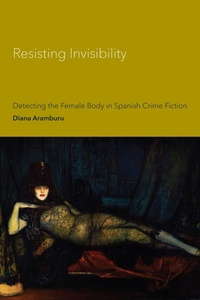
Resisting Invisibility
Detecting the Female Body in Spanish Crime Fiction
Published on 17. May 2019
Book
Hardback
296 pages
978-1-4875-0459-5 (ISBN)
Description
Engaging with pre-feminist and male-authored crime literature, Resisting Invisibility offers a comparative reading of women's bodies as represented in Spanish crime literature from the mid-nineteenth century to the present. Utilizing the twin concepts of visibility and invisibility, the book establishes a genealogy of differing viewpoints regarding women's positions in these narratives, before and after the birth of the modern Spanish female detective.
This examination of the politics of female visibility expands our understanding of the aesthetic regimes that have governed the female body from the early phases of the genre's evolution. While most scholars understand the feminization of the crime genre as a response to second-wave feminism, Resisting Invisibility demonstrates that even in the earliest representations of delinquent women, the politics surrounding the female body are problematized and are more complex than previously conceptualized. Drawing on gender and queer studies, Resisting Invisibility investigates the gendering of crime fiction, forcing us to reconsider the literary history of female visibility and prompting us to establish an alternative genealogy for Spanish crime literature.
This examination of the politics of female visibility expands our understanding of the aesthetic regimes that have governed the female body from the early phases of the genre's evolution. While most scholars understand the feminization of the crime genre as a response to second-wave feminism, Resisting Invisibility demonstrates that even in the earliest representations of delinquent women, the politics surrounding the female body are problematized and are more complex than previously conceptualized. Drawing on gender and queer studies, Resisting Invisibility investigates the gendering of crime fiction, forcing us to reconsider the literary history of female visibility and prompting us to establish an alternative genealogy for Spanish crime literature.
More details
Series
Language
English
Place of publication
Toronto
Canada
Target group
College/higher education
Professional and scholarly
Product notice
sewn/stitched
Cloth over boards
With dust jacket
Dimensions
Height: 231 mm
Width: 160 mm
Thickness: 23 mm
Weight
590 gr
ISBN-13
978-1-4875-0459-5 (9781487504595)
Copyright in bibliographic data and cover images is held by Nielsen Book Services Limited or by the publishers or by their respective licensors: all rights reserved.
Schweitzer Classification
Other editions
Additional editions
E-Book
05/2019
1st Edition
University of Toronto Press
€65.95
Available for download
Person
Diana Aramburu is an assistant professor in the Department of Spanish and Portuguese at University of California, Davis.
Content
Acknowledgements
Introduction: Detecting the Female Body in Gendered Mysteries
1. Reading the Female Delinquent in Early Spanish Crime Fiction
2. Investigating the "Eye" in Twentieth-Century Spanish Crime Novels
3. Parodying the Male Gaze in Lourdes Ortiz's Picadura mortal
4. A New Politics of Visibility in the Lonia Guiu Series
5. Lesbianizing the Genre
Conclusion: Exploring an Alternative Crime Fiction Genealogy
Notes
Bibliography
Introduction: Detecting the Female Body in Gendered Mysteries
1. Reading the Female Delinquent in Early Spanish Crime Fiction
2. Investigating the "Eye" in Twentieth-Century Spanish Crime Novels
3. Parodying the Male Gaze in Lourdes Ortiz's Picadura mortal
4. A New Politics of Visibility in the Lonia Guiu Series
5. Lesbianizing the Genre
Conclusion: Exploring an Alternative Crime Fiction Genealogy
Notes
Bibliography