

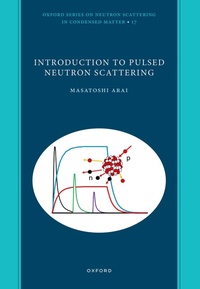
Introduction to Pulsed Neutron Scattering
Will be published approx. on 23. December 2026
Book
Hardback
512 pages
978-0-19-890494-6 (ISBN)
Description
Pulsed spallation neutron sources first came online in the 1980s. This was a new technology and methodology, and it took time to prove its usefulness. Today, pulsed neutron sources are replacing traditional reactor sources across the world. These include ISIS in UK since 1984, SNS in USA since 2006, J-PARC/MLF in Japan since 2008, CSNS in China since 2018, and ESS, which is now under construction in Sweden. The population of pulsed neutron scattering scientists will rapidly increase over the next decade.
The time-of-flight method is commonly used at pulsed sources. It can effectively utilize the polychromatic beam by analysing the time of travel of neutrons, following their production by the impact of a pulse on the neutron target. Accelerator, source, and instruments are coupled together in sequence, and the experimental performance arises from the combination of these components. Different design parameters of the system change the character of an instrument and its experimental performance. Thus, basic knowledge of those components can often help experimental planning, arrangements, and analysis, which can be complex.
Introduction to Pulsed Neutron Scattering offers an accessible and comprehensive overview of the pulsed neutron scattering technique and its associated technology. This is a textbook for students and young scientists who are interested in pulsed neutron scattering. The book covers basic scattering theory, neutron creation, accelerator basics, instrument concepts, and device technologies. Readers can grasp the entire landscape of pulsed neutron science and technology. Concepts are discussed using plain theoretical expressions, so that the reader can understand the analytical background and can confirm theories using their own calculations. The book uses CGS units and A, which are commonly used in the community and are practically useful.
The time-of-flight method is commonly used at pulsed sources. It can effectively utilize the polychromatic beam by analysing the time of travel of neutrons, following their production by the impact of a pulse on the neutron target. Accelerator, source, and instruments are coupled together in sequence, and the experimental performance arises from the combination of these components. Different design parameters of the system change the character of an instrument and its experimental performance. Thus, basic knowledge of those components can often help experimental planning, arrangements, and analysis, which can be complex.
Introduction to Pulsed Neutron Scattering offers an accessible and comprehensive overview of the pulsed neutron scattering technique and its associated technology. This is a textbook for students and young scientists who are interested in pulsed neutron scattering. The book covers basic scattering theory, neutron creation, accelerator basics, instrument concepts, and device technologies. Readers can grasp the entire landscape of pulsed neutron science and technology. Concepts are discussed using plain theoretical expressions, so that the reader can understand the analytical background and can confirm theories using their own calculations. The book uses CGS units and A, which are commonly used in the community and are practically useful.
More details
Series
Language
English
Place of publication
Oxford
United Kingdom
Product notice
sewn/stitched
Cloth over boards
Illustrations
297 b/w and colour images
Dimensions
Height: 246 mm
Width: 171 mm
ISBN-13
978-0-19-890494-6 (9780198904946)
Copyright in bibliographic data and cover images is held by Nielsen Book Services Limited or by the publishers or by their respective licensors: all rights reserved.
Schweitzer Classification
Person
Masatoshi Arai is the Technical Coordinator at the European Spallation Source (ESS) in Lund, Sweden, and Professor Emeritus at the High Energy Accelerator Research Organization (KEK), Japan. He started his career in pulsed neutron scattering in 1978 at Tohoku University in Japan and completed his PhD at the KENS facility at the National Laboratory for High Energy Physics (KEK) between 1980-1983. After post-doctoral work at the IPNS facility in Argonne National Lab, USA, he returned to KEK and started to develop technology for the J-PARC project, which was constructed 2001-2008. Later, he worked at the ISIS Facility, UK, for the UK-Japan Collaboration and at Kobe University as an Associated Professor.