

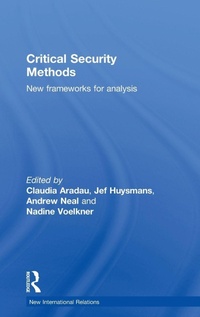
Critical Security Methods
New frameworks for analysis
1st Edition
Published on 15. August 2014
Book
Hardback
230 pages
978-0-415-71294-1 (ISBN)
Description
Critical Security Methods offers a new approach to research methods in critical security studies.
It argues that methods are not simply tools to bridge the gap between security theory and security practice. Rather, to practise methods critically means engaging in a more free and experimental interplay between theory, methods and practice. This recognises that the security practices we research are often methods in their own right, as forms of surveillance, data mining, visualisation, and so on, and that our own research methods are themselves practices that intervene and interfere in those sites of security and insecurity.
Against the familiar methdological language of rigour, detachment and procedural consistency, Critical Security Methods reclaims the idea of method as experiment. The chapters offer a series of methodological experimentations that assemble concepts, theory and empirical cases into new frameworks for critical security research. They show how critical engagement and methodological innovation can be practiced as interventions into diverse instances of insecurity and securitisation, including airports, drug trafficking, peasant struggles, biometrics and police kettling.
The book will be a valuable resource for students and researchers in critical security studies, politics and international relations.
It argues that methods are not simply tools to bridge the gap between security theory and security practice. Rather, to practise methods critically means engaging in a more free and experimental interplay between theory, methods and practice. This recognises that the security practices we research are often methods in their own right, as forms of surveillance, data mining, visualisation, and so on, and that our own research methods are themselves practices that intervene and interfere in those sites of security and insecurity.
Against the familiar methdological language of rigour, detachment and procedural consistency, Critical Security Methods reclaims the idea of method as experiment. The chapters offer a series of methodological experimentations that assemble concepts, theory and empirical cases into new frameworks for critical security research. They show how critical engagement and methodological innovation can be practiced as interventions into diverse instances of insecurity and securitisation, including airports, drug trafficking, peasant struggles, biometrics and police kettling.
The book will be a valuable resource for students and researchers in critical security studies, politics and international relations.
Reviews / Votes
'The contributors to Critical Security Methods show us why talking about methods is engaging. All of us digging into security's myriad manifestations puzzle over what we are doing out there in the mythical "field". Here is a book that joins us in that candid, valuable puzzling.' -- Cynthia Enloe, Clark University, MA, USA'Breaking free from the conventional strictures of methodology, Critical Security Methods offers readers a wonderful panoply of new approaches for thinking about method, methods and methodology.... A generous service to the community of scholars engaged in thinking through the aporias of contemporary security policy.' -- Stefan Elbe, University of Sussex, UK
'Through three distinct moves that complicate rather than separate the relations between theory and method, this book offers a new critical sensibility to questions of method. By providing an analytic framework that attends to methods as practices, experiments and performative, it is not only relevant to CSS but critical methods in the social sciences more generally.' -- Evelyn Ruppert, Goldsmiths College, University of London, UK
More details
Series
Language
English
Place of publication
London
United Kingdom
Publishing group
Taylor & Francis Ltd
Target group
College/higher education
Illustrations
2 s/w Zeichnungen, 1 s/w Tabelle
1 Tables, black and white; 2 Line drawings, black and white
Dimensions
Height: 240 mm
Width: 161 mm
Thickness: 17 mm
Weight
517 gr
ISBN-13
978-0-415-71294-1 (9780415712941)
Copyright in bibliographic data and cover images is held by Nielsen Book Services Limited or by the publishers or by their respective licensors: all rights reserved.
Schweitzer Classification
Other editions
Additional editions
E-Book
08/2014
1st Edition
Routledge
€64.49
Available for download
E-Book
08/2014
1st Edition
Routledge
€64.49
Available for download
Book
07/2014
1st Edition
Routledge
€71.30
Shipment within 15-20 days
Persons
Claudia Aradau is Senior Lecturer in International Relations in the Department of War Studies, King's College London, and is author of Rethinking Trafficking in Women (2008) and co-author, with Rens van Munster, of Politics of Catastrophe: Genealogies of the Unknown (Routledge 2011).
Jef Huysmans is Professor of Security Studies in the Department of Politics and International Studies (POLIS) and Director of the Centre for Citizenship, Identities and Governance at the Open University (UK). He is author of Security Unbound (2014), The Politics of Insecurity (2006) and What is Politics? (2005), and editor of several volumes.
Andrew Neal is Senior Lecturer in Politics & International Relations at the University of Edinburgh, and author of Exceptionalism and the Politics of Counter-Terrorism (Routledge 2010) and co-editor, with Michael Dillon, of Foucault on Politics, Security and War (2008).
Nadine Voelkner is Assistant Professor, Department of International Relations and International Organization (IRIO), University of Groningen.
Jef Huysmans is Professor of Security Studies in the Department of Politics and International Studies (POLIS) and Director of the Centre for Citizenship, Identities and Governance at the Open University (UK). He is author of Security Unbound (2014), The Politics of Insecurity (2006) and What is Politics? (2005), and editor of several volumes.
Andrew Neal is Senior Lecturer in Politics & International Relations at the University of Edinburgh, and author of Exceptionalism and the Politics of Counter-Terrorism (Routledge 2010) and co-editor, with Michael Dillon, of Foucault on Politics, Security and War (2008).
Nadine Voelkner is Assistant Professor, Department of International Relations and International Organization (IRIO), University of Groningen.
Content
1. Introducing Critical Security Methods 2. Mapping 3. Visuality 4. Discourses and Materialities 5. Proximity 6. Genealogy 7. Collaboration