

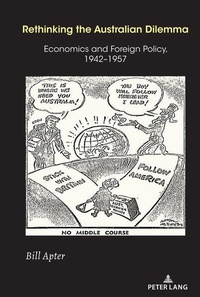
Rethinking the Australian Dilemma
Economics and Foreign Policy, 1942-1957
Published on 29. April 2021
Book
Hardback
292 pages
978-1-4331-8139-9 (ISBN)
Description
This book explains how and why, Australian governments shifted from their historical relationship with Britain to the beginning of a primary reliance on the United States between 1942 and 1957. It shows that, while the Curtin and Chifley ALP governments sought to maintain and strengthen Australia's links with Britain, the Menzies administration took decisive steps towards this realignment.
There is broad acceptance that the end of British Australia only occurred in the 1960s and that the initiative for change came from Britain rather than Australia. This book rejects this consensus, which fundamentally rests on the idea of Australia remaining part of a British World until the UK attempts to join the European Community in the 1960s. Instead, it demonstrates that critical steps ending British Australia occurred in the 1950s and were initiated by Australia. These Australian actions were especially pronounced in the economic sphere, which has been largely overlooked in the current consensus. Australia's understanding of its national self-interest outweighed its sense of Britishness.
Reviews / Votes
"This book by Bill Apter is a major revisionist contribution to the study of Australian foreign policy during a seminal period of its evolution. It thoughtfully engages with past scholarship and offers us a fresh and neglected realistic insight based on careful reading of primary and secondary sources into the evolution of foreign policy in Australia. It is a welcome and nuanced historical study at a time when the study of international relations needs to take history and the archive far more seriously than it has done in recent discussions of foreign policy generally and in Australia in particular. It will have an important impact on the study of international relations in the Asia Pacific."-Dr. David Jones, King's College London and the University of Queensland "Bill Apter's book synthesises historical scholarship on Australia's relationship with Australia and the United States and draws on extensive analysis of primary research in Australia, Britain, and the United States to offer a consistent interpretation of the period from 1941 to the late 1950s. It makes a sustained argument about the primacy of economic considerations in Anglo-Australian relations and the decision to remain with or move away from the British Commonwealth, from before the Second World War to the late 1950s. There is a striking parallel to be drawn between the analysis of Australia's relations with a rising United States and declining Britain in the 1940s and 1950s and Australia's current dilemma in choosing between a rising China and declining United States."-Associate Professor David Lee, University of New South WalesMore details
Series
Edition
New edition
Language
English
Place of publication
New York
United States
Edition type
New edition
Illustrations
13 Illustrations
Dimensions
Height: 231 mm
Width: 155 mm
Thickness: 21 mm
Weight
589 gr
ISBN-13
978-1-4331-8139-9 (9781433181399)
DOI
10.3726/b17510
Schweitzer Classification
Other editions
Additional editions
E-Book
04/2021
1st Edition
Peter Lang Verlag
€103.99
Available for download
E-Book
04/2021
1st Edition
Peter Lang Verlag
€103.99
Available for download
Person
Bill Apter is an independent historian with a PhD from the University of NSW. He was born in England but has lived in Australia for half his life. Prior to completing his PhD, he qualified as a chartered accountant and worked in investment banking and the education sector.
Content
Kinship - Introduction The Anzac Dilemma - The Dependent Dominion: Australia in 1941 - Estrangement - The War Economy - "Australia Looks to America," 1942- 43 - Reconciliation - "Recovering Our Lost Property," 1943- 44 - The Chifley Government: Policy Motivation - Post War Reconstruction and Economic Choices, 1945- 49 - Separation- National Development and the Sterling Bloc, 1951- 52 - Aligning with America, 1952- 57 - Conclusion - Index.