

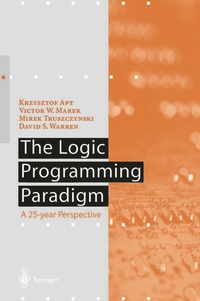
The Logic Programming Paradigm
A 25-Year Perspective
Published on 19. September 2011
Book
Paperback/Softback
XVI, 456 pages
978-3-642-64249-4 (ISBN)
Description
Logic Programming was founded 25 years ago. This exciting new text reveals both the evolution of this programming paradigm since its inception and the impressively broad scope of current research in Logic Programming. The contributions to the book deal with both theoretical and practical issues. They address such diverse topics as: computational molecular biology, machine learning, mobile computing, multi-agent systems, planning, numerical computing and dynamical systems, database systems, an alternative to the "formulas as types" approach, program semantics and analysis, and natural language processing. The contributors are all leading world experts in Logic Programming and their contributions were all invited and refereed.
More details
Series
Edition
Softcover reprint of the original 1st ed. 1999
Language
English
Place of publication
Berlin
Germany
Publishing group
Springer Berlin
Target group
Professional and scholarly
Research
Illustrations
XVI, 456 p.
Dimensions
Height: 235 mm
Width: 155 mm
Thickness: 26 mm
Weight
721 gr
ISBN-13
978-3-642-64249-4 (9783642642494)
DOI
10.1007/978-3-642-60085-2
Schweitzer Classification
Other editions
Additional editions
Krzysztof R. Apt | Victor W. Marek | Mirek Truszczynski
The Logic Programming Paradigm
A 25-Year Perspective
Book
05/1999
1st Edition
Springer
€139.09
Article exhausted; check different version
Content
I. Computing and Programming.- 1 Concurrent and Agent Programming.- Logic Programming and Multi-Agent Systems: A Synergic Combination for Applications and Semantics.- Inference and Computation Mobility with Jinni.- Concurrent Logic/Constraint Programming: The Next 10 Years.- 2 Program Analysis and Methodology.- Formulas as Programs.- Link-time Optimization of Multi-Language Programs.- Horn Logic Denotations and Their Applications.- Global Analysis, Partial Specifications, and Assertions.- 3 Future of Declarative Programming.- Assessment of Some Issues in CL-Theory and Program Development.- How Enterprises Use Functional Languages, and Why They Don't.- Continuous Models of Computation for Logic Programs.- The Logic Programming Paradigm in Numerical Computation.- II. Knowledge Representation and Modeling.- 5 Constraints.- Computational Molecular Biology: A Promising Application Using LP and its Extensions.- Adding Constraints to Logic-based Formalisms.- 6 Machine Learning.- A Perspective on Inductive Logic Programming.- From Deduction to Induction: Logical Perspective.- 7 Answer Set Programming.- Action Languages, Answer Sets, and Planning.- Stable Models and an Alternative Logic Programming Paradigm.- 8 Database Systems.- Logic-Based User-Defined Aggregates for the Next Generation of Database Systems.- 9 Natural Language Processing.- The Logic of Language.