


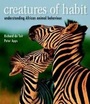
Creatures of Habit
Understanding African Animal Behaviour
Published on 1. March 2001
Book
Hardback
160 pages
978-1-86872-433-8 (ISBN)
Description
The behaviour of mammals is as varied as the niches that they occupy. It is the interface between them and their environment, and between them and other animals -- from the violent struggle of a lion pride pulling down a buffalo, to the delicate precision of a mouse collecting seeds; from the stern glance with which a dominant male baboon displaces a subordinate from a shady resting spot, to the horn clashing battle of kudu bulls fighting for social rank and the access to females that it confers. Some behaviours are universal; others appear only in animals of certain species, only in one of the sexes, or only in animals of a certain age. Yet others are triggered by rare and special circumstances. The mysteries of mammal behaviour are manifold: Why do lions hunt in prides while other cats hunt alone? Why do suricate sentinels risk their lives to watch over their foraging relatives? This book offers answers to these questions and many more. Illustrated in text and photographs that reflect the author's and photographers many years of opportunity and experience.
More details
Language
English
Place of publication
South Africa
Publishing group
Penguin Random House South Africa
Illustrations
190 photographs, index
Dimensions
Height: 266 mm
Width: 266 mm
Weight
1010 gr
ISBN-13
978-1-86872-433-8 (9781868724338)
Copyright in bibliographic data and cover images is held by Nielsen Book Services Limited or by the publishers or by their respective licensors: all rights reserved.
Schweitzer Classification
Other editions
New editions
Book
10/2006
Struik Publishers
€42.27
Article is exhausted; no reprint
Previous edition

Apps
Creatures of Habit
Book
03/2001
Southern Book Publishers
€42.27
Article exhausted; check for reprint
Persons
Peter Apps and Richard du Toit
Content
Introduction - mammals and behaviour; birth and infancy - beginnings and becomings; food and water - the bare necessities; strategies for survival - outwitting the enemy; social life - bonds and boundaries; communication - signalling and sensing; reproduction - closing the cycle.