

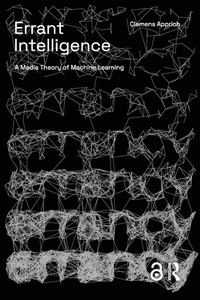
Errant Intelligence
A Media Theory of Machine Learning
1st Edition
Will be published approx. on 8. June 2026
Book
Paperback/Softback
156 pages
978-1-041-17503-2 (ISBN)
Description
Artificial intelligence is often framed as a quest to replicate the human brain, promising frictionless cognition and a future of seamless automation. But what if this pervasive narrative obscures a deeper, more "errant" truth?
Errant Intelligence challenges the prevailing biological and individualistic interpretations of machine learning, arguing instead for a radical understanding of machine intelligence. The book embraces the deviations, inconsistencies, and "errant behaviour" as fundamental to the discovery of new knowledge, moving beyond the illusion of mere optimisation. Drawing on media theory, cybernetics, and a unique psychoanalytic lens, it explores the "technological unconscious" of machine learning. It traces the historical roots of AI, from early automatons and the Turing machine to natural language processing and contemporary machine learning systems. Challenging the idea of an autonomous, self-generating AI, the book exposes the hidden labour, assumed logics, and inherent biases that animate its operation. It re-evaluates computational thinking, insisting on its inherently social, collective, and symbolic character, and revealing how language and logical paradoxes are not obstacles but constitutive forces that shape intelligent machines.
Errant Intelligence offers a vital new framework for understanding the profound co-evolution of human and machine learning. It's time to "unlearn" our assumptions and embrace the productive ambiguity and fallibility at the core of
machine intelligence.
Errant Intelligence challenges the prevailing biological and individualistic interpretations of machine learning, arguing instead for a radical understanding of machine intelligence. The book embraces the deviations, inconsistencies, and "errant behaviour" as fundamental to the discovery of new knowledge, moving beyond the illusion of mere optimisation. Drawing on media theory, cybernetics, and a unique psychoanalytic lens, it explores the "technological unconscious" of machine learning. It traces the historical roots of AI, from early automatons and the Turing machine to natural language processing and contemporary machine learning systems. Challenging the idea of an autonomous, self-generating AI, the book exposes the hidden labour, assumed logics, and inherent biases that animate its operation. It re-evaluates computational thinking, insisting on its inherently social, collective, and symbolic character, and revealing how language and logical paradoxes are not obstacles but constitutive forces that shape intelligent machines.
Errant Intelligence offers a vital new framework for understanding the profound co-evolution of human and machine learning. It's time to "unlearn" our assumptions and embrace the productive ambiguity and fallibility at the core of
machine intelligence.
More details
Series
Language
English
Place of publication
London
United Kingdom
Publishing group
Taylor & Francis Ltd
Target group
Professional and scholarly
Academic
Illustrations
8 s/w Photographien bzw. Rasterbilder, 8 s/w Abbildungen
8 Halftones, black and white; 8 Illustrations, black and white
Dimensions
Height: 234 mm
Width: 156 mm
Weight
310 gr
ISBN-13
978-1-041-17503-2 (9781041175032)
Copyright in bibliographic data and cover images is held by Nielsen Book Services Limited or by the publishers or by their respective licensors: all rights reserved.
Schweitzer Classification
Other editions
Additional editions
E-Book
06/2026
Routledge
€52.49
Available for download
E-Book
06/2026
Routledge
€52.49
Available for download
Book
approx. 06/2026
1st Edition
Amsterdam University Press
€179.50
Not yet published
Person
Clemens Apprich is Professor of Media Theory and History at the University of Applied Arts Vienna, Austria. His current research focuses on computational cultures, particularly machine learning. He is the author of Technotopia: A Media Genealogy of Net Cultures (2017) and co-author of Pattern Discrimination (2019).
Content
Preface
Introduction
Chapter One: Dancing with Machines
Chapter Two: Talking to Machines
Chapter Three: Dreaming of Machines
Chapter Four: Learning from Machines
Conclusion
Bibliography
Index
Introduction
Chapter One: Dancing with Machines
Chapter Two: Talking to Machines
Chapter Three: Dreaming of Machines
Chapter Four: Learning from Machines
Conclusion
Bibliography
Index