

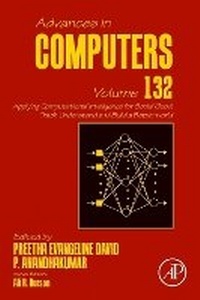
Applying Computational Intelligence for Social Good: Volume 132
Track, Understand and Build a Better world
Academic Press
Published on 17. January 2024
Book
Hardback
503 pages
978-0-323-88544-7 (ISBN)
Description
Applying Computational Intelligence for Social Good: Track, Understand and Build a Better World, Volume 132 presents views on how Computational Intelligent and ICT technologies can be applied to ease or solve social problems by sharing examples of research results from studies of social anxiety, environmental issues, mobility of the disabled, and problems in social safety. Sample chapters in this release include Why is implementing Computational Intelligence for social good so challenging? Principles and its Application, Smart crisis management system for road accidents using Geo-Spacial Machine Learning Techniques, Residential Energy Management System (REMS) Using Machine Learning, Text-Based Personality Prediction using XLNet, and much more.
More details
Series
Language
English
Place of publication
Oxford
United Kingdom
Publishing group
Elsevier Science & Technology
Target group
Professional and scholarly
Dimensions
Height: 229 mm
Width: 152 mm
Weight
450 gr
ISBN-13
978-0-323-88544-7 (9780323885447)
Copyright in bibliographic data and cover images is held by Nielsen Book Services Limited or by the publishers or by their respective licensors: all rights reserved.
Schweitzer Classification
Other editions
Additional editions
Applying Computational Intelligence for Social Good
Track, Understand and Build a Better world
E-Book
01/2024
Academic Press
€130.00
Available for download
Persons
Dr. Preetha Evangeline David is currently working as an Associate Professor and Head of the Department in the Department of Artificial Intelligence and Machine Learning at Chennai Institute of Technology, Chennai, India. She holds a PhD from Anna University, Chennai in the area of Cloud Computing. She has published many research papers and Patents focusing on Artificial Intelligence, Digital Twin Technology, High Performance Computing, Computational Intelligence and Data Structures. She is currently working on Multi-disciplinary areas in collaboration with other technologies to solve socially relevant challenges and provide solutions to human problems. Dr. Anandhakumar is a professor in the Department of Information Technology at Anna University, Chennai. He has completed his doctorate in the year 2006 from Anna University. He has produced 17 PhD's in the field of Image Processing, Cloud Computing, Multimedia technology and Machine Learning. His ongoing research lies in the field of Digital Twin Technology, Machine Learning and Artificial Intelligence. He has published more than 150 papers indexed in SCI, SCOPUS, WOS etc.
Content
1. Why is implementing Computational Intelligence for social good so challenging? Principles and its Application
Preetha Evangeline and Anandhakumar P
2. Smart crisis management system for road accidents using Geo-Spacial Machine Learning Techniques
Cephas Paul Edward
3. Residential Energy Management System (REMS) Using Machine Learning
G Ramya and R Ramaprabha
4. Text-Based Personality Prediction using XLNet
Ashok Kumar Jayaraman and Gayathri Ananthakrishnan
5. Articulating the power of reasoning and gathering data for Information security and Justice
Preetha Evangeline and Anandhakumar P
6. Blockchain Smart Contracts Quality Measurement using Bayesian Networks
Lakshminarayana Kodavali I and K. Sathiyamurthy
7. Short-Term Wind Power Prediction Using Deep Learning Approaches
Anandhakumar P and Alex Luke K.A
8. Cyber Data Trend and Intelligent Computing
Atma Sahu and Preetha Evangeline
9. Demystifying the Edge Intelligence
Pethuru Raj Chelliah Sr. and Preetha Evangeline
10. An Automatic Path Navigation for Visually Challenged People using Deep Q Learning
Muthurajkumar S
11. Delineating Computational Intelligence during Epidemic Emergencies and Outbreaks
Preetha Evangeline and V. Vivek
12. Deep Learning Model for Computation, Calibration and Estimation of Biotic Stress in Crops
Preetha Evangeline and Anandhakumar P
13. Weather Nowcasting Model: A Rough Set Approach
S. Anbarasu and Anandhakumar P
14. Intelligent methodologies for Assessment of Plant exracts as protectants against storage pests
Gowthamy U. and Hemalatha G.
15. Automatic programming (source code generator) based on an ontological model
Preetha Evangeline and Rex Vinod. A
Preetha Evangeline and Anandhakumar P
2. Smart crisis management system for road accidents using Geo-Spacial Machine Learning Techniques
Cephas Paul Edward
3. Residential Energy Management System (REMS) Using Machine Learning
G Ramya and R Ramaprabha
4. Text-Based Personality Prediction using XLNet
Ashok Kumar Jayaraman and Gayathri Ananthakrishnan
5. Articulating the power of reasoning and gathering data for Information security and Justice
Preetha Evangeline and Anandhakumar P
6. Blockchain Smart Contracts Quality Measurement using Bayesian Networks
Lakshminarayana Kodavali I and K. Sathiyamurthy
7. Short-Term Wind Power Prediction Using Deep Learning Approaches
Anandhakumar P and Alex Luke K.A
8. Cyber Data Trend and Intelligent Computing
Atma Sahu and Preetha Evangeline
9. Demystifying the Edge Intelligence
Pethuru Raj Chelliah Sr. and Preetha Evangeline
10. An Automatic Path Navigation for Visually Challenged People using Deep Q Learning
Muthurajkumar S
11. Delineating Computational Intelligence during Epidemic Emergencies and Outbreaks
Preetha Evangeline and V. Vivek
12. Deep Learning Model for Computation, Calibration and Estimation of Biotic Stress in Crops
Preetha Evangeline and Anandhakumar P
13. Weather Nowcasting Model: A Rough Set Approach
S. Anbarasu and Anandhakumar P
14. Intelligent methodologies for Assessment of Plant exracts as protectants against storage pests
Gowthamy U. and Hemalatha G.
15. Automatic programming (source code generator) based on an ontological model
Preetha Evangeline and Rex Vinod. A