

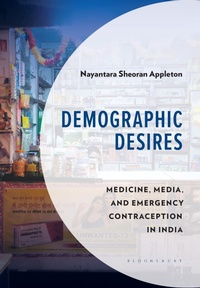
Demographic Desires
Medicine, Media and Emergency Contraception in India
Will be published approx. on 18. February 2027
Book
Paperback/Softback
288 pages
979-8-216-36785-7 (ISBN)
Description
Exploring the intertwined histories of hormonal contraception and population anxiety, in Demographic Desires: Medicine, Media, and Emergency Contraception in India, Appleton shows how historic discourses and practices of 'family planning' remerge as desires of the Indian state and Indian women. In examining the relationship(s) between demographic desires of a nation, reproductive justice on the ground, and women's everyday material conditions, in this book, Appleton posits that under neoliberal regimes of 'empowered consumerism' Emergency Contraceptive Pills (ECPs) introduced as non-prescription pills in 2005 bring histories of demographic control projects and demographic anxieties into the present.
The book highlights nuances of demographic realities which are co-constituted through historical and contemporary narratives, media images, public policy, and medical discourse. Addressing recurring questions about demography, women's reproductive justice, and the visual manifestations of neoliberal aspirations of Indians, this book contributes to conversations that provide an 'alter-narrative' to demographic anxieties. Appleton proposes that demographic desires exist not in opposition to demographic anxiety, but rather as vital adjacent project.
Demographic Desires brings together debates in medical anthropology, media and cultural studies, and a feminist engagement on the medical, scientific, and cultural to showcase the myriad ways emergency contraception in India offers new opportunities for complicating the relationship between contraception, mediated medicine, and demography.
The book highlights nuances of demographic realities which are co-constituted through historical and contemporary narratives, media images, public policy, and medical discourse. Addressing recurring questions about demography, women's reproductive justice, and the visual manifestations of neoliberal aspirations of Indians, this book contributes to conversations that provide an 'alter-narrative' to demographic anxieties. Appleton proposes that demographic desires exist not in opposition to demographic anxiety, but rather as vital adjacent project.
Demographic Desires brings together debates in medical anthropology, media and cultural studies, and a feminist engagement on the medical, scientific, and cultural to showcase the myriad ways emergency contraception in India offers new opportunities for complicating the relationship between contraception, mediated medicine, and demography.
Reviews / Votes
"This timely intervention resets the narrative on demographic unease in the most populous nation on the planet, offering a brilliantly textured introduction to yearning citizens and fantasies conjuring the biopolitical state. A lucid account lifting the veil on desires lurking under demographic anxieties." * Aditya Bharadwaj, Geneva Graduate Institute * "Through the story of the Emergency Contraceptive Pill (ECP) in India, Demographic Desires offers a compelling critique of the troubling intersection between neoliberalism, eugenics, and population control agendas-often entangled with certain strands of feminism. The book serves as a powerful reminder of how states continue to regulate women's bodies, and how reproductive justice remains elusive for women, well into the twenty-first century." * Rachel Simon-Kumar, University of Auckland *More details
Series
Language
English
Place of publication
New York
United States
Publishing group
Bloomsbury Publishing Plc
Target group
Professional and scholarly
Product notice
Paperback (trade)
Unsewn / adhesive bound
Illustrations
8
Dimensions
Height: 229 mm
Width: 152 mm
Thickness: 28 mm
Weight
503 gr
ISBN-13
979-8-216-36785-7 (9798216367857)
Copyright in bibliographic data and cover images is held by Nielsen Book Services Limited or by the publishers or by their respective licensors: all rights reserved.
Schweitzer Classification
Person
Dr. Nayantara Sheoran Appleton is a Senior Lecturer at the interdisciplinary School of Science in Society, Te Herenga Waka | Victoria University of Wellington, Aotearoa New Zealand. Trained as a feminist medical anthropologist and STS Scholar (with a PhD in cultural studies) she has co-edited (w/Bennett) Methods, Moments, and Ethnographic Spaces in Asia (2021) and (w/ Van Hollen) A Companion to the Anthropology of Reproductive Medicine and Technology (2023). Most recently, in light of COVID-19, she has been working collaboratively to research and write over a dozen articles about the experiences withing diverse communities in Aotearoa New Zealand. She is part of a collaboration that has been thinking and writing about COVID-19 since its very start and the collaboration is called CARUL (Care And Responsibility Under Lockdown). She has also individually written about 'the bubble' in NZ as new public health vocabulary and 'looking away' in India as a complex COVID-19 reality.
She has published in leading academic journals (Anthropology and Medicine, American Anthropologist, Economic and Political Weekly, to list but three) and non-academic public facing news platforms (The Hindu, The Wire, The Citizen, again, to just list three). She serves on numerous academic publishing/journal editorial boards, including Science, Technology, and Human Value (STHV). She is also the recipient of the New Zealand Royal Society's Marden Fast Start grant (2023) which is focused on researching the Social Lives of Sex Hormones: Our Hormones, Our Selves in Aotearoa New Zealand.
She has published in leading academic journals (Anthropology and Medicine, American Anthropologist, Economic and Political Weekly, to list but three) and non-academic public facing news platforms (The Hindu, The Wire, The Citizen, again, to just list three). She serves on numerous academic publishing/journal editorial boards, including Science, Technology, and Human Value (STHV). She is also the recipient of the New Zealand Royal Society's Marden Fast Start grant (2023) which is focused on researching the Social Lives of Sex Hormones: Our Hormones, Our Selves in Aotearoa New Zealand.
Content
Acknowledgments
List of Figures
Preface: Population, Polity, and Reproductive Justice in Contemporary India
Section A
The (neo)logics of Demographics, Liberalization, and Malthusianism
Chapter 1 Media, Medicine, and Demographic Desires
Chapter 2 Material Conditions and Social Lives of ECPs
Interlude I: Locations: Physical and Positional
Section B
Demographic Histories: Desiring State, Complicit Medicine
Chapter 3 Temporal Desires: From ' The Emergency' to Emergency Contraception
Chapter 4 Desiring Emergency Contraception: Settling Debates, Creating Markets
Interlude II: Locations: Iron!
Section C
Tracing the Circuit: Regulation, Circulation, Representation, Consumption
Chapter 5 Circulation and Regulations: From Pharmacy Floor to State Policy
Chapter 6 Representation and Consumption: Advertising Images Bleed into the Everyday
Interlude III: Locations: An Ode to Research in India
Section D
Desires Co-opted: Jaghe Kaha Hein/Where is the space?
Chapter 7 Stratified contraception and Overpopulation Narratives
Concluding Thoughts: Population Predictions, Climate Crisis, and Unsettling Demographic Desires
Bibliography
List of Figures
Preface: Population, Polity, and Reproductive Justice in Contemporary India
Section A
The (neo)logics of Demographics, Liberalization, and Malthusianism
Chapter 1 Media, Medicine, and Demographic Desires
Chapter 2 Material Conditions and Social Lives of ECPs
Interlude I: Locations: Physical and Positional
Section B
Demographic Histories: Desiring State, Complicit Medicine
Chapter 3 Temporal Desires: From ' The Emergency' to Emergency Contraception
Chapter 4 Desiring Emergency Contraception: Settling Debates, Creating Markets
Interlude II: Locations: Iron!
Section C
Tracing the Circuit: Regulation, Circulation, Representation, Consumption
Chapter 5 Circulation and Regulations: From Pharmacy Floor to State Policy
Chapter 6 Representation and Consumption: Advertising Images Bleed into the Everyday
Interlude III: Locations: An Ode to Research in India
Section D
Desires Co-opted: Jaghe Kaha Hein/Where is the space?
Chapter 7 Stratified contraception and Overpopulation Narratives
Concluding Thoughts: Population Predictions, Climate Crisis, and Unsettling Demographic Desires
Bibliography