

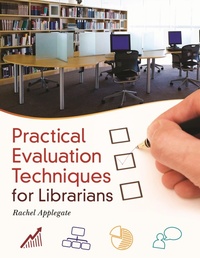
Practical Evaluation Techniques for Librarians
Published on 15. August 2013
Book
Paperback/Softback
244 pages
978-1-61069-159-8 (ISBN)
Description
Evaluation is essential to library management: it provides the data that underlies informed and effective decision-making. This book is a one-volume, how-to guide to library evaluation techniques, planning, and reporting.
Library professionals-regardless of whether they operate in a school, public, or academic library setting-need to have effective evaluation skills in order to be accountable to stakeholders and to effect informed improvement. Practical Evaluation Techniques for Librarians provides information and guidance that is highly useful and accessible for all librarians looking to intelligently manage the strengths and weaknesses of their library as well as communicate its value to its stakeholders.
Rather than focusing on data-gathering methods appropriate for researchers, the book concentrates on data collection at the local level that enables informed managerial decision-making. It describes and compares techniques that can be used with any level or type of resource-staffing, software, and expertise, for example-in any size library. Author Rachel Applegate makes it clear that accountability is everywhere and imperative, and any librarian can learn the simple techniques to benefit from evaluation.
Library professionals-regardless of whether they operate in a school, public, or academic library setting-need to have effective evaluation skills in order to be accountable to stakeholders and to effect informed improvement. Practical Evaluation Techniques for Librarians provides information and guidance that is highly useful and accessible for all librarians looking to intelligently manage the strengths and weaknesses of their library as well as communicate its value to its stakeholders.
Rather than focusing on data-gathering methods appropriate for researchers, the book concentrates on data collection at the local level that enables informed managerial decision-making. It describes and compares techniques that can be used with any level or type of resource-staffing, software, and expertise, for example-in any size library. Author Rachel Applegate makes it clear that accountability is everywhere and imperative, and any librarian can learn the simple techniques to benefit from evaluation.
Reviews / Votes
This insightful manual discusses how to evaluate and assess information using different techniques such as surveys and focus groups. . . . A useful guide for gathering practical information. * School Library Journal * This book can be used as a reference, as a guide, or as a text to help librarians, administrators, and future librarians and administrators evaluate libraries for managerial decision making and research purposes. This book is also of use as a guide for graduate students in library and information science who are seeking to perform evaluation studies on libraries. * ARBA *More details
Language
English
Place of publication
United States
Publishing group
Bloomsbury Publishing Plc
Target group
Professional and scholarly
Dimensions
Height: 280 mm
Width: 216 mm
Thickness: 13 mm
Weight
625 gr
ISBN-13
978-1-61069-159-8 (9781610691598)
Copyright in bibliographic data and cover images is held by Nielsen Book Services Limited or by the publishers or by their respective licensors: all rights reserved.
Schweitzer Classification
Other editions
Additional editions
Rachel Applegate
Practical Evaluation Techniques for Librarians
E-Book
08/2013
1st Edition
Libraries Unlimited Inc
from
€58.29
Available for download
Rachel Applegate
Practical Evaluation Techniques for Librarians
E-Book
08/2013
1st Edition
Libraries Unlimited Inc
€47.49
Available for download
Person
Rachel Applegate, MLS, PhD, is associate professor of library and information science at Indiana University, Indianapolis, IN.
Content
Introduction
Chapter 1: Personal Techniques
Surveys
Interviews
Focus Groups
Usability
Instructional Evaluation
Observation: Tallies
Unobtrusive Observation: Reference Testing
Mystery Shopping
Chapter 2: Impersonal Techniques
List-Checking
Citation Analysis
Collection Mapping
Use Analysis
Availability
Process Evaluation
Transaction Log Analysis
Chapter 3: Technique Selection and Sampling
Decision Factors
Summarizing and Analyzing Data
Using Technology
Using Consultants
Chapter 4: Planning for Evaluation
Library Operations Evaluation Plans (LOEPs)
Chapter 5: Reporting about Evaluation
Targeted Evaluation Reports
Periodic Organizational Reports
Reporting and Organizational Communication
Afterword: How to Handle Numbers
Appendix A: Study Questions Answer Key
Appendix B: Formatting Data
Index
Chapter 1: Personal Techniques
Surveys
Interviews
Focus Groups
Usability
Instructional Evaluation
Observation: Tallies
Unobtrusive Observation: Reference Testing
Mystery Shopping
Chapter 2: Impersonal Techniques
List-Checking
Citation Analysis
Collection Mapping
Use Analysis
Availability
Process Evaluation
Transaction Log Analysis
Chapter 3: Technique Selection and Sampling
Decision Factors
Summarizing and Analyzing Data
Using Technology
Using Consultants
Chapter 4: Planning for Evaluation
Library Operations Evaluation Plans (LOEPs)
Chapter 5: Reporting about Evaluation
Targeted Evaluation Reports
Periodic Organizational Reports
Reporting and Organizational Communication
Afterword: How to Handle Numbers
Appendix A: Study Questions Answer Key
Appendix B: Formatting Data
Index