

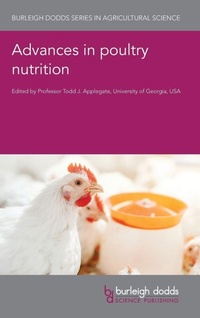
Advances in Poultry Nutrition
Published on 10. September 2024
Book
Hardback
532 pages
978-1-80146-731-5 (ISBN)
Description
"Poultry consumption has increased over the last several years and this trend is expected to continue with the increasing population. With this in mind, the authors of this book have done an excellent job of reviewing current practices in poultry nutrition, evaluating new trends, and discussing how these new trends will impact the poultry industry in the future to meet the increasing demand for poultry meat and eggs. Researchers and nutritionists will find very useful information regarding a variety of topics related to current and future trends in poultry nutrition. Additionally, this book may also be used as supplementary material for poultry science courses." (Book Review Published in the Journal of Applied Poultry Research)
Poultry nutrition faces many challenges, including the need to meet the changing requirements of growing birds whilst also avoiding over-nutrition and nutrient losses which can be both environmentally and economically damaging.** With the sector also facing increasing pressure to reduce its reliance on antibiotics, a greater understanding of the poultry gut, its function and its role in optimising overall bird health is required.
Advances in poultry nutrition provides a detailed overview of the physiology of feed intake in broiler production, focussing on recent advances in nutrient requirements, poultry digestive physiology and the genetic factors which can affect feed conversion efficiency in broilers. The collection also reviews the nutritional value of poultry feed and the range of in vivo and in vitro techniques used to measure factors which can influence its value, such as feed digestibility and metabolizable energy.
Poultry nutrition faces many challenges, including the need to meet the changing requirements of growing birds whilst also avoiding over-nutrition and nutrient losses which can be both environmentally and economically damaging.** With the sector also facing increasing pressure to reduce its reliance on antibiotics, a greater understanding of the poultry gut, its function and its role in optimising overall bird health is required.
Advances in poultry nutrition provides a detailed overview of the physiology of feed intake in broiler production, focussing on recent advances in nutrient requirements, poultry digestive physiology and the genetic factors which can affect feed conversion efficiency in broilers. The collection also reviews the nutritional value of poultry feed and the range of in vivo and in vitro techniques used to measure factors which can influence its value, such as feed digestibility and metabolizable energy.
Reviews / Votes
"Poultry consumption has increased over the last several years and this trend is expected to continue with the increasing population. With this in mind, the authors of this book have done an excellent job of reviewing current practices in poultry nutrition, evaluating new trends, and discussing how these new trends will impact the poultry industry in the future to meet the increasing demand for poultry meat and eggs. Researchers and nutritionists will find very useful information regarding a variety of topics related to current and future trends in poultry nutrition. Additionally, this book may also be used as supplementary material for poultry science courses." (Book Review Published in the Journal of Applied Poultry Research)More details
Series
Language
English
Place of publication
Cambridge
United Kingdom
Target group
College/higher education
Professional and scholarly
University and other researchers in poultry and veterinary science, animal nutritionists, feed manufacturers, advisors consulting poultry farmers on aspects of health and nutrition, as well as government and private sector agencies supporting sustainable poultry production
Product notice
Paper over boards
Illustrations
Color tables, photos and figures
Dimensions
Height: 235 mm
Width: 157 mm
Thickness: 33 mm
Weight
915 gr
ISBN-13
978-1-80146-731-5 (9781801467315)
DOI
10.19103/AS.2024.0143
Copyright in bibliographic data and cover images is held by Nielsen Book Services Limited or by the publishers or by their respective licensors: all rights reserved.
Schweitzer Classification
Other editions
Additional editions
Todd J. Applegate
Advances in poultry nutrition
E-Book
06/2024
Burleigh Dodds Science Publishing
€206.99
Available for download
Person
Dr Todd Applegate is Head of Department and R. Harold and Patsy Harrison Professor of Poultry Science at the University of Georgia, USA. He is a Fellow and former President of the Poultry Science Association (PSA). Amongst other honours, he is a recipient of the PSA's Evonik Degussa Award for Achievement in Poultry Science. Professor Applegate has edited two previous books for Burleigh Dodds Science Publishing: Achieving sustainable production of poultry meat Volume 2: Breeding and nutrition and Achieving sustainable production of poultry meat Volume 3: Health and welfare, both published in 2017.
Gonzalo Gonzalez Mateos is Agricultural Engineer, PhD in Veterinary and in Animal Nutrition. Professor of Animal Production at Universidad Politecnica de Madrid (Spain). He has participated in a total of 170 research projects and published 150 research papers in international scientific journals. He has been involved in over 500 seminars, conferences, communications, and poster presentations at national and international congresses in more than 45 countries. Dr Samuel E. Aggrey is a Richard B. Russell Professor of Genetics, NutriGenomics and Bioinformatics at the University of Georgia, with an international reputation for his work on the genetics of feed utilization efficiency and genome selection in poultry.
Michel Duclos is Research Director (1st class) at INRAE (previously INRA where he led the Avian Research Unit (Unite de Recherches Avicoles) from 2008 to 2016. He is presently Senior Scientist in this unit, now called Avian Biology and Poultry Research (BOA), and is the Vice President of the French branch of the World Poultry Science Association. Dr Guillermo Tellez Isaias worked at the National Autonomous University of Mexico for 16 years and was previously Head of the Avian Medicine Department at the College of Veterinary Medicine. Currently, Dr Tellez is a Research Professor at the Center of Excellence in Poultry Science, University of Arkansas, USA where his research is focused on the advantages of the poultry gastrointestinal model to evaluate the beneficial effects of functional foods to enhance intestinal health and disease resistance. Dr Elisabeth Baeza is a member of the World Poultry Science Association and has contributed more than 130 peer-reviewed research publications to national and international journals. In addition, Dr Baeza has also written four book chapters and is an Associate Editor for several academic journals, including European Poultry Science. Dr Xin Gen Lei is Professor of Molecular Nutrition in the Department of Animal Science at Cornell University, USA. Professor Lei has an international reputation for his wide-ranging research in nutrition as well as algal biomass research. Amongst his many achievements, Professor Lei developed a new phytase enzyme that is now used in 46 countries to improve feed phosphorus bioavailability to animals and reduce their phosphorus excretion. He has won a number of awards from The American Society for Nutrition and the American Society of Animal Science. He is Associate Editor of the Journal of Nutrition as well as President of TEMA (Trace Elements in Man and Animals).
Gonzalo Gonzalez Mateos is Agricultural Engineer, PhD in Veterinary and in Animal Nutrition. Professor of Animal Production at Universidad Politecnica de Madrid (Spain). He has participated in a total of 170 research projects and published 150 research papers in international scientific journals. He has been involved in over 500 seminars, conferences, communications, and poster presentations at national and international congresses in more than 45 countries. Dr Samuel E. Aggrey is a Richard B. Russell Professor of Genetics, NutriGenomics and Bioinformatics at the University of Georgia, with an international reputation for his work on the genetics of feed utilization efficiency and genome selection in poultry.
Michel Duclos is Research Director (1st class) at INRAE (previously INRA where he led the Avian Research Unit (Unite de Recherches Avicoles) from 2008 to 2016. He is presently Senior Scientist in this unit, now called Avian Biology and Poultry Research (BOA), and is the Vice President of the French branch of the World Poultry Science Association. Dr Guillermo Tellez Isaias worked at the National Autonomous University of Mexico for 16 years and was previously Head of the Avian Medicine Department at the College of Veterinary Medicine. Currently, Dr Tellez is a Research Professor at the Center of Excellence in Poultry Science, University of Arkansas, USA where his research is focused on the advantages of the poultry gastrointestinal model to evaluate the beneficial effects of functional foods to enhance intestinal health and disease resistance. Dr Elisabeth Baeza is a member of the World Poultry Science Association and has contributed more than 130 peer-reviewed research publications to national and international journals. In addition, Dr Baeza has also written four book chapters and is an Associate Editor for several academic journals, including European Poultry Science. Dr Xin Gen Lei is Professor of Molecular Nutrition in the Department of Animal Science at Cornell University, USA. Professor Lei has an international reputation for his wide-ranging research in nutrition as well as algal biomass research. Amongst his many achievements, Professor Lei developed a new phytase enzyme that is now used in 46 countries to improve feed phosphorus bioavailability to animals and reduce their phosphorus excretion. He has won a number of awards from The American Society for Nutrition and the American Society of Animal Science. He is Associate Editor of the Journal of Nutrition as well as President of TEMA (Trace Elements in Man and Animals).
Content
Part 1 Physiology of feed intake
1.Nutrient requirements of broilers: an overview of factors affecting feed formulation: Gonzalo G. Mateos, Guillermo Talegon, Lewis Aguirre, Nereida L. Corrales, and Rosa Lazaro, Universidad Politecnica de Madrid, Spain;
2.Advances in understanding poultry digestive anatomy and physiology: Birger Svihus, Norwegian University of Life Sciences, Norway;
3.Digestive kinetics of feedstuffs in broiler chickens: Sonia Yun Liu, Shemil P. Macelline and Peter H. Selle, The University of Sydney, Australia;
4.Advances in understanding poultry feed intake regulation: Jalila S. Dridi, Universite d'Orleans, France; and Sami Dridi, University of Arkansas, USA;
5.Advances in understanding the cellular basis of feed efficiency in poultry muscle: Walter Bottje and Kentu Lassiter, University of Arkansas, USA;
6.Genetic factors affecting feed efficiency in meat-type chickens: Samuel E. Aggrey and Romdhane Rekaya, University of Georgia, USA;
Part 2 Feed formulation
7.Maintaining the safety of poultry feed: G. Raj Murugesan, dsm-firmenich Nutritional Products, Switzerland; and Chasity M. Pender, dsm-firmenich Nutritional Products NA, USA;
8.Poultry feedstuff management and feed formulation utilizing big data: Bob Brill, Brilliant Alternatives Inc., USA; Matthew Clark, FeedGuys Resources Pte Ltd., Malaysia; and Dr Mirza Meghji, Salama Systems Inc., USA;
9.Advances in broiler breeder nutrition: Rick van Emous, Wageningen University, The Netherlands;
Part 3 Individual nutrients/additives
10.Advances in understanding and improving the use of amino acids in poultry nutrition: M. T. Kidd, University of Arkansas, USA; S. Y. Liu and P. Selle, The University of Sydney, Australia;
11.Advances in understanding and improving the use of enzymes in broiler nutrition: Tanner L. Wise, Jung Yeol Sung, and Olayiwola Adeola, Purdue University, USA;
12.Advances in understanding and improving the use of macro-minerals in poultry nutrition: the example of phosphorus: A. Narcy , BOA-INRAE-Universite France; F. Hervo, BOA-INRAEUniversite de Tours, France and Universite Laval, Canada; C. R. Angel, University of Maryland, USA; A. Bonadiman, Universite Laval, Canada; M. Duclos, B. Meda and S. Mignon-Grasteau, BOA-INRAE-Universite de Tours, France; M. Reis, Trouw Nutrition R&D - El Viso de San Juan, Spain; and M. P. Letourneau-Montminy, Universite Laval, Canada;
13.The use of probiotics and prebiotics to improve gut function and immunity in poultry: unlocking the secrets of avian wellness: Guillermo Tellez-Isaias , University of Arkansas, USA; Daniel Hernandez-Patlan and Bruno Solis-Cruz, Universidad Nacional Autonoma de Mexico (UNAM), Mexico; Saeed El-Ashram, Kafrelsheikh University, Egypt; and Ebtsam Al-Olayan, King Saud University, Saudi Arabia;
Part 4 Novel feed sources
14.Emerging protein sources for poultry feed: Archibold G. Bakare, Fiji National University, Fiji Islands; Taiye Olugbemi, Ahmadu Bello University, Nigeria; Mohammed M. Ari, Nasarawa State University, Nigeria; and Paul A. Iji, Fiji National University, Fiji Islands and University of New England, Australia;
15.The use of phytogenics in optimizing gut function and health in poultry: Konstantinos C. Mountzouris and Ioannis Brouklogiannis, Agricultural University of Athens, Greece;
16.Using macroalgae/seaweed and microalgae in poultry feed: Elisabeth Baeza and Cecile Berri, INRAE Nouzilly, France; and Edouard Coudert, Roullier, France;
17.Advances in synthetic biology to improve poultry production: Emile Fierro-Morel, Annika Kirsten Madler, Xin Gen Lei, Cornell University, USA;
18.High protein corn fermentation products for poultry derived from corn ethanol production: Peter E.V. Williams, FluidQuipTechnologies, USA;
1.Nutrient requirements of broilers: an overview of factors affecting feed formulation: Gonzalo G. Mateos, Guillermo Talegon, Lewis Aguirre, Nereida L. Corrales, and Rosa Lazaro, Universidad Politecnica de Madrid, Spain;
2.Advances in understanding poultry digestive anatomy and physiology: Birger Svihus, Norwegian University of Life Sciences, Norway;
3.Digestive kinetics of feedstuffs in broiler chickens: Sonia Yun Liu, Shemil P. Macelline and Peter H. Selle, The University of Sydney, Australia;
4.Advances in understanding poultry feed intake regulation: Jalila S. Dridi, Universite d'Orleans, France; and Sami Dridi, University of Arkansas, USA;
5.Advances in understanding the cellular basis of feed efficiency in poultry muscle: Walter Bottje and Kentu Lassiter, University of Arkansas, USA;
6.Genetic factors affecting feed efficiency in meat-type chickens: Samuel E. Aggrey and Romdhane Rekaya, University of Georgia, USA;
Part 2 Feed formulation
7.Maintaining the safety of poultry feed: G. Raj Murugesan, dsm-firmenich Nutritional Products, Switzerland; and Chasity M. Pender, dsm-firmenich Nutritional Products NA, USA;
8.Poultry feedstuff management and feed formulation utilizing big data: Bob Brill, Brilliant Alternatives Inc., USA; Matthew Clark, FeedGuys Resources Pte Ltd., Malaysia; and Dr Mirza Meghji, Salama Systems Inc., USA;
9.Advances in broiler breeder nutrition: Rick van Emous, Wageningen University, The Netherlands;
Part 3 Individual nutrients/additives
10.Advances in understanding and improving the use of amino acids in poultry nutrition: M. T. Kidd, University of Arkansas, USA; S. Y. Liu and P. Selle, The University of Sydney, Australia;
11.Advances in understanding and improving the use of enzymes in broiler nutrition: Tanner L. Wise, Jung Yeol Sung, and Olayiwola Adeola, Purdue University, USA;
12.Advances in understanding and improving the use of macro-minerals in poultry nutrition: the example of phosphorus: A. Narcy , BOA-INRAE-Universite France; F. Hervo, BOA-INRAEUniversite de Tours, France and Universite Laval, Canada; C. R. Angel, University of Maryland, USA; A. Bonadiman, Universite Laval, Canada; M. Duclos, B. Meda and S. Mignon-Grasteau, BOA-INRAE-Universite de Tours, France; M. Reis, Trouw Nutrition R&D - El Viso de San Juan, Spain; and M. P. Letourneau-Montminy, Universite Laval, Canada;
13.The use of probiotics and prebiotics to improve gut function and immunity in poultry: unlocking the secrets of avian wellness: Guillermo Tellez-Isaias , University of Arkansas, USA; Daniel Hernandez-Patlan and Bruno Solis-Cruz, Universidad Nacional Autonoma de Mexico (UNAM), Mexico; Saeed El-Ashram, Kafrelsheikh University, Egypt; and Ebtsam Al-Olayan, King Saud University, Saudi Arabia;
Part 4 Novel feed sources
14.Emerging protein sources for poultry feed: Archibold G. Bakare, Fiji National University, Fiji Islands; Taiye Olugbemi, Ahmadu Bello University, Nigeria; Mohammed M. Ari, Nasarawa State University, Nigeria; and Paul A. Iji, Fiji National University, Fiji Islands and University of New England, Australia;
15.The use of phytogenics in optimizing gut function and health in poultry: Konstantinos C. Mountzouris and Ioannis Brouklogiannis, Agricultural University of Athens, Greece;
16.Using macroalgae/seaweed and microalgae in poultry feed: Elisabeth Baeza and Cecile Berri, INRAE Nouzilly, France; and Edouard Coudert, Roullier, France;
17.Advances in synthetic biology to improve poultry production: Emile Fierro-Morel, Annika Kirsten Madler, Xin Gen Lei, Cornell University, USA;
18.High protein corn fermentation products for poultry derived from corn ethanol production: Peter E.V. Williams, FluidQuipTechnologies, USA;