

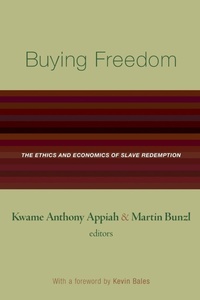
Buying Freedom
The Ethics and Economics of Slave Redemption
Will be published approx. on 22. July 2007
Book
Paperback/Softback
280 pages
978-0-691-13010-1 (ISBN)
Description
If "slavery" is defined broadly to include bonded child labor and forced prostitution, there are upward of 25 million slaves in the world today. Individuals and groups are freeing some slaves by buying them from their enslavers. But slave redemption is as controversial today as it was in pre-Civil War America. In Buying Freedom, Kwame Anthony Appiah and Martin Bunzl bring together economists, anthropologists, historians, and philosophers for the first comprehensive examination of the practical and ethical implications of slave redemption. While recognizing the obvious virtue of the desire to buy the freedom of slaves, the contributors ask difficult and troubling questions: Does redeeming slaves actually increase the demand for--and so the number of--slaves? And what about cases where it is far from clear that redemption will improve the material condition, or increase the real freedom, of a slave?
Buying Freedom includes essays by the editors and by Dean Karlan and Alan Krueger, Carol Ann Rogers and Kenneth Swinnerton, Arnab Basu and Nancy Chau, Stanley Engerman, Jonathan Conning and Michael Kevane, Jok Madut Jok, Ann McDougall, Lisa Cook, Margaret Kellow, John Stauffer, and Howard McGary.
Buying Freedom includes essays by the editors and by Dean Karlan and Alan Krueger, Carol Ann Rogers and Kenneth Swinnerton, Arnab Basu and Nancy Chau, Stanley Engerman, Jonathan Conning and Michael Kevane, Jok Madut Jok, Ann McDougall, Lisa Cook, Margaret Kellow, John Stauffer, and Howard McGary.
Reviews / Votes
"Slavery? In the modern world? Many readers will be shocked to read that human beings are still owned, bought, and sold. Editors Appiah and Bunzl present a series of essays documenting current slavery issues in a broad context as well as providing a historic context, analyzing some changes that have occurred in slave-based industries from the late 1700s to the present."--D. E. Mattson, Choice "Buying Freedom is an instructive volume on the question whether slave redemption makes sense or not. The contributions cover the most varied methodological approaches, which is certainly an asset of the book."--Paul Ramskogler, Journal of Economic IssuesMore details
Language
English
Place of publication
New Jersey
United States
Target group
Professional and scholarly
College/higher education
Product notice
Paperback (trade)
Illustrations
8 line illus. 22 tables.
Dimensions
Height: 234 mm
Width: 156 mm
Thickness: 16 mm
Weight
453 gr
ISBN-13
978-0-691-13010-1 (9780691130101)
Copyright in bibliographic data and cover images is held by Nielsen Book Services Limited or by the publishers or by their respective licensors: all rights reserved.
Schweitzer Classification
Other editions
Additional editions
E-Book
11/2018
1st Edition
Princeton University Press
€35.99
Available for download
Book
07/2007
Princeton University Press
€76.88
Article exhausted; check different version
Persons
Kwame Anthony Appiah is the Laurance S. Rockefeller University Professor of Philosophy at Princeton University. His books include "Cosmopolitanism" (Norton). Martin Bunzl is professor of philosophy at Rutgers University and the author of "Real History: Reflections on Historical Practice".
Content
Foreword by Kevin Bales vii Introduction by Kwame Anthony Appiah and Martin Bunzl 1 PART I: THE ECONOMICS OF REDEMPTION 7 Chapter 1: Some Simple Analytics of Slave Redemption by Dean S. Karlan and Alan B. Krueger 9 Chapter 2: Slave Redemption When It Takes Time to Redeem Slaves by Carol Ann Rogers and Kenneth A. Swinnerton 20 Chapter 3: An Exploration of the Worst Forms of Child Labor: Is Redemption a Viable Option? by Arnab K. Basu and Nancy H. Chau 37 Chapter 4: Slavery, Freedom, and Sen by Stanley Engerman 77 Chapter 5: Freedom, Servitude, and Voluntary Contracts by Jonathan Conning and Michael Kevane 108 PART II: ANTHROPOLOGICAL CONSIDERATIONS 141 Chapter 6: Slavery and Slave Redemption in the Sudan by Jok Madut Jok 143 Chapter 7: Dilemmas in the Practice of Rachat in French West Africa by E. Ann McDougall 158 PART III: HISTORICAL CONSIDERATIONS 179 Chapter 8: The End of Serfdom in Russia-Lessons for Sudan? by Lisa D. Cook 181 Chapter 9: Conflicting Imperatives: Black and White American Abolitionists Debate Slave Redemption by Margaret M. R. Kellow 200 Chapter 10: Frederick Douglass and the Politics of Slave Redemptions by John Stauffer 213 PART IV: PHILOSOPHICAL CONSIDERATIONS 223 Chapter 11: The Moral Quandary of Slave Redemption by Howard McGary 225 Chapter 12: The Next Best Thing by Martin Bunzl 235 Chapter 13: What's Wrong with Slavery? by Kwame Anthony Appiah 249 Appendix: "They Call Us Animals," Testimonies of Abductees and Slaves in Sudan by Jok Madut Jok 259 List of Contributors 269 Index 271