

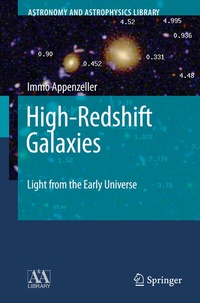
High-Redshift Galaxies
Light from the Early Universe
Published on 9. July 2009
Book
Hardback
XIV, 352 pages
978-3-540-75823-5 (ISBN)
Description
The high-redshift galaxies became a distinct research ?eld during the ?nal decade of the20thcentury. AtthattimetheLyman-breaktechniquemadeitpossibletoidentify signi?cant samples of such objects, and the new generation of 8 to 10-m telescopes resulted in ?rst good spectroscopic data. Today the high-redshift galaxies have developed into one of the important topics of astrophysics, accounting for about 5-10% of the publications in the major scienti?c journals devoted to astronomy. Because high-redshift galaxies is a rapidly developing ?eld and since new results are published constantly, writing a book on this topic is challenging. On the other hand, in view of the large amount of individual results now in the literature, and in view of the still growing interest in this topic, it appears worthwhile to summarize and evaluate the available data and to provide an introduction for those who wish to enter this ?eld, or who, for various reasons, might be interested in its results. The end of the ?rst decade of the 21st century appears to be a good point in time to attempt such a summary. The current generation of ground-based 8 to 10-m - optical telescopes, the Hubble Space Telescope, and the most important large radio telescopes have by now been in operation since about one or two decades. Although these instruments will continue to produce important scienti?c results for some time to come, many of the initial programs exploiting their unique new possibilities have been completed.
Reviews / Votes
From the reviews: "This ambitious book aims to summarize our view of high-redshift galaxies and their contents. . He describes how to find high-redshift objects, how to characterize them, how to deal with selection effects, and so on. . Appenzeller has done a fine job in summarizing the study of high-redshift galaxies and this will act as an excellent introduction to the subject for students and researchers." (Paul O'Brien, The Observatory, Vol. 130 (1214), February, 2010)More details
Series
Edition
2009 ed.
Language
English
Place of publication
Berlin
Germany
Publishing group
Springer Berlin
Target group
Professional and scholarly
Research
Illustrations
XIV, 352 p.
Dimensions
Height: 23.5 cm
Width: 15.5 cm
Weight
738 gr
ISBN-13
978-3-540-75823-5 (9783540758235)
DOI
10.1007/978-3-540-75824-2
Schweitzer Classification
Other editions
Additional editions
Book
08/2016
Springer
€117.69
Shipment within 7-9 days
E-Book
06/2009
Springer
€96.29
Available for download
Person
Prof. Immo Appenzeller is the emeritus director of the Heidelberg Observatory (Landessternwarte Heidelberg). From 1994 - 1997 he served as General Secretary of the International Astronomical Union. He was PI or CO of various large national and international instrumentation and research projects. His current main research topics are very distant (young) galaxies, active galaxies and QSOs, massive luminous stars, cosmic X-ray sources, astronomical instrumentation.
Content
I The Context.- The Nearby Universe.- The Past and the Future.- II Methods and Tools.- Basic Techniques and their Limitations.- Finding Very Distant Galaxies.- Deriving Physical Parameters.- III Observational Results and their Interpretation.- Observed Properties of High-redshift Galaxies.- The Space Distribution of High-redshift Galaxies.- Interactions with the Intergalactic Medium.- Implications.- IV An Outlook to the Future.- Ongoing Work.- Future Facilities and their Opportunities.