

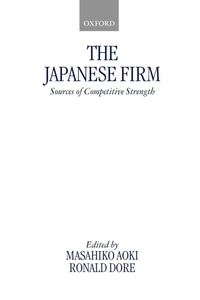
The Japanese Firm
The Sources of Competitive Strength
Published on 5. September 1996
Book
Paperback/Softback
424 pages
978-0-19-829215-9 (ISBN)
Description
Masahiko Aoki and Ronald Dore have edited an authoritative account of the Japanese firm and the sources of its success, including contributions from some of the best, and best known, scholars in the field.
The book represents an attempt to explain and understand aspects of the firm in the Japanese economic system, and to explain the corporate success of Japan. It is interdisciplinary in approach, containing both theoretical and empirical work, and has contributions from the fields of labour economics, comparative institutional analysis, information economics, finance, organizational theory, economic history, political science, and sociology.
Chapters range from contemporary descriptions--of training (in overseas subsidiaries as well as Japan), of R&D structures, of product development practices, of finance and corporate governance, of trading relations, especially between small and large firms--to an historical overview of the evolution of Japanese management in the wartime planned economy. The book also situates Japan in the literature of economic analysis and in the on-going debate about trade-offs between equality and efficiency.
The contemporary media would have us believe that the Japanese system of management--characterized by lifetime employment, emphasis on long-term, slow consensual decision-making, heavy investments in training, R&D, and quality, close inter-enterprise ties, and short rations for shareholders--is in crisis and about to change fundamentally. This book will enable the reader to decide just how solid the foundations of the Japanese enterprise system are, and to identify the rationale that lies behind it.
The book represents an attempt to explain and understand aspects of the firm in the Japanese economic system, and to explain the corporate success of Japan. It is interdisciplinary in approach, containing both theoretical and empirical work, and has contributions from the fields of labour economics, comparative institutional analysis, information economics, finance, organizational theory, economic history, political science, and sociology.
Chapters range from contemporary descriptions--of training (in overseas subsidiaries as well as Japan), of R&D structures, of product development practices, of finance and corporate governance, of trading relations, especially between small and large firms--to an historical overview of the evolution of Japanese management in the wartime planned economy. The book also situates Japan in the literature of economic analysis and in the on-going debate about trade-offs between equality and efficiency.
The contemporary media would have us believe that the Japanese system of management--characterized by lifetime employment, emphasis on long-term, slow consensual decision-making, heavy investments in training, R&D, and quality, close inter-enterprise ties, and short rations for shareholders--is in crisis and about to change fundamentally. This book will enable the reader to decide just how solid the foundations of the Japanese enterprise system are, and to identify the rationale that lies behind it.
Reviews / Votes
This is an excellent collection of papers for which the authors, the editors and the conference organizers should be congratulated. I found valuable insights in almost every chapter, and the whole was even better than the sum of its parts. One point that was brought out by a number of authors was what the editors referred to in their introduction as `systemic awareness' - that specific attributes of the Japanese firm should not be considered in isolation, as they are all interrelated elements of a broader system. This book brings together many of these elements, and provides the reader with that vital systemic awareness. * Asia Pacific Business Review * Many of the papers reflect the use of the new institutional economies to explain the nature of the Japanese firm and the sources of its competitive strength. They also display a laudable attempt to show the dependency between institutions, something which is important, but difficult, to do ... The papers are not only theoretical and empirical studies of the Japanese case, they also often contain a comparative aspect ... the account of the Japanese firm under the wartime planned economy given by Tetsuji Okazaki is fascinating ... higly informative and expertly combines modern approaches to the theory of the firm with empirical studies of a diverse range. I recommend this volume for those interested in the firm, the Japanese firm, and the skilful application of theories of the firm. The papers will undoubtedly enhance people's knowledge of the Japanese economy, but also stimulate new avenues of enquiry. * Japan Forum * This is an excellent collection of papers for which the authors, the editors and the conference organizers should be congratulated. I found valuable insights in almost every chapter, and the whole was even better than the sum of its parts. * Asia Pacific Business Review * 'all of the essays are to be highly recommended.' * Business History * Fourteen useful papers that attempt to improve our understanding of the role of the firm in the Japanese economic system, as well as explain the corporate success of Japan. I hoipe we will not be required to wait too long for a similar volume that examines the traumas of the past five years. - Long Range Planning. April 1998.More details
Language
English
Place of publication
Oxford
United Kingdom
Target group
College/higher education
Professional and scholarly
Illustrations
line figures, tables
Dimensions
Height: 234 mm
Width: 156 mm
Thickness: 23 mm
Weight
641 gr
ISBN-13
978-0-19-829215-9 (9780198292159)
Copyright in bibliographic data and cover images is held by Nielsen Book Services Limited or by the publishers or by their respective licensors: all rights reserved.
Schweitzer Classification
Other editions
Additional editions
Book
05/1994
Clarendon Press
€48.88
Shipment within 15-20 days
Persons
Content
The Japanese firm as a system of attributes, Aoki; learning and incentive systems in Japanese industry, Koike; different quality paradigms and their implications for organizational learning, Cole; training, productivity and quality control in Japanese multinational companies, Sako; co-ordination between production and distribution in a globalizing network of firms, Asanuma; the evolution of Japan's industrial research and development, Westney; R&D organization in Japanese and American semi-condutor firms, Okimoto and Nishi; SME's, entry barriers, and "strategic alliances", Whittaker; Japanese human resource management for the viewpoint of incentive theory, Itoh; co-ordination, specialization, and incentives in product development organization, Itoh; the economic role of corporate grouping and the main bank system, Hoshi; interlocking shareholdings and corporate governance in Japan; the Japanese firm under the wartime planned economy, Okazaki; equality-efficiency trade-offs - Japanese perceptions and choices, Dore