

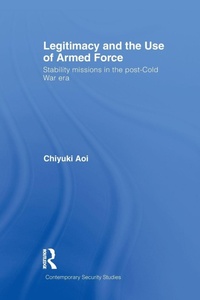
Legitimacy and the Use of Armed Force
Stability Missions in the Post-Cold War Era
1st Edition
Published on 15. December 2011
Book
Paperback/Softback
304 pages
978-0-415-51003-5 (ISBN)
Description
This book examines the concept of legitimacy as it may be used to explain the success, or failure, of key stability operations since the end of the Cold War.
In the success of stability operations, legitimacy is key. In order to achieve success, the intervening force must create a sense of legitimacy of the mission among the various constituencies concerned with and involved in the venture. These parties include the people of the host nation, the host government (whose relations with the local people must be legitimate), political elites and the general public worldwide-including the intervening parties' own domestic constituencies, who will sustain (or not sustain) the intervention by offering (or withdrawing) support. This book seeks to bring into close scrutiny the legitimacy of stability interventions in the post-Cold War era, by proposing a concept that captures both the multi-faceted nature of legitimacy and the process of legitimation that takes place in each case. Case studies on Liberia, Bosnia, Somalia, Rwanda, Afghanistan and Iraq explain how legitimacy related to the outcome of these operations.
This book will be of much interest to students of stability operations, counterinsurgency, peace operations, humanitarian intervention, and IR/security studies in general.
In the success of stability operations, legitimacy is key. In order to achieve success, the intervening force must create a sense of legitimacy of the mission among the various constituencies concerned with and involved in the venture. These parties include the people of the host nation, the host government (whose relations with the local people must be legitimate), political elites and the general public worldwide-including the intervening parties' own domestic constituencies, who will sustain (or not sustain) the intervention by offering (or withdrawing) support. This book seeks to bring into close scrutiny the legitimacy of stability interventions in the post-Cold War era, by proposing a concept that captures both the multi-faceted nature of legitimacy and the process of legitimation that takes place in each case. Case studies on Liberia, Bosnia, Somalia, Rwanda, Afghanistan and Iraq explain how legitimacy related to the outcome of these operations.
This book will be of much interest to students of stability operations, counterinsurgency, peace operations, humanitarian intervention, and IR/security studies in general.
More details
Series
Language
English
Place of publication
London
United Kingdom
Publishing group
Taylor & Francis Ltd
Target group
College/higher education
Professional and scholarly
Postgraduate, Professional, and Undergraduate
Dimensions
Height: 234 mm
Width: 156 mm
Thickness: 16 mm
Weight
465 gr
ISBN-13
978-0-415-51003-5 (9780415510035)
Copyright in bibliographic data and cover images is held by Nielsen Book Services Limited or by the publishers or by their respective licensors: all rights reserved.
Schweitzer Classification
Other editions
Additional editions
E-Book
10/2010
Routledge
€64.49
Available for download
E-Book
10/2010
Routledge
€64.49
Available for download
Book
09/2010
1st Edition
Routledge
€232.10
Shipment within 15-20 days
Person
Chiyuki Aoi is Associate Professor of International Politics at Aoyama Gakuin University, Tokyo. She has a PhD in Political Science from Columbia University.
Content
1. Legitimacy in Stability Operations 2. Liberia: Creating Peace in Africa 3. Bosnia-Herzegovina: From Peace Support to Coercive Diplomacy 4. Somalia: From Peace Enforcement to Disengagement 5. Rwanda: Failure to Stop Genocide 6. Iraq: From Preemption to Counterinsurgency 7. Iraq: Transformation Failure and Intervention Performance 8. Iraq: Non-Support of Preemptive War 9. Afghanistan: From Self-Defence to State-Building 10. Afghanistan: Stabilisation and Counterinsurgency Performance 11. Afghanistan: From Adequate to Dwindling Support 12. Legitimacy and the Conditions of Success