

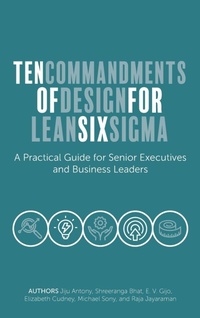
Ten Commandments of Design for Lean Six Sigma
A Practical Guide for Senior Executives and Business Leaders
Published on 13. May 2026
Book
Hardback
280 pages
978-1-83753-533-0 (ISBN)
Description
Design for Lean Six Sigma (DFLSS) is a powerful methodology adopted by many world-class companies today. It aims to build quality into products or services at the very early stages of the product development process. Ten Commandments of Design for Lean Six Sigma brings together the experience of six authors with more than 50 years of cumulative DFLSS deployment in the field.
The book covers key topics such as alignment of DFLSS with organizational strategy; top management support and involvement; listening to the voice of the customers (VOC); effective training programme for right project teams; project selection and prioritization; linking DFLSS with ISO international standards; effective use of DFLSS methodology and the integrated tools within the methodology and reward and recognition schemes.
The practical nature of the book makes this ideal reading for senior executives in all organizations with an interest in developing, implementing, and deploying DFLSS. It will be a great asset to many trainers and consultants who would like to deliver executive courses for senior managers in any organisation.
The book covers key topics such as alignment of DFLSS with organizational strategy; top management support and involvement; listening to the voice of the customers (VOC); effective training programme for right project teams; project selection and prioritization; linking DFLSS with ISO international standards; effective use of DFLSS methodology and the integrated tools within the methodology and reward and recognition schemes.
The practical nature of the book makes this ideal reading for senior executives in all organizations with an interest in developing, implementing, and deploying DFLSS. It will be a great asset to many trainers and consultants who would like to deliver executive courses for senior managers in any organisation.
Reviews / Votes
A must-read for anyone serious about designing processes aligned with strategic goals of the business - from top management through developers and process engineers. -- Prof. Dr. Ronald J.M.M. Does, Amsterdam Business School, University of AmsterdamMore details
Language
English
Place of publication
Bingley
United Kingdom
Target group
Professional and scholarly
Dimensions
Height: 235 mm
Width: 157 mm
Thickness: 20 mm
Weight
560 gr
ISBN-13
978-1-83753-533-0 (9781837535330)
Copyright in bibliographic data and cover images is held by Nielsen Book Services Limited or by the publishers or by their respective licensors: all rights reserved.
Schweitzer Classification
Persons
Jiju Antony is a Professor of Newcastle Business School of Northumbria University, UK.
Shreeranga Bhat is a Professor at the Department of Mechanical Engineering of St Joseph Engineering College, India.
Gijo E V is a Professor of SQC and OR Unit, Indian Statistical Institute, India.
Elizabeth Cudney is a Professor at Maryville University, USA.
Michael Sony is a faculty member in the Oxford Brookes Business School, UK.
Raja Jayaraman is an Associate Professor at the Department of Industrial Engineering of New Mexico State University, USA.
Shreeranga Bhat is a Professor at the Department of Mechanical Engineering of St Joseph Engineering College, India.
Gijo E V is a Professor of SQC and OR Unit, Indian Statistical Institute, India.
Elizabeth Cudney is a Professor at Maryville University, USA.
Michael Sony is a faculty member in the Oxford Brookes Business School, UK.
Raja Jayaraman is an Associate Professor at the Department of Industrial Engineering of New Mexico State University, USA.
Content
Chapter 1. Introduction to Design for Lean Six Sigma and Ten Commandments
Chapter 2. Alignment of DFLSS with Organisational Strategy
Chapter 3. Top Management Support and Involvement in DFLSS
Chapter 4. Listening to the Voice of the Customers (VOC)
Chapter 5. Effective Training Program for DFLSS and Selecting the Right Project Teams for Successful Execution of Projects
Chapter 6. DFLSS Project Selection, Prioritisation, and Execution of Projects
Chapter 7. Linking DFLSS with ISO Standards such as ISO 9001, ISO 14000, and ISO 26000
Chapter 8. Linking DFLSS with Organisational Learning and Innovation
Chapter 9. Linking DFLSS with the 4th Industrial Revolution Data-based Technologies
Chapter 10. Use of DFLSS Methodology and the Integrated Tools within the Methodology
Chapter 11. Reward and Recognition Schemes for Sustaining the DFLSS Initiative
Chapter 12. Leadership for Design for Lean Six Sigma
Chapter 2. Alignment of DFLSS with Organisational Strategy
Chapter 3. Top Management Support and Involvement in DFLSS
Chapter 4. Listening to the Voice of the Customers (VOC)
Chapter 5. Effective Training Program for DFLSS and Selecting the Right Project Teams for Successful Execution of Projects
Chapter 6. DFLSS Project Selection, Prioritisation, and Execution of Projects
Chapter 7. Linking DFLSS with ISO Standards such as ISO 9001, ISO 14000, and ISO 26000
Chapter 8. Linking DFLSS with Organisational Learning and Innovation
Chapter 9. Linking DFLSS with the 4th Industrial Revolution Data-based Technologies
Chapter 10. Use of DFLSS Methodology and the Integrated Tools within the Methodology
Chapter 11. Reward and Recognition Schemes for Sustaining the DFLSS Initiative
Chapter 12. Leadership for Design for Lean Six Sigma