

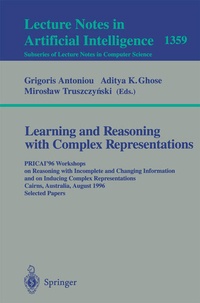
Learning and Reasoning with Complex Representations
PRICAI'96 Workshops on Reasoning with Incomplete and Changing Information and on Inducing Complex Representations Cairns, Australia, August 26-30, 1996, Selected Papers
Published on 15. April 1998
Book
Paperback/Softback
XII, 288 pages
978-3-540-64413-2 (ISBN)
Description
This book constitutes the thoroughly revised and refereed post-workshop documentation of two international workshops held in conjunction with the Pacific Rim International Conference on Artificial Intelligence, PRICAI'96, in Cairns, Australia, in August 1996.
The volume presents 14 revised full papers togehter with two invited contributions and two introductory surveys particularly commissioned for this book. Among the topics addressed are computational learning, commonsense reasoning, constraint logic programming, fuzzy reasoning, vague data, inductive inference, belief revision, action theory, uncertainty, and probabilistic diagnosis.
The volume presents 14 revised full papers togehter with two invited contributions and two introductory surveys particularly commissioned for this book. Among the topics addressed are computational learning, commonsense reasoning, constraint logic programming, fuzzy reasoning, vague data, inductive inference, belief revision, action theory, uncertainty, and probabilistic diagnosis.
More details
Series
Edition
1998 ed.
Language
English
Place of publication
Berlin
Germany
Publishing group
Springer Berlin
Target group
Professional and scholarly
Professional/practitioner
Illustrations
XII, 288 p.
Dimensions
Height: 235 mm
Width: 155 mm
Thickness: 17 mm
Weight
458 gr
ISBN-13
978-3-540-64413-2 (9783540644132)
DOI
10.1007/3-540-64413-X
Schweitzer Classification
Content
Inductive constraint logic programming: An overview.- Some approaches to reasoning with incomplete and changing information.- Curried least general generalization: A framework for higher order concept learning.- Approximate validity.- Inductive theories from equational systems.- The role of default representations in incremental learning.- Learning stable concepts in a changing world.- Inducing complex spatial descriptions in two dimensional scenes.- A framework for learning constraints: Preliminary report.- Induction of constraint logic programs.- Belief network algorithms: A study of performance based on domain characterisation.- A Group Decision and Negotiation Support System for argumentation based reasoning.- From belief revision to design revision: Applying theory change to changing requirements.- Using histories to model observations in theories of action.- Modelling inertia in action languages.- Combinatorial interpretation of uncertainty and conditioning.- Probabilistic diagnosis as an update problem.- Cooperative combination of default logic and autoepistemic logic.