

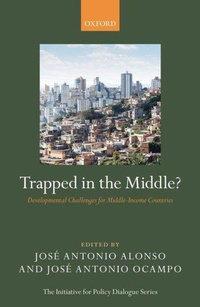
Trapped in the Middle?
Developmental Challenges for Middle-Income Countries
Published on 22. October 2020
Book
Hardback
366 pages
978-0-19-885277-3 (ISBN)
Description
There is growing evidence that overcoming the low-income threshold and reaching middle-income status is not sufficient for countries to converge toward high-income levels. Few middle-income countries have successfully completed that transit in recent decades, with the majority remaining in the middle-income group, and so facing what has come to be called "the middle-income trap". It is therefore essential to explore whether middle-income traps really exist and, if they do, how these pitfalls are manifested, what their causes are, what economic policy measures are required to escape from them, and what international cooperation can do to support this process. Trapped in the Middle? brings together diverse perspectives on these important questions, providing new evidence and analytical approaches to enrich the debate on the domestic and international challenges faced by a significant number of middle-income countries, in which over three-quarters of the global population live.
More details
Series
Language
English
Place of publication
Oxford
United Kingdom
Target group
Professional and scholarly
Product notice
sewn/stitched
Cloth over boards
Dimensions
Height: 236 mm
Width: 161 mm
Thickness: 26 mm
Weight
666 gr
ISBN-13
978-0-19-885277-3 (9780198852773)
Copyright in bibliographic data and cover images is held by Nielsen Book Services Limited or by the publishers or by their respective licensors: all rights reserved.
Schweitzer Classification
Other editions
Additional editions
José Antonio Alonso | José Antonio Ocampo
Trapped in the Middle?
Developmental Challenges for Middle-Income Countries
E-Book
10/2020
1st Edition
OUP eBook
€117.99
Available for download
José Antonio Alonso | José Antonio Ocampo
Trapped in the Middle?
Developmental Challenges for Middle-Income Countries
E-Book
10/2020
1st Edition
OUP eBook
€117.99
Available for download
Persons
Jose Antonio Alonso is Professor of Applied Economics at the Universidad Complutense de Madrid. Previously, he was Adjunct Professor at the Columbia University (SIPA), General Director of Economic Cooperation at the Instituto de Cooperacion Iberoamericana, vice-chancellor at Universidad Internacional Menendez Pelayo, and director of the Instituto Complutense de Estudios Internacionales (ICEI). He was member of the High-Level Group of Wise Persons on the European Financial Architecture for Development (2019), member of the Committee for Development Policy (UN ECOSOC) from 2007 to 2018, and member of the European Advisory Group of the Bill and Melinda Gates Foundation from 2012 to 2014. He is a member of the Consejo de Cooperacion para el Desarrollo (Spain). His has published research on growth and development, international economic relations, and financing for development.
Jose Antonio Ocampo is Professor at the School of International and Public Affairs, Member of the Committee on Global Thought, and Co-President of the Initiative for Policy Dialogue at Columbia University. He is also the Chair of the Committee for Development Policy, an expert committee of the United Nations Economic and Social Council (ECOSOC). Ocampo has previously served in a number of positions in the United Nations and the Government of Colombia. most notably as United Nations Under-Secretary General for Economic and Social Affairs. He has published extensively on macroeconomic theory and policy, international financial issues, economic and social development, international trade, and Colombia and Latin American economic history.
Jose Antonio Ocampo is Professor at the School of International and Public Affairs, Member of the Committee on Global Thought, and Co-President of the Initiative for Policy Dialogue at Columbia University. He is also the Chair of the Committee for Development Policy, an expert committee of the United Nations Economic and Social Council (ECOSOC). Ocampo has previously served in a number of positions in the United Nations and the Government of Colombia. most notably as United Nations Under-Secretary General for Economic and Social Affairs. He has published extensively on macroeconomic theory and policy, international financial issues, economic and social development, international trade, and Colombia and Latin American economic history.
Content
1: Jose Antonio Alonso and Jose Antonio Ocampo: Economic traps and progress in Middle-Income Countries: An Introduction
2: Homi Kharas and Indermit Gill: Growth strategies to avoid the Middle-Income Traps
3: Keun Lee: Innovation and the three detours for economic growth beyond the middle-income stage
4: Jose Antonio Alonso: Is there an institutional trap in MICs?
5: Richard Doner and Ben Ros Schneider: Centripetal politics and institutional building in existing the middle-income traps
6: Mario Pezzini: Citizen?s raising expectations: A call to rebuild the social contract
7: Christopher Hoy and Andy Sumner: Is there new capacity for redistribution to end poverty in MICs?
8: Juliana Martinez Franzoni and Diego Sanchez-Ancochea: Promoting universal social policy in MICs
9: Rolph Van Der Hoeven: Employment and labour markets in MICs: How to cope with technological change and global challenges
10: Emilio Padilla: Should middle-income countries implement environmental policies?
11: Stephany Griffith-Jones: National development finance in middle-income countries: The role of national development banks
12: Otaviano Canuto, Matheus Cavallari and Tiago Ribeiro dos Santos: Middle-income countries and Multilateral Development Banks: Traps on the way to graduation
13: Jose Antonio Alonso and Jonathan Glennie: The disruptive role of MICs in the development cooperation system: Providers and recipients
14: Renato Baumann: Global value chains, Preferential Trade and the middle-income trap
15: Jose Antonio Ocampo: Middle-income countries and the international monetary system
2: Homi Kharas and Indermit Gill: Growth strategies to avoid the Middle-Income Traps
3: Keun Lee: Innovation and the three detours for economic growth beyond the middle-income stage
4: Jose Antonio Alonso: Is there an institutional trap in MICs?
5: Richard Doner and Ben Ros Schneider: Centripetal politics and institutional building in existing the middle-income traps
6: Mario Pezzini: Citizen?s raising expectations: A call to rebuild the social contract
7: Christopher Hoy and Andy Sumner: Is there new capacity for redistribution to end poverty in MICs?
8: Juliana Martinez Franzoni and Diego Sanchez-Ancochea: Promoting universal social policy in MICs
9: Rolph Van Der Hoeven: Employment and labour markets in MICs: How to cope with technological change and global challenges
10: Emilio Padilla: Should middle-income countries implement environmental policies?
11: Stephany Griffith-Jones: National development finance in middle-income countries: The role of national development banks
12: Otaviano Canuto, Matheus Cavallari and Tiago Ribeiro dos Santos: Middle-income countries and Multilateral Development Banks: Traps on the way to graduation
13: Jose Antonio Alonso and Jonathan Glennie: The disruptive role of MICs in the development cooperation system: Providers and recipients
14: Renato Baumann: Global value chains, Preferential Trade and the middle-income trap
15: Jose Antonio Ocampo: Middle-income countries and the international monetary system