

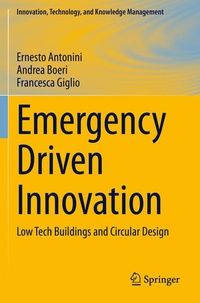
Emergency Driven Innovation
Low Tech Buildings and Circular Design
Published on 27. September 2021
Book
Paperback/Softback
XIX, 179 pages
978-3-030-55971-7 (ISBN)
Description
This book explores the relationship between the circular economy and the building technologies within the quintuple helix innovation model. The main question the book answers is whether and how the conversion of sustainable construction processes can be a powerful engine of innovation for the industry. The post-disaster settlements and temporary shelters are assumed as examples of what can be defined as circular buildings in regards to the technical arrangements and features, material and process reversibility, as the social and participative dimensions.
Several cases of these interventions are documented and classified by three thematic axes: design, building and living. This highlighted new trajectories for innovation in building technology, consistent with the social, economic and productive dynamics that no longer allows for growing performance by increasing the resource demand. A theoretic framework is traced supporting this vision, which shows how the low technologies can respond to the transition of the economic model from linear to circular. Within this trajectory, the low-tech design for remanufacturing represents a reference framework and a promising tool applicable to the building processes.
The enabling technologies and new paradigms for the transition to circular economy emerging from the European research scenario are also mapped, outlining z`the possible future developments in line with open technical and societal challenges.
Several cases of these interventions are documented and classified by three thematic axes: design, building and living. This highlighted new trajectories for innovation in building technology, consistent with the social, economic and productive dynamics that no longer allows for growing performance by increasing the resource demand. A theoretic framework is traced supporting this vision, which shows how the low technologies can respond to the transition of the economic model from linear to circular. Within this trajectory, the low-tech design for remanufacturing represents a reference framework and a promising tool applicable to the building processes.
The enabling technologies and new paradigms for the transition to circular economy emerging from the European research scenario are also mapped, outlining z`the possible future developments in line with open technical and societal challenges.
More details
Series
Edition
2020 ed.
Language
English
Place of publication
Cham
Switzerland
Publishing group
Springer International Publishing
Target group
Professional and scholarly
Illustrations
83 s/w Abbildungen
XIX, 179 p. 83 illus.
Dimensions
Height: 235 mm
Width: 155 mm
Thickness: 12 mm
Weight
312 gr
ISBN-13
978-3-030-55971-7 (9783030559717)
DOI
10.1007/978-3-030-55969-4
Schweitzer Classification
Other editions
Additional editions
Ernesto Antonini | Andrea Boeri | Francesca Giglio
Emergency Driven Innovation
Low Tech Buildings and Circular Design
Book
09/2020
1st Edition
Springer
€117.69
Shipment within 7-9 days
Persons
Ernesto Antonini is a Professor of Architectural Technology at the University of Bologna, Italy. His research interests focuses on innovation in building techniques, materials and components as well as on new tools and equipment for the building process and, lately, on recycling of construction & demolition waste and sustainable architecture.
Andrea Boeri is a Professor of Architectural Technology and Head of the Department of Architecture, University of Bologna, Italy. His research covers a broad range of topics such as materials performances and construction elements, architectural innovation technologies, quality of buildings and urban systems, environmental sustainability. His fields of expertise: energy efficiency and sustainable buildings, smart and resilient cities, climate responsive strategies in regeneration processes at building and district scale.
Francesca Giglio is Assistant Professor of Architectural Technology and Adjunct Professor at the Mediterranea University of Reggio Calabria, Department of Architecture and Territory, Italy. Her research and didactic activities regard three principal Ttopics: technological innovation, reversible building process and advanced materials for building envelope, also depth in collaboration of building sector companies.
Andrea Boeri is a Professor of Architectural Technology and Head of the Department of Architecture, University of Bologna, Italy. His research covers a broad range of topics such as materials performances and construction elements, architectural innovation technologies, quality of buildings and urban systems, environmental sustainability. His fields of expertise: energy efficiency and sustainable buildings, smart and resilient cities, climate responsive strategies in regeneration processes at building and district scale.
Francesca Giglio is Assistant Professor of Architectural Technology and Adjunct Professor at the Mediterranea University of Reggio Calabria, Department of Architecture and Territory, Italy. Her research and didactic activities regard three principal Ttopics: technological innovation, reversible building process and advanced materials for building envelope, also depth in collaboration of building sector companies.
Content
Chapter 1. Building in Emergency: Low-Tech Driven Innovations.- Chapter 2. Technologies for Building After Disaster: A Critical Review.- Chapter 3. Beyond Emergency, Toward Circular Design: Building Low Tech.- Chapter 4. Assessing the Circular Potential. Design, Build, Living Reversible.- Chapter 5. Building Strategies for Circular Economy. New Visions and Knowledge Production for European Research.