

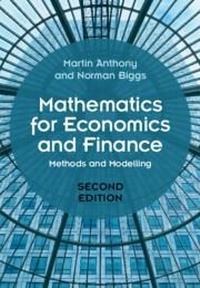
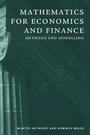
Mathematics for Economics and Finance
Methods and Modelling
2nd Edition
Published on 30. May 2024
Book
Hardback
436 pages
978-1-108-47239-5 (ISBN)
Description
Accessible, concise, and interactive, this book introduces the mathematical methods that are indispensable in economics and finance. Fully updated to be as student friendly as possible, this edition contains extensive problems, worked examples and exercises (with full solutions at the end of the book). Two brand new chapters cover coupled systems of recurrence/differential equations, and matrix diagonalisation. All topics are motivated by problems from economics and finance, demonstrating to students how they can apply the mathematical techniques covered. For undergraduate students of economics, mathematics, or both, this book will be welcomed for its clarity and breadth and the many opportunities it provides for readers to practise and test their understanding.
Reviews / Votes
Review of the first edition: 'Throughout, the stress is firmly on how the mathematics relates to economics, and this is illustrated with copious examples and exercises that will foster depth of understanding.' L'Enseignement Mathematique 'This is a very good book for building foundational skills in the topic. I highly recommend this to any student looking to build their mathematical skills and also as a quick reference to brush up skills if you are out-of-practice.' Manoj Kulchania, Wayne State UniversityMore details
Edition
2nd Revised edition
Language
English
Place of publication
Cambridge
United Kingdom
Target group
College/higher education
Edition type
Revised edition
Illustrations
Worked examples or Exercises
Dimensions
Height: 250 mm
Width: 175 mm
Thickness: 28 mm
Weight
930 gr
ISBN-13
978-1-108-47239-5 (9781108472395)
Copyright in bibliographic data and cover images is held by Nielsen Book Services Limited or by the publishers or by their respective licensors: all rights reserved.
Schweitzer Classification
Other editions
Additional editions
Book
05/2024
2nd Edition
Cambridge University Press
€62.50
Shipment within 15-20 days
E-Book
05/2024
Cambridge University Press
€55.49
Available for download
E-Book
05/2024
2nd Edition
Cambridge University Press
€55.49
Available for download
Previous edition
Book
07/1996
Cambridge University Press
€62.00
Article exhausted; check for reprint
Persons
Martin Anthony is Professor of Mathematics at the London School of Economics and Political Science, where he has been Head of Department and Vice-Chair of the Academic Board. He is the author of five books. Martin has been heavily involved in LSE's distance learning initiatives through the University of London International Programme and is a recipient of multiple LSE Teaching Excellence Awards. Norman Biggs is Professor Emeritus in the Department of Mathematics at the London School of Economics and Political Science, where he was Head of Department and Vice-Chair of the Appointments Committee. He is the author of thirteen books, including 'Discrete Mathematics' (Second Edition, 2002). He previously served as General Secretary of the London Mathematical Society.
Content
Preface to second edition; Preface to first edition; 1. Mathematical models in economics; 2. Mathematical terms and notations; 3. Sequences, recurrences, limits; 4. The elements of finance; 5. The cobweb model; 6. Introduction to calculus; 7. Some special functions; 8. Introduction to optimisation; 9. The derivative in economics - I; 10. The derivative in economics - II; 11. Partial derivatives; 12. Applications of partial derivatives; 13. Optimisation in two variables; 14. Vectors, preferences, and convexity; 15. Matrix algebra; 16. Linear equations - I; 17. Linear equations - II; 18. Inverse matrices; 19. The input-output model; 20. Determinants; 21. Constrained optimisation; 22. Lagrangians and the consumer; 23. Second-order recurrence equations; 24. Macroeconomic applications; 25. Areas and integrals; 26. Techniques of integration; 27. First-order differential equations; 28. Second-order differential equations; 29. Coupled systems and diagonalisation; 30. Applications of diagonalisation; Appendix A. Solutions to exercises; Appendix B. Answers to problems; Index.