

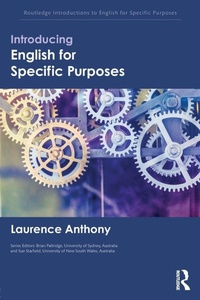
Introducing English for Specific Purposes
1st Edition
Published on 23. May 2018
Book
Paperback/Softback
210 pages
978-1-138-93665-2 (ISBN)
Description
Introducing English for Specific Purposes presents the key concepts and practices of ESP in a modern, balanced, and comprehensive way. This book defines ESP and shows how the approach plays a crucial role in the world of English language teaching. Explaining how needs analysis, language and learning objectives, materials and methods, and evaluation combine to form the four main pillars of ESP, the book includes:
practical examples that illustrate how the core theories and practices of ESP can be applied in real-world academic and occupational settings;
discussion of some of the most hotly debated issues in ESP;
insights on how ESP courses can be organized and integrated to form a complete program;
reflection boxes, practical tasks, extension research questions, and resources for further reading in each chapter.
Introducing English for Specific Purposes serves as an ideal textbook for graduate and advanced undergraduate students studying courses on English for Specific Purposes or English for Academic Purposes, as part of degrees in English for Specific Purposes, Education, ELT, Applied Linguistics, TESOL or TEFL. This comprehensive publication is also an invaluable reference resource for pre-service and in-service teachers of ESP, and for English program managers and administrators.
practical examples that illustrate how the core theories and practices of ESP can be applied in real-world academic and occupational settings;
discussion of some of the most hotly debated issues in ESP;
insights on how ESP courses can be organized and integrated to form a complete program;
reflection boxes, practical tasks, extension research questions, and resources for further reading in each chapter.
Introducing English for Specific Purposes serves as an ideal textbook for graduate and advanced undergraduate students studying courses on English for Specific Purposes or English for Academic Purposes, as part of degrees in English for Specific Purposes, Education, ELT, Applied Linguistics, TESOL or TEFL. This comprehensive publication is also an invaluable reference resource for pre-service and in-service teachers of ESP, and for English program managers and administrators.
Reviews / Votes
"Laurence Anthony has done a great job of providing both novice and experienced teachers with an up-to-date and comprehensive introduction to ESP. Assuming no previous knowledge of the topic, he packs into this short book a great deal of background on the history, context and principles of ESP together with user-friendly, detailed suggestions of how to go about the nuts and bolts of designing and teaching a course. Written in a personal and accessible style and with copious tasks, examples and research ideas, this is an invaluable resource for those new to ESP and looking for sensible advice and clear guidance."Ken Hyland, University of East Anglia, UK
"Laurence Anthony's very useful contribution to the ESP literature is accessible and interactive. It offers broad-ranging coverage of both ESP contexts and ways of responding to them. Although a relatively slim volume, it is by no means a slight one."
John M. Swales, University of Michigan, USA
"Introducing English for Specific Purposes is an accessible and comprehensive introduction to ESP, balancing both pedagogy and research. The text's candid and friendly prose will be useful in introducing truly novice readers to the field of ESP, particularly undergraduates and pre-service teachers studying in a TESL/TEFL program."
Erin Todey, The Electronic Journal for English as a Second Language
"The writing style of this book is direct and friendly. The language is clear and concise. The regular pattern in each chapter enables readers either to read chapter by chapter to develop a coherent view, or to read selectively to meet their current needs. To sum up, Anthony has written an informative and resourceful book, offering a contemporary and comprehensive view of ESP. [...] It deserves a place on the bookshelves of graduate students in applied linguistics, language teachers or ESP administrators."
Qiong Li & Jianying DU, System 82 (2019)
More details
Series
Language
English
Place of publication
London
United Kingdom
Publishing group
Taylor & Francis Ltd
Target group
ELT/ESL
Illustrations
12 s/w Abbildungen, 9 s/w Tabellen, 2 s/w Photographien bzw. Rasterbilder, 10 s/w Zeichnungen
9 Tables, black and white; 10 Line drawings, black and white; 2 Halftones, black and white; 12 Illustrations, black and white
Dimensions
Height: 234 mm
Width: 156 mm
Thickness: 12 mm
Weight
345 gr
ISBN-13
978-1-138-93665-2 (9781138936652)
Copyright in bibliographic data and cover images is held by Nielsen Book Services Limited or by the publishers or by their respective licensors: all rights reserved.
Schweitzer Classification
Other editions
Additional editions
Laurence Anthony
Introducing English for Specific Purposes
Book
05/2018
1st Edition
Routledge
€206.20
Shipment within 10-20 days
Laurence Anthony
Introducing English for Specific Purposes
E-Book
05/2018
1st Edition
Routledge
€52.49
Available for download
Laurence Anthony
Introducing English for Specific Purposes
E-Book
05/2018
1st Edition
Routledge
€52.49
Available for download
Person
Laurence Anthony is Professor of Applied Linguistics at the Faculty of Science and Engineering, Waseda University, Japan. He has served as Director of the Center for English Language Education in Science and Engineering (CELESE), and has created large-scale ESP programs in academia and industry for over 25 years.
Content
List of figures
List of tables
Acknowledgments
Introduction: how to use this book
SECTION 1: Contextualizing ESP
Situating ESP in English language teaching and learning
Situating ESP in the world at large
Introducing the four pillars of ESP
SECTION 2: Understanding the four pillars of ESP
Identifying the needs in the design of ESP courses and programs
Deciding learning objectives for ESP courses and programs
Deciding materials and methods in ESP
Evaluating learners, instructors, courses, and programs in ESP
SECTION 3: Applying ESP in real-world settings
Implementing ESP in ideal, opportunistic, and just-in-time settings
Dealing with challenges in ESP
Moving forward in ESP
References
Index
List of tables
Acknowledgments
Introduction: how to use this book
SECTION 1: Contextualizing ESP
Situating ESP in English language teaching and learning
Situating ESP in the world at large
Introducing the four pillars of ESP
SECTION 2: Understanding the four pillars of ESP
Identifying the needs in the design of ESP courses and programs
Deciding learning objectives for ESP courses and programs
Deciding materials and methods in ESP
Evaluating learners, instructors, courses, and programs in ESP
SECTION 3: Applying ESP in real-world settings
Implementing ESP in ideal, opportunistic, and just-in-time settings
Dealing with challenges in ESP
Moving forward in ESP
References
Index