

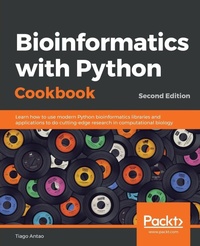
Bioinformatics with Python Cookbook
Learn how to use modern Python bioinformatics libraries and applications to do cutting-edge research in computational biology
2nd Edition
Published on 30. November 2018
Book
Paperback/Softback
360 pages
978-1-78934-469-1 (ISBN)
Description
Discover modern, next-generation sequencing libraries from Python ecosystem to analyze large amounts of biological data
Key Features
Perform complex bioinformatics analysis using the most important Python libraries and applications
Implement next-generation sequencing, metagenomics, automating analysis, population genetics, and more
Explore various statistical and machine learning techniques for bioinformatics data analysis
Book DescriptionBioinformatics is an active research field that uses a range of simple-to-advanced computations to extract valuable information from biological data.
This book covers next-generation sequencing, genomics, metagenomics, population genetics, phylogenetics, and proteomics. You'll learn modern programming techniques to analyze large amounts of biological data. With the help of real-world examples, you'll convert, analyze, and visualize datasets using various Python tools and libraries.
This book will help you get a better understanding of working with a Galaxy server, which is the most widely used bioinformatics web-based pipeline system. This updated edition also includes advanced next-generation sequencing filtering techniques. You'll also explore topics such as SNP discovery using statistical approaches under high-performance computing frameworks such as Dask and Spark.
By the end of this book, you'll be able to use and implement modern programming techniques and frameworks to deal with the ever-increasing deluge of bioinformatics data.What you will learn
Learn how to process large next-generation sequencing (NGS) datasets
Work with genomic dataset using the FASTQ, BAM, and VCF formats
Learn to perform sequence comparison and phylogenetic reconstruction
Perform complex analysis with protemics data
Use Python to interact with Galaxy servers
Use High-performance computing techniques with Dask and Spark
Visualize protein dataset interactions using Cytoscape
Use PCA and Decision Trees, two machine learning techniques, with biological datasets
Who this book is forThis book is for Data data Scientistsscientists, Bioinformatics bioinformatics analysts, researchers, and Python developers who want to address intermediate-to-advanced biological and bioinformatics problems using a recipe-based approach. Working knowledge of the Python programming language is expected.
Key Features
Perform complex bioinformatics analysis using the most important Python libraries and applications
Implement next-generation sequencing, metagenomics, automating analysis, population genetics, and more
Explore various statistical and machine learning techniques for bioinformatics data analysis
Book DescriptionBioinformatics is an active research field that uses a range of simple-to-advanced computations to extract valuable information from biological data.
This book covers next-generation sequencing, genomics, metagenomics, population genetics, phylogenetics, and proteomics. You'll learn modern programming techniques to analyze large amounts of biological data. With the help of real-world examples, you'll convert, analyze, and visualize datasets using various Python tools and libraries.
This book will help you get a better understanding of working with a Galaxy server, which is the most widely used bioinformatics web-based pipeline system. This updated edition also includes advanced next-generation sequencing filtering techniques. You'll also explore topics such as SNP discovery using statistical approaches under high-performance computing frameworks such as Dask and Spark.
By the end of this book, you'll be able to use and implement modern programming techniques and frameworks to deal with the ever-increasing deluge of bioinformatics data.What you will learn
Learn how to process large next-generation sequencing (NGS) datasets
Work with genomic dataset using the FASTQ, BAM, and VCF formats
Learn to perform sequence comparison and phylogenetic reconstruction
Perform complex analysis with protemics data
Use Python to interact with Galaxy servers
Use High-performance computing techniques with Dask and Spark
Visualize protein dataset interactions using Cytoscape
Use PCA and Decision Trees, two machine learning techniques, with biological datasets
Who this book is forThis book is for Data data Scientistsscientists, Bioinformatics bioinformatics analysts, researchers, and Python developers who want to address intermediate-to-advanced biological and bioinformatics problems using a recipe-based approach. Working knowledge of the Python programming language is expected.
More details
Edition
2nd Revised edition
Language
English
Place of publication
Birmingham
United Kingdom
Target group
Professional and scholarly
US School Grade: College Graduate Student
Edition type
Revised edition
Dimensions
Height: 235 mm
Width: 191 mm
Thickness: 20 mm
Weight
672 gr
ISBN-13
978-1-78934-469-1 (9781789344691)
Copyright in bibliographic data and cover images is held by Nielsen Book Services Limited or by the publishers or by their respective licensors: all rights reserved.
Schweitzer Classification
Other editions
Additional editions
Tiago Antao
Bioinformatics with Python Cookbook
Learn how to use modern Python bioinformatics libraries and applications to do cutting-edge research in computational biology
E-Book
09/2024
2nd Edition
Packt Publishing
€31.49
Available for download
Person
Tiago Antao is a bioinformatician working in genomics. A former computer scientist, he moved into computational biology with an MSc in bioinformatics from the Faculty of Sciences at the University of Porto (Portugal) and a PhD on the spread of drug-resistant malaria from the Liverpool School of Tropical Medicine (UK). He has worked with human datasets at the University of Cambridge (UK) and mosquito whole-genome sequencing data at the University of Oxford (UK), and helped set up bioinformatics infrastructure at the University of Montana. He now works as a data engineer in biotechnology in Boston, MA. He is also a co-author of Biopython, a major bioinformatics package written in Python.
Content
Table of Contents
Python and the Surrounding Software Ecology
Next-generation Sequencing
Working with Genomes
Population Genetics
Population Genetics Simulation
Phylogenetics
Using the Protein Data Bank
Bioinformatics pipelines
Python for Big Genomics Datasets
Other Topics in Bioinformatics
Machine learning in Bioinformatics
Python and the Surrounding Software Ecology
Next-generation Sequencing
Working with Genomes
Population Genetics
Population Genetics Simulation
Phylogenetics
Using the Protein Data Bank
Bioinformatics pipelines
Python for Big Genomics Datasets
Other Topics in Bioinformatics
Machine learning in Bioinformatics